
Situated about 2.5 miles south east of Withypool, Tarr Steps is an ancient Grade I listed clapper bridge that spans the River Barle. The age of the bridge is unknown with some theories dating it as far back as the Bronze Age, while others claim it was built in around 1400 AD. It is constructed entirely from large stone slabs and boulders with 17 spans and is the longest of its kind found in Britain measuring 180 feet in length.
Over the last century, the river has silted up and often now rises above the bridge when it floods. It has had to be repaired several times in recent years when the top slabs have been washed downstream.
Tarr Steps lies within a National Nature Reserve comprising mainly oak woodland with pockets of richer soil supporting beech, ash, sycamore, and hazel. In spring the floor is carpeted with bluebells, while in summer there is an abundance of brambles and honeysuckle. The woodland is internationally important for a variety of mosses, liverworts, and lichens which thrive in its cool, damp conditions. Look out for otters along the banks of the river, and dusk, the rare Barbastelle bat flitting amongst the trees.
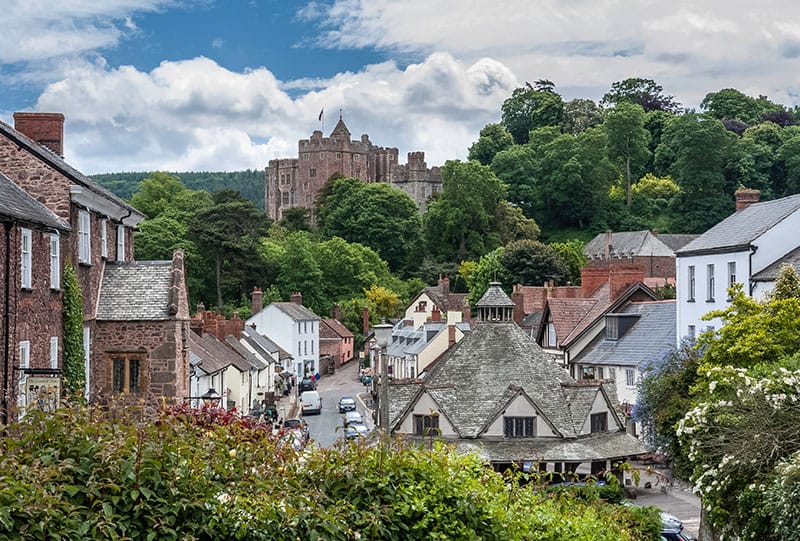
Managed by the National Trust, Dunster Castle is a former motte and bailey castle that in the 19th century became a country house. It is situated on a steep, wooded 200-foot-high hill known as the Tor overlooking the village of Dunster, and when built would have been surrounded the sea providing a natural defence and making the village an inland port.
A castle has existed at Dunster since at least Norman times, with a stone shell keep built on the motte by the start of the 12th century. Further stone buildings were added over the next two hundred years, with an impressive gatehouse and a ruined tower still standing today. In 1376 it was sold to the Luttrell family who inhabited it for 600 years, extensively remodelling the medieval fortress in the 1870s into the family home. During the Second World War the castle was used as a convalescent home for injured naval and American officers between 1943 and 1944, and in 1976 it was donated to the National Trust.
Inside visitors can tour the lavish rooms which hold important collections of artworks, a sequence of rare leather tapestries that illustrate the love story of Antony and Cleopatra, and a Victorian library of books. The centrepiece is a grand staircase built in 1680 with intricate carvings depicting a fox and stag hunt, and some Charles II shillings.
The gardens the castle are renowned for their diversity with four microclimates supporting a wide range of plants from around the world. The subtropical garden on the South Terrace is a particular highlight with beds of vibrant dahlias, gingers, salvias, and helenium forming a rainbow of colour, alongside hydrangeas in shades of soft pink and baby blue, and swathes of fragrant lavender.
Below is the peaceful River Garden which leads to a working Victorian watermill with three floors of machinery, as well as an exhibition of photographs, documents, and historic artefacts. On milling day, visitors can see the mill producing flour from grain which is used by local businesses.
There is also a natural play area, a gift shop housed in the 17th century stable block, and a charming tearoom serving hot drinks, light lunches, ice cream, and traditional afternoon teas.
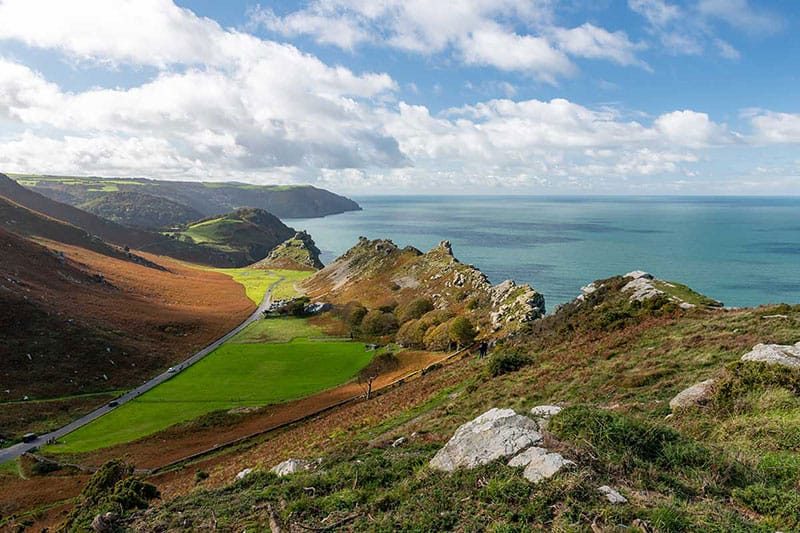
Running parallel to the coast where Exmoor meets the sea, the Valley of Rocks is a dry U-shaped valley that has inspired painters, poets, novelists, and composers for centuries. Formed during the last Ice Age, it consists of steep cliffs, exposed ridge lines, and some of the oldest Devonian rocks with large numbers of fossils.
Two of the most prominent craggy rock formations are known as Castle Rock and Rugged Jack. Others to look out for include The White Lady, a hole in the rocks that resembles a woman, The Devil’s Cheese Ring, a large pile of rocks steeped in local legend, and Mother Meldrum’s Cave, said to be the home of an ancient witch.
The Valley of Rocks is also well known for its herd of feral goats that roam freely and often quite precariously along the jagged cliff edges. It’s reasonable to assume that goats have been grazed here for thousands of years, and The Domesday Book records 75 goats in the Manor of Lyntonia (Lynton). Since the mid 19th century, their presence has been intermittent, and they died out during the very cold winters in the early 1960s.
The current herd was reintroduced in 1976 using goats from the Cheviot Hills in Northumberland, and today are managed by The Lyton Feral Goat Preservation Society which oversees their conservation and welfare.
Evidence suggests that red deer have been present on Exmoor for over 10,000 years, and before the Bronze Age, the park would have been covered by broad-leaved woodland, their natural habitat. When the forest was cleared to expand agricultural land for crops and grazing, the deer population adapted to survive in open moorland. The Normans protected deer populations by implementing Royal Forests, large swathes of land with strict laws to ensure a supply of venison and hunting ground for the monarch. Exmoor was one of the areas chosen for protection with the first steward of the forest appointed in the 12th century under King Henry II of England. By the 15th century, much of Exmoor had been disafforested and converted to ordinary land, with the remaining parts eventually sold by the crown in 1819.
It’s estimated that Exmoor is now home to around 3,500 red deer, Britain’s largest native land mammal, and are best looked for in remote areas at dawn or dusk. Good vantage points include Homer Wood, Dunkery Beacon, North Hill near Minehead, and the area around Simonsbath.
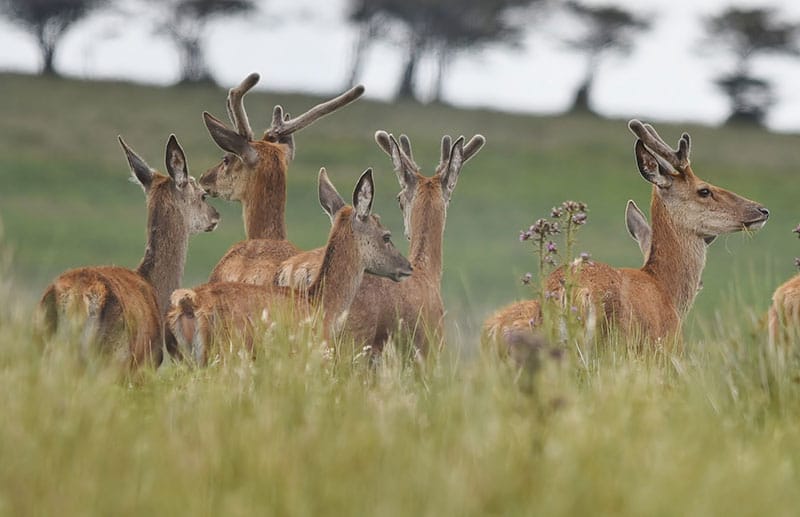
Stags can stand up to four feet tall at the shoulder and weigh over 30 stone. They shed their antlers in April and early May and new ones begin to grow immediately. Discarded antlers can sometimes be found in woodlands, on bracken slopes, or by following deer trails.
Calves are born in June and July and are usually born in vegetation or by the edge of woodland. They have white spots on their backs for their first few weeks to help camouflage the calf against the woodland floor. If you come across a calf, it is important not to touch it or get too close as its mother may abandon it.
The diverse landscapes and habitats in Exmoor National Park support a wide variety of birds, many of which are more common than in the rest of South West England. Although some upland birds such as the red grouse and ring ouzel no longer breed in the park, as a whole song birds are faring much better on Exmoor than in the rest of the British Isles.
Meadow pipit – meadow pipits can be difficult to spot as their streaky, brown plumage blends into the surrounding vegetation. It has white feathers on its wing and pale flesh-coloured legs. In spring, it has a fluttery ‘parachute’ display flight, while in autumn and winter it moves to lowland areas where gathering in sociable flocks.
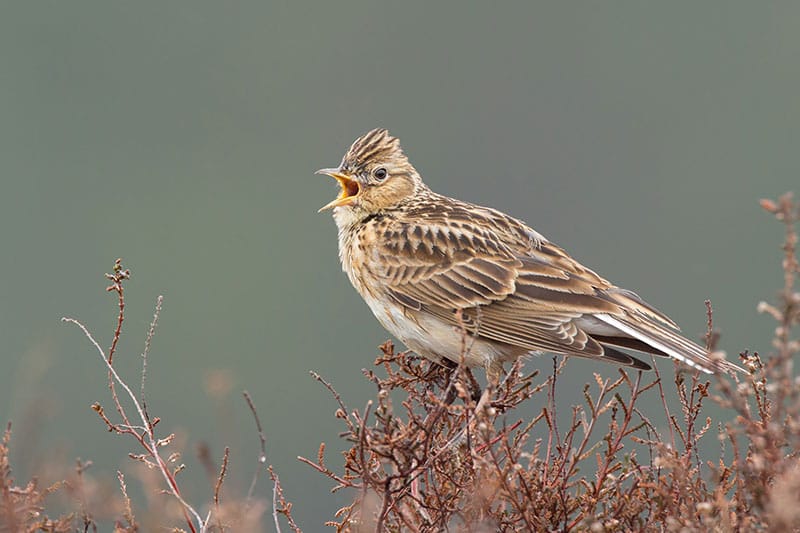
Skylark – the skylark is much larger than the meadow pipit and has a distinctive crest which is raised when the bird is excited or alarmed. It is known for its display flight, rising vertically into the air, where it can remain for up to an hour, singing from a great height, before parachuting back to the ground.
Stonechat – the stonechat is a small, dumpy bird. Males have a reddish-orange breast, and a black head with a white band around the back of the neck. Listen out for its sharp, loud call that sounds like two stones being hit together.
Whinchat – similar to the stonechat, the whinchat has paler plumage overall, and can be identified by the prominent white stripe above its eye. It is a summer visitor to the British Isles, arriving in April before returning to its wintering grounds in Africa in October.
Wheatear – named for its white rump visible when it flies, the wheatear has a slate grey back, black wings, and a black mask on its face. Females are much duller. A ground-dwelling bird, it can be seen from March to October.
Lapwing – also known as the peewit due to its display calls, from a distance the lapwing looks black and white but up close its back has an iridescent green and purple sheen. In winter, large flocks wheel around on rounded wings, giving the species its common name.
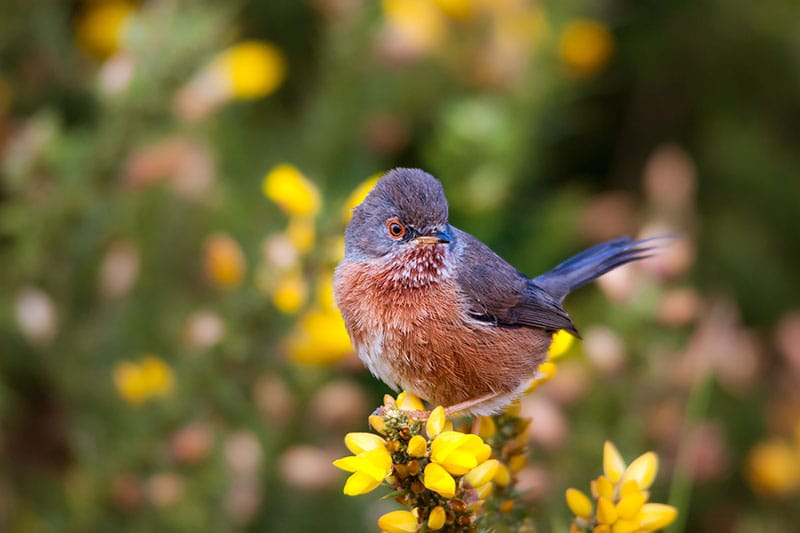
Dartford warbler – after a serious decline from the 1960s, in recent decades the Dartford warbler has significantly increased in numbers on Exmoor thanks to heathland management and milder winters. It has a blue-grey head, reddish breast, and long tail, and can often be seen warbling its scratchy song from the top of a gorse bush.
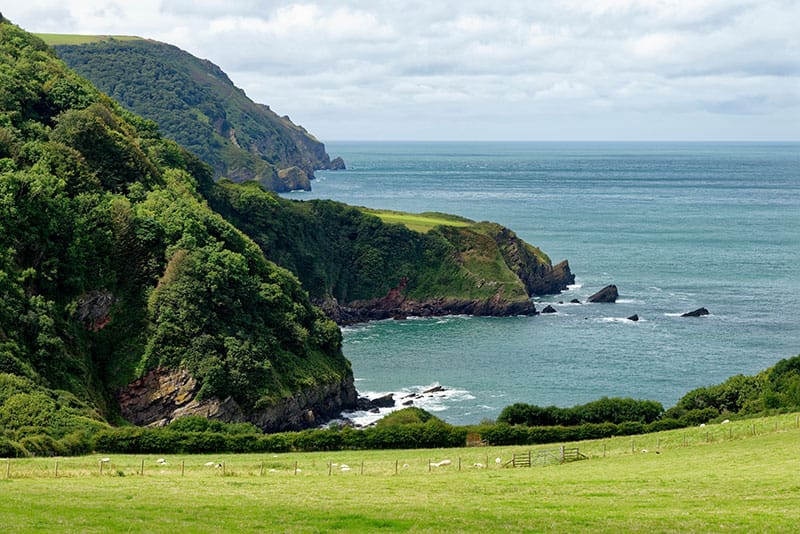
Situated between the villages of Lyton and Lynmouth, Lee Abbey Beach, also known as Lee Bay, is a secluded cove reached via a narrow lane from the Valley of Rocks. Backed by cliffs and surrounded by lush woodland, at high tide the beach is rocky, with shingle and a good stretch of sand as the tide goes at.
At low tide rock pools are exposed with chitons, starfish, crabs, sea anemones to be discovered, and occasionally seals and porpoises can be spotted in the bay. There’s also a small waterfall and some caves to explore, as well as sea glass and shells between the pebbles.
The water is good for swimming or paddleboarding on a spring low or high tide but be aware that there are some strong currents further out, and the water can move in fast as the tide rises so check times before you go.
Over the summer, The Lee Abbey Tea Cottage, situated in woodland about five minutes from the beach, serves drinks, cream teas, cakes, and ice cream. Alternatively, there are some grassy areas at the back of the beach for enjoying a picnic.
Backed by steep, wooded cliffs, Combe Martin Beach is largely made up of shingle and pebbles, giving way to sand closer to the water’s edge. Its sheltered setting makes it an excellent spot for swimming, with generally calm waters and few strong currents or waves. Visitors can also hire kayaks and paddleboards in the village, offering an ideal opportunity to enjoy gentle water sports.
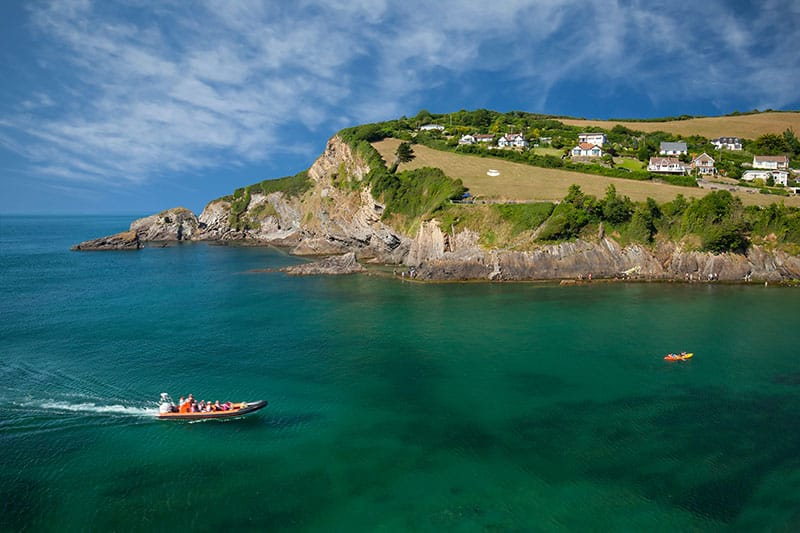
A rocky breakwater separates the high and low water lines, creating a convenient platform for sea anglers to cast from. The small River Umber flows into the harbour, bringing fresh water that attracts a wide variety of fish species, including bass, mullet, flounder, plaice, and pollack.
The South West Coast Path runs through Combe Martin village from where you can hike to Great Hangman, the tallest sea cliff in mainland Britain, or descend the 230 steps down to the Golden Cove, a secret sandy beach with spectacular views.