Scattered across the British Isles, herds of wild ponies roam some of the country’s most beautiful and remote landscapes. Their hardy nature enables them to thrive in even the harshest conditions, and they play an important role in conserving the land.
Britain’s wild ponies are only ‘wild’ in the sense that they are allowed to roam freely, as every herd is owned. The more accurate term is free-roaming, and their management is governed by long-established laws and customs. Some of the best-known breeds live within Britain’s National Parks, but ponies are also used to manage land naturally in conservation areas and nature reserves overseen by organisations such as the RSPB, the National Trust, and the Wildlife Trusts.
Wild ponies have helped to shape Britain’s landscapes for thousands of years, primarily through grazing. If grasses and shrubs are left unchecked, they become dense and scrubby, with dominant species such as thistles, bramble, and blackthorn, along with invasive plants, taking over and creating a hostile environment for wildlife.
Grazing coarse grasses and herbs keeps the vegetation short and allows more light to reach the soil, and by nibbling the tops of saplings, ponies can slow the growth of trees, preventing woodland from forming and maintaining open habitats. This encourages a diverse range of grasses and wildflowers to flourish, attracting insects and pollinators, and providing valuable habitats for ground-nesting birds.
Wallowing, a natural behaviour in which ponies roll in mud, sand, or water to cool down and protect their skin from parasites, also plays an important role. It creates shallow depressions that form ideal niches for burrowing insects, including pollinating bees and wasps. The hollows may also collect water, forming pools that provide vital habitats for invertebrates, amphibians, reptiles, birds, and small mammals.
As they move across the landscape, ponies spread seeds through their dung and by carrying them in their coats. Their hooves break up the soil as they trample, helping seeds to germinate further enriching the ecosystem.
There are two main types of pony found on Dartmoor: the purebred, registered Dartmoor Pony, and the more common mixed-breed Dartmoor Hill Pony. The registered Dartmoor Pony is a native breed, known for its strong build, small, refined head, free-flowing mane, and large, expressive eyes. It appears in a range of colours, including bay, brown, black, grey, and chestnut. Piebald and skewbald colouring is not permitted, although a small amount of white marking is acceptable.
Dartmoor Hill Ponies, by contrast, have a mixed ancestry that includes Shetland, Arab, and Welsh bloodlines, and therefore show far greater variation in both colour, shape, and size.
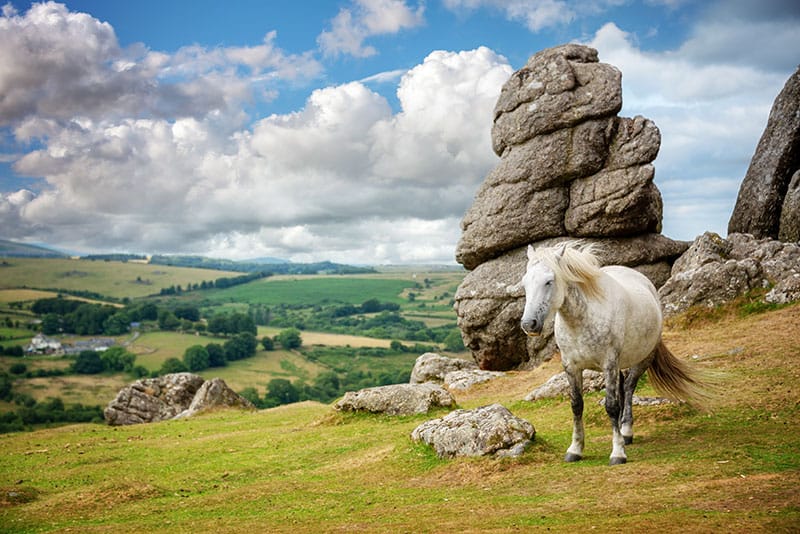
Ponies have roamed freely on Dartmoor for at least four millennia, and archaeological evidence shows that domesticated ponies were living there as early as 1500 BC. The first written reference to ponies on Dartmoor dates to the Middle Ages, when Awlfwold, Bishop of Crediton, bequeathed “the wild horses in the land of Ashburton” in his will in 1012.
Ponies are also mentioned in the Exon Domesday Book of 1086, where Dartmoor Hill Ponies, known as Wild Hillies were recorded on farms around the fringes of Dartmoor that held grazing rights on the moor. As today, the ponies were owned, but their feral nature led to debate over whether they should be counted as taxable goods.
They were also widely used as pack ponies, carrying heavy loads of tin ore from mines across the moor to surrounding towns. When the mines closed in the early 20th century, many of these ponies were turned loose to roam Dartmoor, with only a few retained by local farmers for work on their farms.
Traditionally, the ponies are “drifted”, or rounded up, from the moors each autumn and gathered into a nearby pound. From there, each owner removes their own ponies and takes them back to the farms. Foals born the previous spring are separated from their mares for weaning and are later sold at local markets.
Some foals are retained as replacement stock, branded, and returned to the commons to breed in future years. Others are trained as children’s riding ponies or used for driving small traps. All free-roaming ponies on Dartmoor are owned and protected by Dartmoor Commoners, and a byelaw forbids members of the public from feeding them.
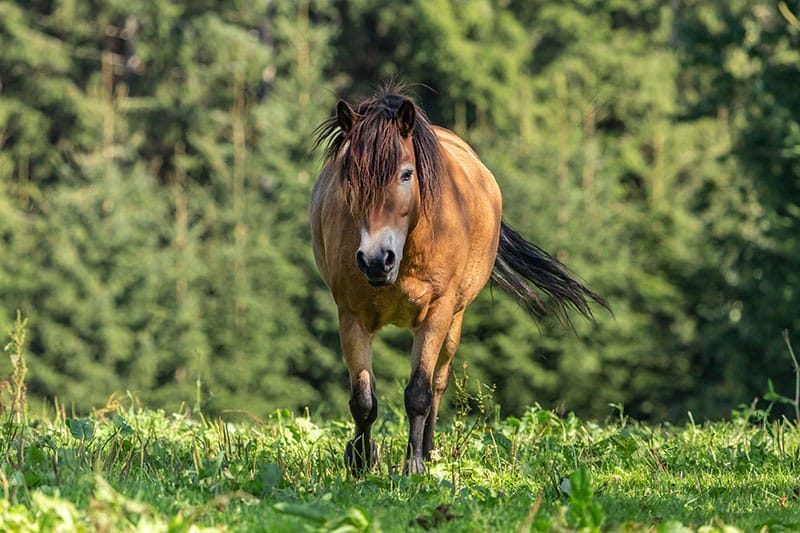
The Exmoor pony is one of Britain’s oldest native hill pony breeds, with origins thought to date back to around 50,000 BC. It is a stocky animal with short legs and a relatively large head, a thick mane, and a coat that is typically brown or bay. Distinctive pale, buff-coloured markings appear around the eyes, muzzle, and underbelly.
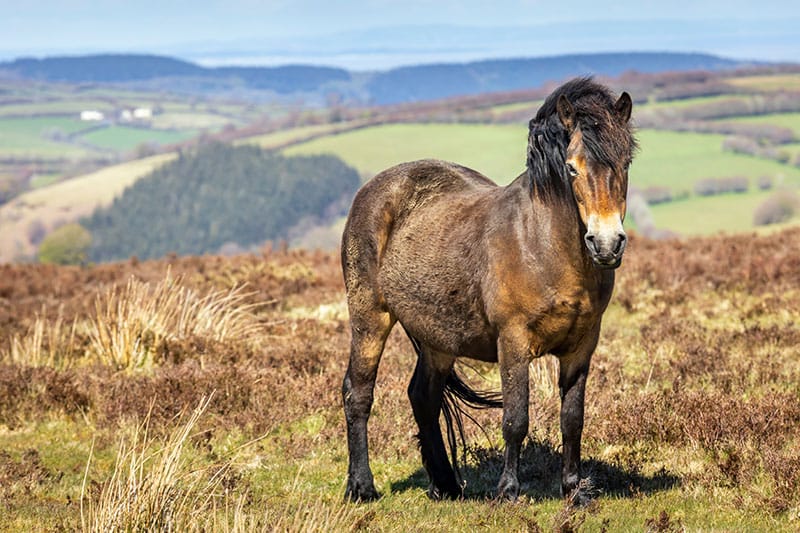
The first written records of ponies on Exmoor appear in the Domesday Book, compiled when Exmoor was designated a Royal Forest and hunting ground. By the 1500s, their numbers were estimated at around 1,500.
In 1818, most of Exmoor was sold to John Knight, a Worcestershire industrialist who began an ambitious programme to enclose and reclaim the moorland for agriculture. At this time, Sir Thomas Acland, the outgoing Warden of Exmoor, removed thirty ponies and established the Acland Herd, now known as the Anchor Herd, on Winsford Hill, a heath-covered common just beyond the edge of the Exmoor plateau. Farmers who had worked for the Warden also purchased ponies at the dispersal sale and founded several other herds. The ponies that roam the moor today are the direct descendants of these original groups.
The breed came close to extinction during the Second World War, when Exmoor was used as a military training ground and many ponies were stolen. Some were traced as far away as Cumbria, but most were slaughtered for the black-market meat trade. Numbers fell to around fifty ponies, including just six stallions. In the decades that followed, the population slowly recovered, although some bloodlines were lost. Today, there are thought to be approximately 3,500 Exmoor ponies worldwide. Fewer than 500 remain on Exmoor itself, running in around twenty herds, and the breed is classified as endangered by the Rare Breeds Survival Trust.
Before the advent of agricultural machinery, Exmoor ponies were widely used for hill farming tasks such as ploughing, shepherding, and transporting feed. As these roles declined, surplus ponies found new uses in leisure activities including trail riding, driving, and equine agility.
Foals are born in spring and early summer and spend the warmer months running with their mothers, building up fat reserves to sustain them through the harsh winter. In autumn, the herds are brought down from the moor to local farms to be inspected and microchipped. Foals are then weaned and either sold or returned to the moor for the winter.
The Exmoor Pony Centre, based at Ashwick, offers visitors the opportunity to see Exmoor ponies up close and learn more about the breed. Trekking sessions are also available.
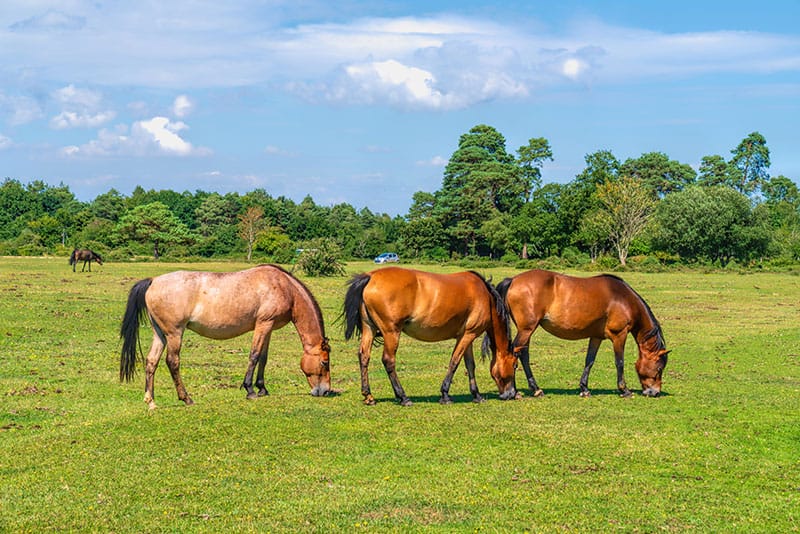
Ponies have grazed in the area now known as the New Forest for thousands of years, long predating the Ice Age. When William the Conqueror claimed the New Forest as a royal hunting ground, he is said to have shipped more than 2,000 horses across the English Channel during his invasion of England in 1066, and written records from this period refer to horses in connection with the rights of common pasture granted to the Forest’s inhabitants.
Although the New Forest Pony is a recognised breed in its own right, the ponies grazing the Forest today are diverse in type, reflecting the introduction of bloodlines such as Welsh, Arab, Exmoor, Thoroughbred, and Hackney. The indigenous breed is renowned for its speed, intelligence, strength, and versatility. It is most commonly bay, chestnut, or grey, sometimes with white markings on the head and lower legs, while piebald, skewbald, and blue-eyed cream colouring is not permitted. New Forest ponies are a working type, strong enough to carry weight yet narrow enough to be suitable for both adults and children. Historically they were used as pack ponies, pit ponies, and even cavalry mounts. Today they excel in activities such as gymkhanas, show jumping, cross-country, dressage, and driving.
The ponies of the New Forest are owned by local people with grazing rights, known as commoners, who pay an annual fee for each animal turned out. The ponies are cared for by their owners and by Agisters, local officials responsible for managing the Forest livestock and monitoring their welfare. Agisters are employed by the Verderers of the New Forest, an ancient governing body tasked with protecting the Forest’s traditional rights, landscape, and ecology.
Most ponies living in the Forest are mares, with a small number of geldings. For much of the year, they live in small family groups consisting of a mare, her daughters, and their foals, occupying a defined area known as a haunt. Stallions must be registered New Forest ponies and are turned out only for limited periods in spring and summer. This ensures foals are born at an appropriate time the following year, neither too early, before sufficient grass is available, nor too late, when cold weather and declining forage pose a risk. Over winter, ponies remaining in the Forest supplement their grazing with gorse and holly.
Each autumn, the ponies are gathered into drifts, and most colts and fillies are removed, along with any animals deemed unfit to remain out over winter. At this time, the tail hair of each pony is trimmed into a distinctive pattern to indicate that grazing fees have been paid for the year, with each Agister using their own unique tail mark.
The open nature of the New Forest means ponies are often seen wandering through towns and villages, and alongside ponies, donkeys, sheep, and cattle also roam freely. In autumn, pigs are released for a period of around sixty days in a practice known as pannage. During this time, they gorge on fallen acorns, which are toxic to other livestock. The resulting meat, known as pannage pork, is prized for its rich marbling and its distinctive nutty, earthy flavour.