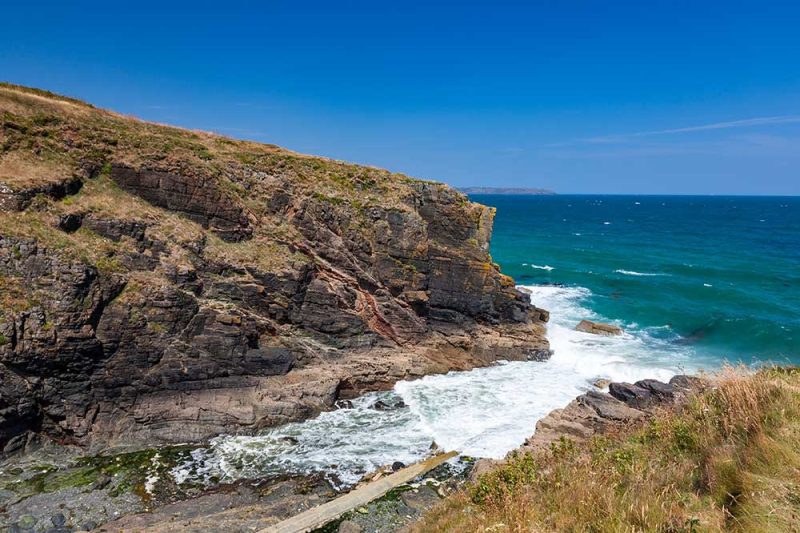
Church Cove is a narrow, rocky beach located near Landwednack on the eastern side of Lizard Point. It was once known as Perranvose which translates from the Cornish as ‘cove with the wall’ which probably refers to the steep cliffs that surround it. The beach is mainly shingle, although at low tide, a small patch of sand is exposed. There are numerous rock pools to explore lined with pink coraline algae. As well as shrimp, crabs, and small fish, keep an eye out for anemones, sponges, and sea snails.
The clean, turquoise sea is ideal for swimming, although be aware it can be a little difficult to get out of the water. At high tide, it’s possible to swim through various arches, gullies, and caves in the surrounding cliffs. Diving and snorkelling are also popular with numerous shipwrecks to explore in the area.
The cove forms a natural harbour, and a small fleet of traditional fishing boats can be found on the beach. You can sometimes watch as fishermen launch them from the slipway and sail out to sea to catch pilchards and crab, before pulling them back in with wire ropes and winches. Canoes and kayaks can also be launched from the slipway, with the cliffs providing shelter on the water from the prevailing south-westerly winds.
At the top of the slipway perched on a rock shelf, is the old RNLI boathouse which was opened in 1885 and built for a cost of £300. There is an inscription above the door that reads, “This boat house was erected and presented to the Royal National Lifeboat Institution by two cousins partly at their own cost and with some help from friends in loving memory of their parents Thomas Chavasse Esq FRCS and Miriam Sarah his wife and the Rev Horace Chavasse M.A and Margaret Colquhoun 1887”.
However, the location was difficult to launch boats from, and so the station was only open for 14 years before it was sold for £40. Today it is private residence available for holiday lettings, and the current RNLI station sits a little further south in Kilcobben Cover at the foot of a 45-metre cliff. You can visit the station which houses a Tamar class lifeboat, a heritage centre, and a gift shop.
Along the lane leading to the beach are a collection of white-washed thatched cottages and other buildings many of which have interesting histories. The Cellars, built in 1787, was used for processing pilchards, once an important industry along the Cornish coast. The fish were pressed, salted, and packed into barrels before being exported all over Europe. Next door is the Round House which was used for winching boats up from the sea and still has the huge beam in the roof, known as a capstan, which would have been part of the pulley system.
Mariners, the thatched cottage nearest the sea, was built in the 17th century and was originally three separate cottages with the middle becoming a public house in the 1800s known as a kiddlywink. This was a Cornish nickname for a pub that was only licensed to sell beer. However, smuggled spirits were often kept behind the bar and customers would ask for a glass with a knowing wink. Noel Coward spent time at Mariners, and it’s said the cottage was the inspiration for his song A Room With A View written in 1928.
The parish church of Landewednack, St Wynwallow, after which the cove was named, also sits on the lane and is famous for being the most southerly church in mainland Britain.
The South West Coast Path runs behind Church Cove beach and from here you can walk north to Cadgwith Cove or south to Lizard Point. In spring there are plenty of wildflowers to look out for on the grassy embankments of the cliffs at the top of the cove, while crows, rooks, and choughs come to breed. From the top of the cliffs you can sometimes see dolphins and seals playing out at sea. Autumn is also a good time for bird watchers when flocks of seabirds including terns, skuas, and petrels pass by on migration.
There is a small car park about half a mile in Landewednack. From here, access to the beach is via a steep lane which is not suitable for people with limited mobility.