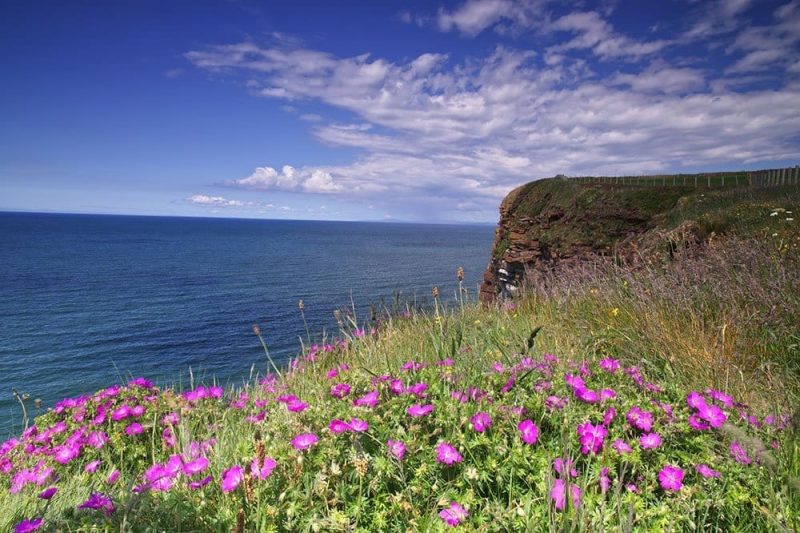
Situated on the Cumbrian coast underneath St Bees headland and looking out over the Irish Sea, St Bees is the only stretch of Heritage Coast between Wales and Scotland. On a clear day, it’s possible to see across to the Isle of Man and Scotland.
Dominated by the South Head of the headland, known locally as Tomlin, the beach is a wide expanse of red sand which is always accessible except for a couple of hours either side of high tide when only the area of shingle at the back of the beach is exposed.
There’s plenty of space for building sandcastles, playing beach games, flying a kite, or enjoying a picnic, and children will enjoy paddling in the sea. On calm days, the water is safe for swimming with no strong currents, although the rocks near the South Head should be avoided and be aware there is no lifeguard patrol.
Rock pools are dotted amongst the sand in which you can find crabs, starfish, shrimps, whelks, mussels, limpets, and winkles, as well as wracks and other seaweeds.
At the back of the beach is a concrete promenade ideal for a gentle stroll along the seafront. The RNLI lifeboat station is located here built in 1970. The crew have received six awards for gallantry can sometimes be seen on training exercises on the beach. There is also a children’s play area with an agility course, zip wires, climbing wall, swings, slides, climbing frames, and a wooden galleon.
St Bees marks the start of Alan Wainwright’s Coast to Coast Walk, described in his 1973 book of the same name. Tradition dictates that walkers should begin the route by getting their feet wet and collecting a pebble at St Bees before following the 190 mile route to Robin Hood’s Bay in North Yorkshire where they should wet their feet again and leave the pebble on the beach.
A walk along the clifftops to Fleswick Bay, a secluded cove, which divides the North and South Head is the first part of the Coast to Coast Walk. Start from St Bees beach and follow the Cumbria Coastal Way north, climbing up to the top of the cliffs. From here, you can look down to see the remains of an old tidal swimming pool carved into the rocks.
It was built by Isaac Spedding, an unemployed marine engineer, and a team of volunteers in 1933. Six hundred tons of rock were removed with explosives and a crane to construct the pool which held 80,000 gallons of seawater and included a diving board and training apparatus.
The pool was maintained by the St Bees Unemployed Men’s Club. Pensioners and the unemployed could use it for free, while adults paid twopence and children a penny. During World War II it was cleaned by the boys from St Bees School but by the end of the war it had fallen out of use and had silted with shingle and rocks.
There are steep steps down to Fleswick Bay, which take you through the gorge and onto the pebbled beach sitting on a wave-cut platform. A beck runs through the gorge but unless the weather has been very wet, this is usually no more than a trickle.
Caves in the bay were used by smugglers to store illicit goods and carved into the walls are signatures dating back to the 19th century. Semi-precious stones including agate, garnet, and jasper can sometimes be found among the pebbles.
Climb back up the steps to the top of the cliffs from where you can get a good view of St Bees Lighthouse. There has been a lighthouse on the site since 1718, but the current tower was built in 1865 after a fire destroyed the original. Standing 102 metres above sea level it was built from local sandstone with an oil-powered lantern. In 1913, a fog horn was added, in the mid-1950s, the light was electrified, and in 1987, the light was fully automated and the fog horn was decommissioned.
The cliffs support a diverse range of plants. At the bottom look out for sea pink, common scurvygrass, sea campion, sea spleenwort, rock samphire, and the rare rock sea spleenwort, while at the top bloody cranesbill, wood vetch, orpine soft shield-fern, dyer’s greenweed, western gorse, heather, and bracken can be found.
Fleswick Bay is popular with rock climbers with some easy climbs for novices and friendly bolting, although some areas are restricted in bird-nesting season and there have been landslides in the area. Bouldering is also popular with a good collection of blocks, but please check tide times before you go.
When the tide is out, the wreck of a fishing vessel can sometimes be seen on the shore near Fleswick Bay. The Coeur de Lion was stranded on a rocky outcrop on the 31st July 1993, and her two crew were rescued by St Bees RNLI. The remains include the boat’s engine, a gearbox, a transfer case, and some winding gear.
The RSPB reserve St Bees Head and home to the only cliff-nesting seabird colony in North West England can be found at North Head. Each spring, thousands of razorbills, fulmars, puffins, terns, cormorants, shags, gannets, kittiwakes, and gulls, as well as the UK’s largest colony of black guillemots arrive to lay their eggs and hatch chicks. In winter, ducks, divers, and grebes can be seen, and look out too for peregrine falcons, merlins, sparrowhawks, tawny owls, ravens, rock pipits, and wheatears.
There are three viewing platforms and two bird hides which look out to the main colony, and whales, dolphins, and seals can sometimes be spotted in the sea below.
Overlooking St Bees beach is St Bees Golf Club, a nine-hole course opened in 1928, that welcomes golfers of all abilities. When the prevailing winds are strong, the small greens and tight fairways can be challenging.
Seacote Holiday Park lies behind the beach which has static caravans and pitches for camper vans, motor homes, caravans, and tents. Facilities include a laundrette, showers, a shop, and a café, and guests have access to the Seacote Hotel’s restaurant and bar. The hotel puts on a programme of live entertainment throughout the year and screens important sports matches.
For something to eat, head to Hartley’s Café and Beach Shop on the seafront with a menu that includes breakfast, soups, sandwiches, jacket potatoes, toasties, a small selection of main meals, and hot and cold drinks. It also has a tearoom serving cakes and afternoon tea, and an ice cream parlour with 60 flavours of ice cream in cones, tubs, and waffles. The shop sells souvenirs and gifts and beach essentials.
There are two car parks near the beach: one near the caravan park and the other near the café. Public toilets with disabled facilities are also found near the caravan park.