Although some asparagus was eaten by ordinary people, the quality was unlikely to have been particularly good. Giacomo Castelvetro, the exiled Italian humanist, was famously appalled by the heavy, meat-centred English diet of the early 17th century, and in 1614 wrote The Fruit, Herbs & Vegetables of Italy: An Offering to Lucy, Countess of Bedford in an attempt to encourage the English nobility to eat more fruit and vegetables.
Commenting on the poor quality of English asparagus, he observed:
“When I see the weedy specimens of this noble plant for sale in London, I never cease to wonder why no one has yet taken the trouble to improve its cultivation.”
However, that all changed in the late 16th and early 17th centuries, when refugees from France and the Low Countries arrived in Britain, seeking sanctuary from Catholic persecution. Known for having some of the best-fed populations in Europe, they brought with them new eating habits and advanced growing techniques. Their influence marked the beginning of commercial market gardening in Britain, transforming the nation’s diet and permanently reshaping both its rural and urban landscapes.
Before this period, many vegetables that are now dietary staples were regarded by the British as inedible, worthless, or even poisonous. Crops such as carrots, turnips, spinach, cucumbers, pumpkins, salad leaves, and asparagus were introduced and popularised among the wider population.
Large areas surrounding London were divided into smallholdings dedicated to growing produce for the capital’s markets. The 300 acres of fields between Nine Elms and Battersea became especially renowned for the quality and size of their asparagus, which grew to be the parish’s most important crop. Sold in bundles known as “Battersea Bundles”, the asparagus could earn market gardeners between £2,000 and £4,000 a year.

For many years, the pub standing at the junction of Falcon Road and Battersea Park Road was called The Asparagus, in honour of the area’s agricultural heritage. In 2026, it was renamed the Falconbrook, after the historic southwest London river that flows beneath Falcon Road.
Although scholars and botanists continued to use the Latin-derived name asparagus, the common term at the time was the folk-etymologised “sparrowgrass”. Because the formal Latin word was awkward for many people to pronounce, 17th century Londoners reshaped it into something more familiar and easier to say, in the same way that “crayfish” evolved from the earlier word crevis.
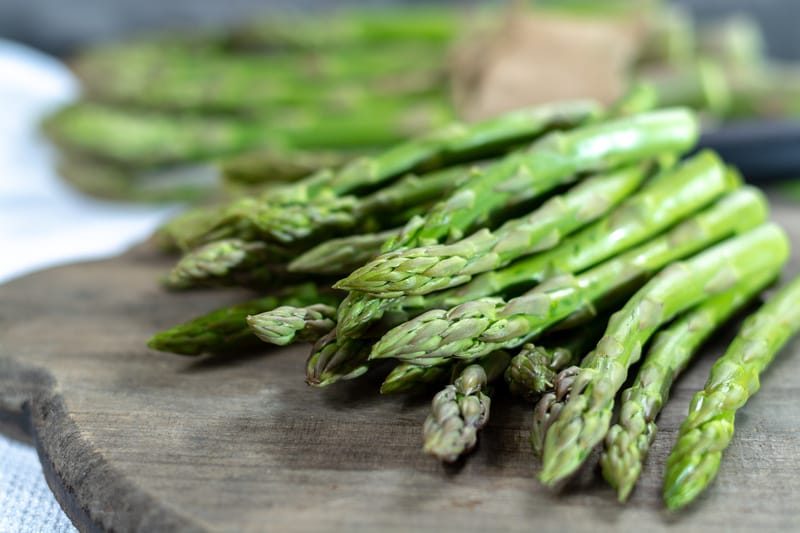
In his diary, Samuel Pepys records buying “a hundred of sparrow-grass” in Fenchurch Street. Confusingly, this did not mean a hundred individual spears. Asparagus was sold in rounds of 15 spears, with eight rounds tied together with willow to make a “long hundred”, a bundle containing 120 spears in total. Pepys paid one shilling and eight pence for the bundle and his meal later consisted of the asparagus accompanied by ‘a little bit of salmon’.
By the eighteenth century, vegetables such as artichokes and asparagus had lost much of their exclusivity and were being prepared in British kitchens as naturally as native cabbages or cauliflowers. Such was the popularity of asparagus, that during this period, Britain grew more than any other country in the world.
As London expanded and the railway network developed, the capital no longer relied on the market gardens that once surrounded it. Fresh produce could be transported rapidly from the countryside to the city’s markets.
Fruit and vegetable cultivation flourished in Worcestershire thanks to the region’s light, free-draining soils. The opening of two railway lines in 1853 and 1868 enabled growers to send freshly picked produce to the booming urban markets of London, Birmingham, Bristol, and Oxford in less than a day.
The Vale of Evesham, a fertile river plain along the River Avon, proved particularly well suited to asparagus cultivation. Sheltered by surrounding hills, the valley benefits from a mild microclimate that allows the soil to warm up quickly in spring, encouraging rapid growth of the spears. Although asparagus is usually grown on sandy soils, the Vale’s heavy clay has proved exceptionally productive. Rich in minerals and able to retain moisture during dry spring months, the clay creates ideal growing conditions.
The dense Evesham clay also places the plants under slight stress, encouraging them to produce additional sugars and secondary compounds. The result is asparagus that is sweeter, more tender, and especially succulent. To reduce the risk of waterlogging in the heavy soil, local growers traditionally plant the crowns on raised ridges, allowing the roots to drain properly while enabling the shoots to push easily through the earth.
Because of these unique growing conditions and traditional cultivation methods, Vale of Evesham asparagus has Protected Geographical Indication (PGI) status in the UK. Only asparagus grown, harvested, and processed within the designated area may be marketed under that name.
Asparagus remains central to life in the Vale of Evesham. In the village of Badsey, the Round of Gras pub celebrates the region’s heritage through its name, a seasonal asparagus menu, and a collection of historic asparagus cutters and agricultural tools.
Each May, the nearby village of Bretforton hosts the British Asparagus Festival, with Morris dancing, asparagus songs, demonstrations of traditional asparagus-tying, and appearances by Gus the Asparagus Man and Eve the Asparagus Fairy. Those curious about their future can also consult the world’s only “Asparamancer”, who predicts fortunes by tossing asparagus spears and interpreting the way they fall.
Bretforton’s St Leonard’s Church also pays tribute to the crop. A modern stained-glass window designed by Keith Brettle in 2010 depicts local motifs, including a round of asparagus. Every year, the church hosts an open-air evening service in the heart of the village, followed by an auction of the season’s finest and freshest asparagus.
Want to see exactly how asparagus grows and take part in some of the fun festivities associated with it?
Book a fam stay in Worcestershire and taste one of England’s most delicious delicacies from field-to-fork.
We have a fantastic collection of farmhouses, country cottages, barn conversions, lodges, and glamping treats set on working farms in some the most beautiful parts of the county. With the stunning Malvern Hills, ancient Wye Forest, and honey-coloured stone villages to explore, Worcestershire is a beautiful destination at any time of year.