A farm stay with a toddler sounds idyllic in theory, with plenty of fresh air, wide open fields to run around in, and animals to point at. In practice, however, the same qualities that make farms wonderful for small children, and the lack of barriers between them and all the exciting sights, sounds, and activities, can also give parents pause for thought.
If you’re wondering whether a holiday on a working farm is right for toddlers and whether it’s actually going to be relaxing or just a different kind of exhausting, then read on. Our guide answers all your questions honestly so you can make an informed decision on whether a farm stay is right for your family, and if you go, have a genuinely wonderful time.
Is a farm stay suitable for toddlers?
Yes, but with some caveats that are worth understanding before you book.
Farms are working environments, and working environments have hazards that toddler-proofed homes and traditional holiday resorts don’t. However, that doesn’t mean they should be avoided. Thousands of families take toddlers on farm stays every year and come home with nothing but muddy clothes and happy memories.
The key is choosing accommodation that’s been set up with families in mind, understanding basic safety principles, and accepting that you’ll be supervising your child more closely than you might in some other holiday settings. Despite that, most parents find that the extra vigilance is a small price to pay for the quality of experience a farm gives a child of this age.
What age is best for a first farm stay?
There’s no single right answer, but most parents find that somewhere between 18 months and 3 years is when the magic really starts to happen. At this age, children are developing a real sense of curiosity and wonder, and are happy to stand at a fence and watch a cow for a surprisingly long time, or crouch on the ground and study a beetle with real concentration.
Before about 18 months, toddlers are mobile and curious but not yet able to understand instructions like “don’t go near the fence” or “leave the chicken alone”. Although, this doesn’t make a farm stay impossible at this age, it will be more physically and mentally demanding on the parent. After three, children tend to be better at following safety rules, which will make any holiday easier.
Babies and non-mobile infants can go on farm stays perfectly happily when the considerations are more about the accommodation itself than the farm, and are the same as any rural self-catering trip.
Choosing the right farm accommodation
This is arguably the most important decision you’ll make. While may farm stays welcome children, not all are equally suitable for toddlers, so it’s worth taking time to assess your options carefully before booking.
Look for an enclosed garden or outdoor space
For many parents, this is the single most valuable feature a property can offer. A private, fenced outdoor space where a small child can roam freely without direct supervision changes the quality of the whole stay.
When browsing listings, don’t rely solely on the word “garden”. Read the description carefully and study the photos. A patio or terrace may be pleasant, but it doesn’t offer the same freedom as a fully enclosed lawn or garden. Equally, a listing’s “garden” could range from a securely fenced area to an unfenced paddock that opens directly onto fields.

Reviews can often provide useful clues, and if a garden is described as being “dog-proof”, that’s usually a good indication that it’s secure enough for adventurous toddlers too.
Check how the accommodation connects to the farm
Farm stays vary considerably in their layout, so it’s worth understanding exactly how the accommodation relates to the working part of the farm before you book.
Some properties are set apart from the main farmyard, for example, a cottage at the end of a lane with fields nearby and farm activities accessible only when you choose to visit, while other are located right in the heart of the farm with tractors, machinery, and livestock on your doorstep.
Neither arrangement is inherently better than the other. The key is knowing what to expect so you can choose the setting that best suits your family and your comfort level when supervising a curious toddler.
Think carefully about stairs
This is one area where farm accommodation is genuinely different from purpose-built holiday cottages, and it’s worth being direct about. Many farm stays are located in historic farmhouses, farm workers’ cottages, or converted barns, and their staircases reflect the age of the building. You may encounter narrow winding staircases, stone spirals, ladder-style access to mezzanine levels, shallow steps without handrails, or open banisters with gaps large enough for a toddler to squeeze through or get stuck in.
These features are part of what makes the building full of character, but they are not always compatible with the realities of travelling with a young child.
It’s also important not to assume that bringing a stairgate will solve the problem. Older properties often have irregular layouts, exposed stone walls, or unusual banister designs that make it difficult, or impossible, to fit a standard pressure-mounted gate securely. Even where a gate can be installed, it may not be as stable as it would be in a modern home.
For parents of adventurous toddlers, this can be more than a minor inconvenience. A first-floor bedroom reached by a steep or open staircase may require constant supervision and can quickly become a source of stress throughout the holiday.
Where possible, consider accommodation with ground-floor bedrooms or a single-level layout. Lodges and single-storey barn conversions are particularly well suited to families with toddlers, allowing children to move around more safely and giving parents greater peace of mind.
If you’re considering a property with an upper floor, don’t hesitate to ask the host for details. Find out what the staircase is like, whether a stairgate can be fitted, and whether there are any other ways to restrict access. The more specific your question, the more useful the answer is likely to be. For example, rather than simply asking if the property is child-friendly, you might say:
“Our child is two years old and will attempt to climb any staircase unsupervised. Is there a way to prevent access, or can the bedrooms be reached without using stairs?”
A good host will be honest about whether their property is suitable and help you decide if it’s the right fit for your family.
Ask specifically about water
Of all the potential hazards on a farm, open water is one of the most important for parents of toddlers to consider before booking.
Unlike a typical holiday cottage, farms have water features that are part of the working landscape, including ponds, lakes, streams, rivers, drainage ditches, irrigation channels, livestock troughs, water butts, and occasionally slurry lagoons. Some may be fenced, but many are not, simply because they’re not intended to be accessed by young children. Toddlers can move surprisingly quickly, and even very shallow water can pose a serious risk.
Before booking, ask your host directly whether there is any unfenced water near the accommodation or within areas that guests can easily access. Listing photos rarely show the full layout of a property or the surrounding land, so it’s difficult to judge these risks from images alone.
A farm bordering a river or with a wildlife pond may be a wonderful setting for older children and adults, but it can create additional challenges for parents of curious toddlers who are still learning boundaries and have little sense of danger.
If there is open water nearby, ask how it is separated from guest areas and what measures are in place to restrict access. A simple post-and-wire fence, for example, may not provide much of a barrier to an adventurous child.
This isn’t a reason to rule out farm stays altogether. Many family-friendly properties have fully enclosed gardens and guest areas, with no accessible open water nearby. However, it’s one of those questions that’s far easier to ask before booking than to worry about once you’ve arrived.
Consider the time of year
The season can have a significant impact on your farm stay experience, especially when travelling with a toddler.
A farm holiday in the height of summer offers long daylight hours, dry ground underfoot, and plenty of opportunities to spend the day outdoors. Children can explore, play, and meet animals from morning until evening, making it easier to fill the day without much planning.
A winter farm stay can be just as enjoyable, but it comes with different challenges. Shorter days, colder weather, and muddy conditions mean spending more time indoors and having a few wet-weather activities up your sleeve. Depending on the farm, some outdoor experiences may also be more limited during the quieter months.
Neither season is necessarily better than the other, but it’s worth thinking about how much of your holiday you expect to spend outside. The younger your child, the more valuable it can be to have a backup plan for those days when the weather doesn’t cooperate.
Animals – the joy and practicalities
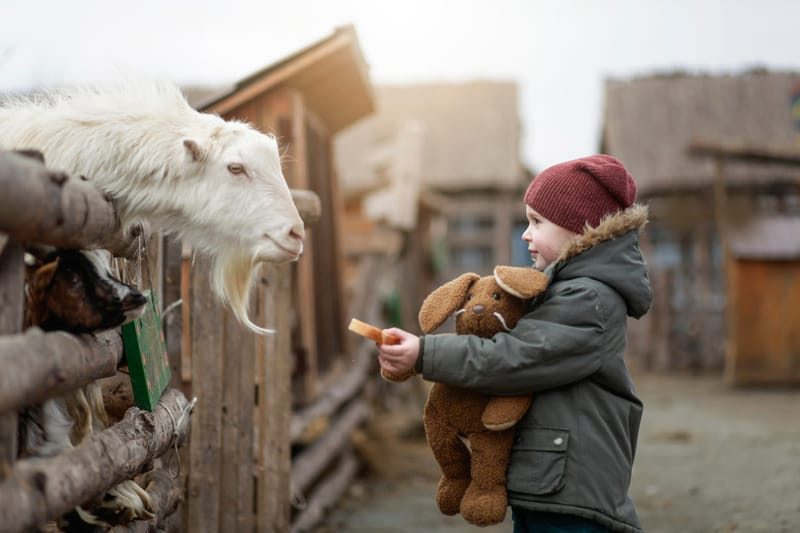
For most families, the animals are the main reason to choose a farm stay, and they rarely disappoint. For a toddler, meeting a calf for the first time, hearing a cockerel crow, or seeing a sheepdog working in a field can be genuinely magical.
At this age, children tend to be fascinated by animals, and seeing them in real life is very different from seeing them in books or on screens, create a fantastic holiday experience that simply can’t be replicated elsewhere.
That said, a little preparation goes a long way.
Remember, farm animals are not pets
Farm animals are generally accustomed to people, but they aren’t the same as family pets. Even the calmest animals can be startled by sudden movements, loud noises, or an enthusiastic toddler who wants to grab, hug, or chase them.
Whenever children are interacting with animals, close adult supervision is essential, regardless of how gentle the animals appear to be. Always follow the farmer’s guidance about which animals can be approached and how.
Teach the basic rules before you arrive
Toddlers are more likely to behave appropriately around animals if they know what to expect beforehand.
Before your trip, talk through a few simple rules: we walk calmly around animals, we use quiet voices, we only touch animals when a grown-up says it’s okay, and we always wash our hands afterwards. Frame them as how to be a good farm guest rather than a list of restrictions.
Take handwashing seriously
Good hygiene is one of the most important aspects of any farm visit. Farm animals can carry germs that may cause serious illness in young children, even when the animals themselves appear perfectly healthy.
After touching animals, or spending time in areas where animals have been, children should wash their hands thoroughly with soap and warm running water. Hand sanitiser is useful for many situations, but it should not be relied upon as a substitute for proper handwashing on a farm.
Keep a close eye on toddlers, who have a habit of putting fingers, snacks, or toys into their mouths at exactly the wrong moment. A child who’s just been delightedly stroking a lamb may need a gentle reminder before reaching for their next biscuit.
Some animals are best enjoyed from a distance
For toddlers, watching from behind the safety of a fence can be just as exciting as touching. Large animals such as horses and cattle are impressive to see, but their size and strength mean they can move unexpectedly and should be treated with caution.
As a general rule, follow the farmer’s advice and err on the side of caution. Farm stays offer plenty of opportunities for memorable animal encounters without needing to get up close to every creature on the farm.
The farmyard and the wider farm
Even the most family-friendly farm is still a working environment, and that means there will be areas that aren’t designed with toddlers in mind. Machinery, tools, livestock feed, chemicals, and agricultural buildings all play a role in the day-to-day running of the farm, but they can present risks for curious young children.
A few simple precautions can help ensure everyone enjoys the experience safely.
Never leave toddlers unsupervised in working areas
This is perhaps the most important rule of all. Farm machinery can look irresistibly climbable to a toddler, while sheds, workshops, and storage areas are likely to contain things like chemicals that are not always labelled in the way domestic products are.
Even a brief moment of unsupervised exploration can be enough for a child to wander somewhere they shouldn’t, so treat working farm areas as places where active supervision is always required.
Stick to designated paths and guest areas
Most farms clearly separate guest spaces from working areas and will explain where visitors are welcome to go. Staying on marked paths and within designated areas not only keeps your family safe but also helps avoid disrupting farm operations.
If you’re ever unsure whether an area is open to guests, simply ask. Farmers are usually happy to explain where it’s safe to explore.
Treat gates as boundaries
Closing gates behind you is good farm etiquette, but it’s also an important safety habit when travelling with young children.
An open gate can allow livestock to escape, while a closed gate helps define boundaries for toddlers. Teaching children that gates are something only grown-ups open and close can be helpful in reinforcing where they can and can’t go.
Bring proper outdoor footwear
A good pair of wellies is one of the most useful things you can pack for a farm stay. Fields, farmyards, and animal areas can be muddy in any season, and that mud often contains traces of animal waste.
Suitable footwear helps keep children comfortable while reducing hygiene risks, particularly if they’re prone to sitting, kneeling, or exploring every puddle they find.
One practical tip many parents swear by is keeping a shallow basin, bucket, or a small paddling pool near the entrance to their accommodation to rinse muddy boots before coming inside. A quick wash can save a great deal of cleaning later, especially when a toddler decides to remove their wellies halfway between the gate and the front door.
Inside the accommodation
While most parents naturally focus on outdoor hazards such as water, animals, and machinery, it’s worth paying attention to the less obvious risks inside the accommodation too. These are often specific to farm stays and converted rural properties in a way that standard holiday cottages may not be.
Open fires and wood burning stoves
Many farm stays feature open fireplaces or wood burning stoves, one of the great pleasures of a rural break, but something that needs careful management with a toddler.
A fireguard is essential, and most properties will provide one. However, it’s important not to rely on it as a guarantee of safety. The hearth area should still be treated as a supervised zone at all times.
Fire tools such as pokers, tongs, and irons can retain heat for a long time after use, far longer than they appear to. A toddler touching a poker that was used even twenty minutes earlier can still sustain a serious burn. For that reason, fire equipment should always be stored safely out of reach when not in use, and the entire fireplace area should be considered off-limits unless actively supervised, even when the fire is out.
The Aga
If your accommodation includes an Aga, understand from the outset that it behaves very differently from a standard cooker. An Aga is continuously on, with no obvious visual cue to indicate how hot it is. For a toddler who has learned that cookers are only dangerous when they look hot or are switched on, this can be misleading.
The insulated lids should be kept down whenever the appliance is not in active use, but even these can become warm. The surrounding rail, front panel, and oven handles may also be hot enough to cause injury. Treat the Aga as a strict no-touch zone from the moment you arrive, before curiosity has a chance to take over.
Hot water temperature
Some older farmhouses and converted buildings have water systems that deliver hotter water than modern thermostatic setups. Before allowing a toddler to use a bath or low sink, always check the temperature yourself. Water that feels merely warm to an adult can cause scalding in a matter of seconds for a small child.
If the water is excessively hot, adjust it carefully or ask the host whether the system can be regulated. As a rule, water above 60°C can cause serious burns very quickly.
Outbuildings accessible from the garden
What appears to be a secure garden may sometimes include an unlatched gate or door leading to a barn, workshop, or storage area that isn’t part of the guest accommodation but is still physically accessible.
These buildings may contain tools, chemicals, or machinery and should be treated as restricted areas. On arrival, do a quick walk-around of the outdoor space to identify any access points and ensure they are properly secured. Never assume that a “garden” on a working farm has been fully childproofed.
Low windows
Barn conversions may have beautiful, low-silled windows that bring in plenty of light, but can also be within reach of a climbing toddler. Check whether windows open fully and whether there are restrictors in place to limit how far they can swing open.
A low window with an accessible sill above a drop outside should be secured during your stay. It’s one of those details that can easily be overlooked until a child starts exploring.
Low beams
Exposed beams are a hallmark of many farmhouses and barns, but they can create unexpected hazards. Adults quickly learn to duck instinctively, but a toddler being carried on shoulders, or sitting on an adult’s back, can suddenly be at exactly the wrong height.
Note the positions of beams on arrival, particularly in stairwells, doorways, and bedrooms where attention may be elsewhere. A quick awareness check can prevent a painful bump later on.
What toddlers love most on a farm stay
Toddlers are often the age group that gets the most out of a farm stay. At this stage, everything is new, absorbing, and inherently interesting, and they don’t need structured activities to stay engaged. Some of the most memorable moments require no planning of cost.
Collecting eggs
A firm favourite on many farms, collecting freshly laid eggs is a simple but magical experience for young children. Most hens are unfazed by small visitors, and the act of finding an egg and carrying it back to the kitchen can become a highlight of the stay.
Check with the farmer beforehand, as many are happy to include egg collecting as part of the experience.
Watching farm routines
Daily farm life, such as feeding animals, milking, or moving livestock between fields, can be endlessly fascinating for toddlers. On a farm they are ordinary parts of the day, but for a small child they can feel like a front-row seat to something extraordinary.
Open outdoor space
A toddler with safe access to a field or large garden, free from pavements, traffic, and constant “stay close” reminders, is a toddler who will likely sleep extremely well. The freedom to simply move, explore, and wander within safe boundaries is one of the greatest benefits of a farm stay at this age.
Simple outdoor play
Sticks, puddles, stones, insects, long grass, and mud can provide more entertainment than any planned activity. There’s no need for special equipment or structured games – just a change of clothes and a willingness to embrace a bit of mess.
Early mornings
Farms and toddlers are often aligned when it comes to early starts. The countryside at 6am in summer, with its low light, fresh air, and chorus of birds, is something a small child greets with great enthusiasm, and one context in which being woken up at dawn is worth it.
Attitudes to food might surprise you
This is something that comes up again and again in conversations with parents who’ve taken toddlers on farm stays: the child who refuses vegetables at home suddenly eats three helpings of something they’ve helped find, pick, or collect.
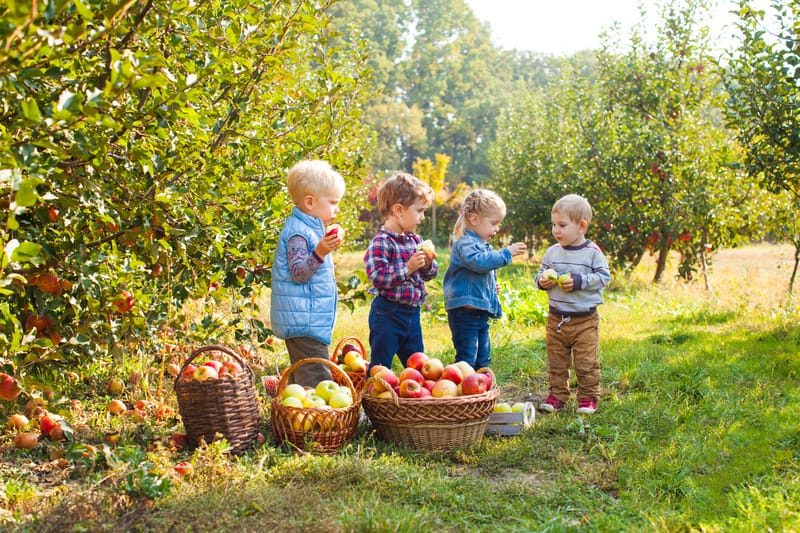
It isn’t magic, and it isn’t simply “fresh country air” at work. It’s context. A toddler who has collected an egg from a hen that morning experiences that egg differently from one that appears, wrapped and anonymous, from a fridge. A child who has watched carrots being pulled from the ground, or picked a strawberry straight from a plant and eaten it still warm from the sun, begins to understand food as something that comes from somewhere real, made through visible effort and care.
Buying food from a farm shop can have the same effect. Choosing ingredients at a counter, carrying them home, and helping to prepare them gives a small child a sense of ownership over what ends up on their plate. When food has a story, they’re often far more willing to engage with it.
Of course, none of this is guaranteed, and it would be misleading to suggest that a farm stay will transform a genuinely anxious or restricted eater. But many parents do find that a combination of outdoor time, healthy appetite, and direct experience of where food comes from makes mealtimes noticeably easier than at home.
What to pack for a toddler on a farm stay
Alongside your usual toddler travel essentials, a farm stay calls for a few additional items that can make a noticeable difference to comfort and practicality.
Well-fitting wellies are at the top of the list. Farm mud is unavoidable, and poorly fitting boots tend to come off at exactly the wrong moment, or simply refuse to stay on at all.
It’s also worth packing more changes of clothes than you think you’ll need. Mud on a farm has a way of getting everywhere, and more than once a day is not uncommon.
Liquid hand soap can be surprisingly important. While many properties provide basic supplies, you shouldn’t assume there will always be enough placed near animal areas for proper handwashing after every visit.
If you’re considering bringing a portable stair gate, read the section on staircases first to make sure it will actually be usable in your accommodation. Older properties in particular don’t always accommodate standard fittings.
A baby monitor with a good range can be helpful, especially in larger properties or those with thick stone walls where sound doesn’t travel easily.
Sun protection is essential. Farms often have limited natural shade, and toddlers are rarely inclined to stay where the shade is most convenient.
Finally, a sling or backpack carrier can be invaluable if your child is still at the stage where tired legs quickly become adult responsibility. Many farm paths are uneven, muddy, or simply not suitable for pushchairs, so having an alternative way to carry a tired toddler can make outings much easier.
A word on relaxation
It’s understandable that some parents worry a farm stay with a toddler won’t feel especially relaxing. And to an extent, that concern is fair, as this kind of holiday does require a more attentive style of parenting, particularly around water, animals, and the general openness of a working farm.
But there is another kind of ease that comes with it.
A toddler who has spent the day outdoors, watching animals, running freely, getting muddy, and collecting small treasures is usually a very satisfied toddler. They tend to eat well, settle easily at bedtime, and sleep deeply through the night.
As a result, while the days can be full-on, the evenings on a farm stay with a toddler are often remarkably calm. For many parents, that quiet end to the day makes a significant difference to the overall experience.
Ready to find the right farm?
Browse our collection of family-friendly farm stays, many of which are specifically set up for younger children with enclosed gardens, ground-floor bedrooms, and easy access to gentle animal experiences.