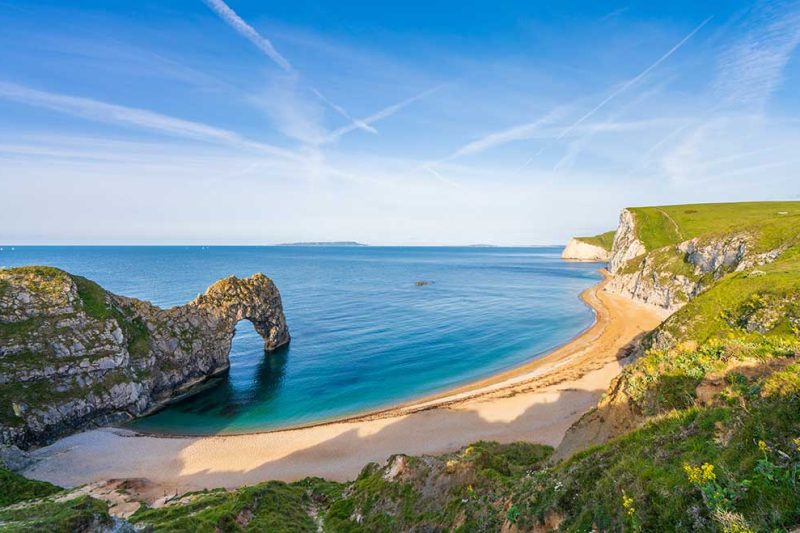
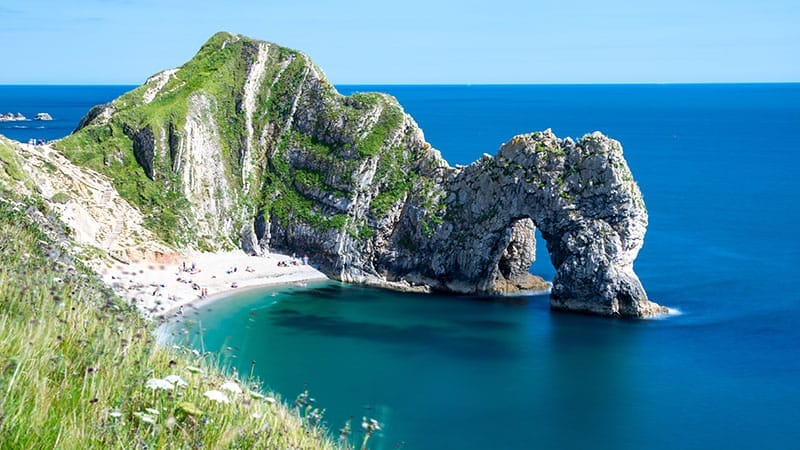
If you’re planning a farm holiday in Dorset, a day at the beach is an absolute must. With so many stunning beaches to choose from, Dorset has something for everyone. But for a truly iconic experience and plenty of Instagram-worthy photos, make sure to visit Durdle Door beach.
Situated about 15 miles west of Weymouth, Durdle Door is a pebble and shingle cove that forms part of the Jurassic Coast World Heritage Site. The beach is privately owned by the Weld family who own the Lulworth Estate, but is open to the public.
The famous arch lies to the east of the beach separating it from Man O’ War bay, and was formed over 1000s of years by the waves pounding against the Portland limestone until they finally eroded the softer rocks at the bottom around 10,000 years ago. The name Durdle is derived from an old English word ‘thirl’ which means to pierce, bore, or drill.
The beach has been used as a backdrop for numerous films including Far From The Madding Crowd, Nanny McPhee, and Wilde, as well as the music videos for Saviour’s Day by Cliff Richard, Shout by Tears For Fears, Loverboy by Billy Ocean, and Tears of a Dragon by Bruce Dickinson.
In 2022, the BBC broadcast a controversial scene in which it appeared that Doctor Who actor Jodie Whittaker regenerated into the former Doctor, David Tennant, while standing on top of the arch.
Things to do at Durdle Door beach
Although the main draw of Durdle Door is the iconic arch, there are plenty of other things to do at the beach. The clear, turquoise waters are ideal for swimming and snorkelling, but be aware that there are no lifeguards at the beach and the sea floor shelves steeply in places, so children should be supervised.
The reef around Durdle Door is excellent for shore diving with the chance to explore the rippled rock formations from another perspective. Near the arch is an underwater cavern, spacious enough to accommodate two divers, illuminated by sunlight that streams through a blowhole. There are also several boulders and plenty of life including kelp, crabs, lobsters, scallops, and Wrasse.
At low tide, rock pools are exposed on the beach with crabs, sea anemones, starfish, small fish, and seaweeds to hunt for. Although, there is little sand, it’s a nice spot for a picnic and taking in the beautiful scenery, but please note that BBQs and open fires are not permitted. Dogs are allowed on the beach all year round so you’re welcome to bring your four-legged friend; just be sure to clean up any mess.
At the base of the limestone cliffs that back onto the beach are several caves, known as wave-cut notches, that have been carved out by the sea. However, cliff falls are common so they should not be entered, and care should be taken when walking close to the cliffs. Fossils can also be found including ostracods, echinoids, cockle shells, oyster shells, and fossilised insects.
Walking at Durdle Door
With the South West Coast Path running behind the beach, there are plenty of opportunities for walks in the area. One of the most popular is from Durdle Door to Lulworth Cove along cliffs. It’s just 2 miles there and back, but with hundreds of thousands walking the route each year it can get very busy during the summer.
A more challenging walk is from Durdle Door to Ringstead. From the car park at the top of the beach, follow the inland bridleway behind the caravan park along Old Daggers Gate. You’ll pass through farmland and in the summer, fields full of wildflowers such as poppies, heather, and thistles. Keep an eye out too for farmland birds including skylarks, yellowhammers, and corn buntings. The views inland look over the Frome and Piddle valleys.

Continue following the path passing by the remains of RAF Ringstead Chain Home Radar Station. The site includes two transmitter blocks, two receiver blocks, the bases of two receiver towers, a substation and an emergency standby set house bunker, some of which have been converted into quirky holiday cottages.
Once you reach Ringstead car park, turn back on yourself and follow the coastal path back to Durdle Door along the top of the cliffs. At Burning Cliff, under the White Nothe headland, you’ll pass by St Catherine-by-the-Sea, a wooden church built in 1905. Further on, there is a row of former coastguard cottages, which are completely off-grid with no mains gas or electricity, no running water, and no telephone or internet. There are also fantastic views out to sea and across to Weymouth and Portland, and look out for the stone marking the start of a smuggler’s path down to the beach.
Pass through the unusually named Scratchy Bottom valley. The name is believed to mean a rough hollow, and it was the location where Gabriel Oak’s sheep were driven off a cliff by a sheepdog at the beginning of the 1967 Far From the Madding Crowd. Durdle Door beach is now just ahead of you.
There is a holiday park a few hundred metres from the beach with facilities including a children’s adventure playground, a convenience store, shower blocks, dishwashing area, and the Man O’ War Bar & Restaurant which serves a range of dishes from locally sourced suppliers, pizzas, salads, sandwiches, and hot and cold drinks.
A pay-and-display car park is located next to the holiday park. From here, access to the beach is via a steep downhill path and then 143 steps. Sturdy footwear is recommended for the walk down. Accessible toilets can also be found in the holiday park.