Situated on Eskdale Fell, Burnmoor Tarn is the largest natural tarn in the Lake District and a favourite destination for hikers drawn by its remoteness and dramatic mountain backdrop. On the southern shore stands Burnmoor Lodge, a 19th-century hunting lodge later used as a holiday cottage. It is now managed by the Burnmoor Lodge Club, which uses it as a base for hill walking. Only club members may stay at the lodge, and membership requires an overnight visit as a guest of an existing member, a tradition that keeps it exclusive to a very select group.

Alongside excellent mountaineering opportunities around the tarn, there are also some less demanding walks to enjoy. One option is to follow the medieval “corpse road” that runs past the eastern shore, once used to carry bodies from Wasdale Head to St Catherine’s Church in the village of Boot. The full route is a 12-mile return journey, passing a double-arched packhorse bridge and, at times, crossing fairly boggy ground. Alternatively, you can begin at either end of the path, walk as far as Burnmoor Tarn, and then retrace your steps.
Owned by the National Trust, Buttermere lies in a classic U-shaped valley just 15 minutes from Keswick and Cockermouth. It offers one of the finest circular lake walks in the Lake District, a 4.5-mile route with an excellent reward-to-effort ratio. Along the western shore, a bridleway hugs the water’s edge before climbing gently through the tall trees of Burtness Wood. Along the way, you’ll pass Sourmilk Gill, which tumbles 1,300 feet down from Bleaberry Tarn, and enjoy impressive views of Moss Force cascading over a dramatic black crag beneath High Snockrig. On the southern shore, the path passes through a Victorian rock tunnel carved by a mill owner to bypass a difficult stretch of shoreline.
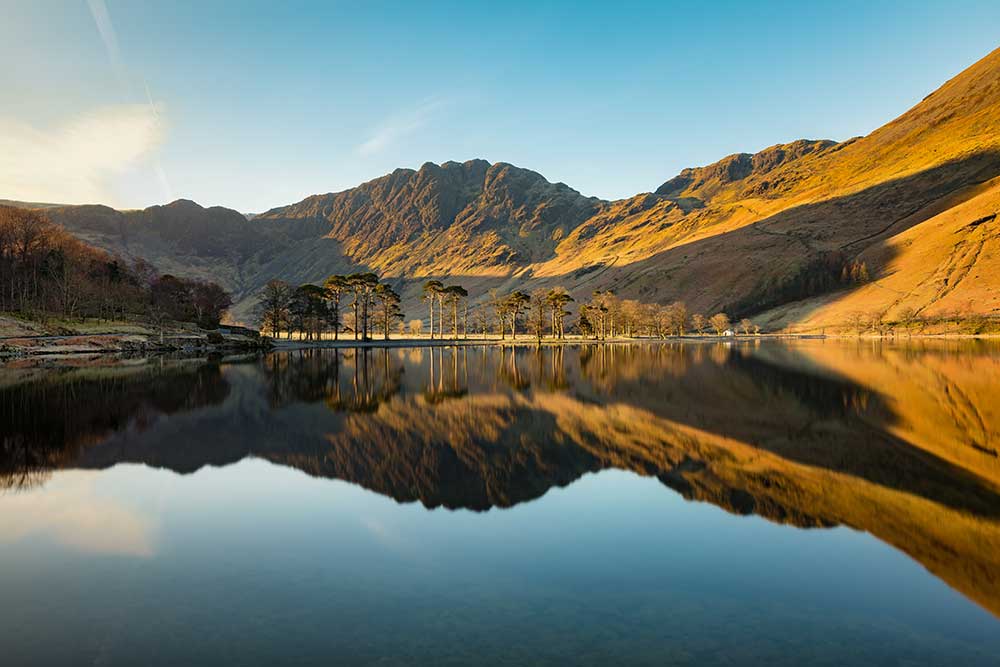
Buttermere is a popular spot for wild swimming, thanks to its clear, cold waters, with a wetsuit strongly recommended if you’re not accustomed to open-water swimming. High above the lake, the Buttermere Infinity Pool can be reached from Honister Pass via a well-marked path that winds steadily uphill. Set at the base of a waterfall, the pool offers spectacular views towards High Stile, Red Pike, and the lakes below.
The village of Buttermere sits at the north-western end of the lake and is home to St James’s Church, built in 1840. Inside is a memorial to writer and fellwalker Alfred Wainwright, with his favourite mountain, Haystacks, rising above the village.
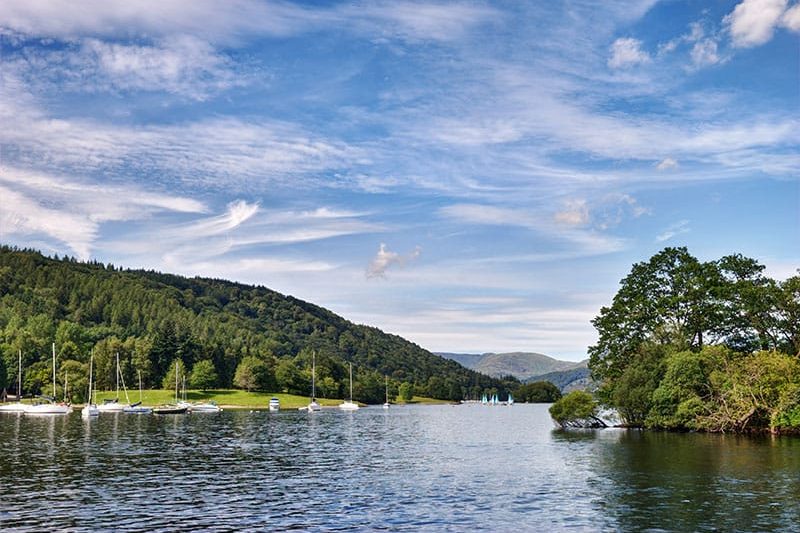
An example of a ribbon lake formed by glaciation, Windermere is the largest lake in England by length, area and volume. It has attracted visitors since the opening of the Kendal and Windermere Railway branch line in 1847, and today it remains one of the Lake District’s most popular destinations, drawing tourists keen to enjoy the many activities available both along its shores and on the water itself.

The lake is particularly well known for watersports, with opportunities for waterskiing, wakeboarding, kayaking, canoeing, and sailing. A range of cruises also operate on the lake, offering a relaxed way to take in views of the surrounding mountains, woodlands, and islands, while motorboat and rowing boat hire allows visitors to explore at their own pace.
On the eastern shore, not far from Bowness-on-Windermere, stands the Windermere Jetty Museum, a family-friendly attraction that brings the lake’s 200-year boating heritage to life through interactive displays, oral histories, and an impressive collection of motorboats, steam launches, speedboats, and sailing yachts.
Situated around half a mile from the village of Coniston, Coniston Water is the third-largest lake in the Lake District by volume. Quieter than its neighbour Windermere, it nevertheless offers spectacular scenery, excellent walking routes, and a wide range of outdoor activities. Arthur Ransome chose Coniston as the setting for his beloved Swallows and Amazons series of children’s novels, and the lake remains a popular destination for watersports, with several activity centres nearby.

At Coniston Boating Centre, visitors can hire motor boats, rowing boats, canoes, kayaks, and paddleboards, a wonderful way to explore the lake and enjoy its surroundings, whether you’re seeking a peaceful paddle or a more exhilarating adventure. Electric and mountain bikes are also available to hire for those who prefer to discover Coniston on two wheels.
If you would rather sit back and let someone else take the helm, you can experience the charm of a bygone era aboard the Steam Yacht Gondola, a beautifully restored mid-Victorian steam-powered passenger yacht of significant industrial heritage. Enjoy spectacular views of the Coniston Fells, including the Old Man of Coniston, which rises to over 2,600 feet, while travelling in style within Gondola’s opulent saloons or relaxing on her open-air decks.
Situated on the route between Wasdale and Borrowdale, and along the popular Corridor Route to Scafell Pike, Styhead Tarn is a well-known stopping point for walkers and hikers. The tarn lies within a Site of Special Scientific Interest and supports a variety of notable aquatic plants, including quillwort, shoreweed, floating bur-reed, and awlwort. It is also home to a population of brown trout, which anglers may fish for free with the appropriate licence.

As one of the quieter lakes in the area, it is an excellent location for wildlife watching. Look out for birds such as ravens, peregrine falcons, and buzzards soaring above the surrounding fells, alongside heathland species including black grouse, meadow pipits, and wheatears. Red deer are occasionally seen on the higher slopes, and autumn is an especially rewarding time to visit if you hope to witness the rut.
Wastwater is a glacial lake set within Wasdale Valley, renowned for some of the finest views in the British Isles. It is surrounded by several of the Lake District’s highest peaks, including Scafell Pike, Great Gable, Yewbarrow, and Lingmell. Winter is a particularly rewarding time to visit, when crisp air and clear light create exceptional visibility, allowing views that stretch for miles in every direction.

As England’s deepest lake, Wastwater is also a popular destination for divers. Marked dive routes lead from the shoreline to a number of underwater points of interest, including The Pinnacles, where steep submerged cliffs plunge into deep drop-offs, and The Screes, a series of dramatic rock faces and near-vertical underwater walls. Marine life in the lake includes Arctic char, trout, eels, and salmon during the spawning season.
Near The Pinnacles lies a submerged gnome garden complete with a picket fence, originally placed by divers as a curiosity for others to discover. The gnomes were once removed by police divers following several fatalities linked to divers searching for them. They have since been replaced at a depth beyond the legal limit for police diving operations.
Crummock Water is a clear, rocky-bottomed lake flanked by steep fellsides of Skiddaw slate. Mellbreak fell runs the full length of the western shore, of which Alfred Wainwright remarked, “no pairing of hill and lake in Lakeland have a closer partnership than these”. Nearby Scale Force, the highest waterfall in the Lake District, plunges 170 feet to feed the lake and is well worth a visit, particularly after rainfall, when water thunders over the rocky ledges above. The two-hour walk can be challenging, but the spectacular views make the effort worthwhile.

Fishing is popular at Crummock Water, where trout, char, pike, and perch can all be found. Visitors may launch their own boats, although a ten-boat limit, including canoes and windsurfers, is in place, and motorised craft are not permitted in order to preserve the lake’s tranquillity. Rowing boats are also available to hire for those wishing to explore the lake from the water.
Crummock Water is a favourite spot for wild swimming, although entry points are limited. One of the best locations is a sheltered shingle beach beside the late nineteenth-century boathouse on the eastern shore.
Situated just south of Keswick and often referred to as the “Queen of the Lakes”, Derwentwater is the third-largest lake in the Lake District by area, covering 2.1 square miles. Several islands lie within the lake, including Derwent Island, the only inhabited island. During the medieval era, the island formed part of the Borrowdale Estate owned by the monks of Fountains Abbey in Yorkshire, when it was known as Hestholm, meaning “Horse Island”. Following the Dissolution of the Monasteries, ownership passed to the Crown and later to a group of German miners.

In the late 18th century, Joseph Pocklington, a wealthy banker once described as a man “with no taste whatsoever”, built a Palladian villa on the island, along with a Gothic chapel-boathouse, a druid’s circle and a small fort. The Marshall family extended the house in the mid-1800s, and in 1951 the island was transferred to the National Trust, which now opens it to visitors on occasional open days.
A scenic 10-mile walking route circles the lake, passing through ancient woodland and offering plenty of picturesque picnic spots. Along the way, look out for Entrust, a wooden sculpture of cupped hands created to mark the 100th anniversary of the National Trust’s purchase of Brandelhow Park. At Calf Close Bay, a modern sculpture carved from a boulder of volcanic rock with ten segments across ten rings, commemorates the National Trust’s centenary.