Northumberland is home to over 70 castles, more than any other English county, largely due to its position on the front line of centuries-long border conflicts between England and Scotland. The town of Berwick-upon-Tweed, just three miles from the Scottish border, for example, changed hands between the two nations 13 times before finally comiing under English control from 1482.
As a volatile frontier region, Northumberland required extensive defences to guard against invasion, raids by Border Reivers, and to maintain authority, resulting in a concentration of castles, as well as fortified pele towers dotted across the landscape.
Today, many of these structures still stand proudly, while others survive as hauntingly beautiful ruins, but all are steeped in history, legend, and enduring legacy.
Perched on top of a 180-foot-high volcanic dolerite crag overlooking a vast sweep of golden sand, Bamburgh Castle is an imposing Norman fortress and one of the largest inhabited castles in the British Isles. Following a revolt in 1095, it passed into the ownership of the English monarchy, and during the Wars of the Roses in 1464, it became the first castle in England to fall to modern cannon fire.

In the 18th century, the castle took on a more humanitarian role, serving as one of the world’s earliest voluntary coastguard stations, where a lifeboat was developed and tested. At the same time, it housed a hospital, pharmacy, doctor’s surgery, and a free school for underprivileged children.
In 1894, industrialist and inventor William Armstrong purchased the castle and began an extensive restoration. His descendants have remained its custodians ever since.
Inside, visitors can explore the state rooms, which display an eclectic collection of artefacts and heirlooms, including Armstrong’s own artwork, ceramics, and objets d’art, alongside gifts from members of the Royal Family, actors, authors, and politicians. The Great Hall is a particular highlight, a Victorian showpiece with an impressive false hammerbeam ceiling crafted from Thai teak.
The armoury houses a chilling collection of battle-worn weaponry, including pikes, muskets, halberds, and crossbows. Meanwhile, the archaeology museum displays remarkable Anglo-Saxon finds, such as an intricate gold plaque depicting the Bamburgh Beast.
The former laundry rooms now contain the Armstrong and Aviation Artefacts Museum, with exhibits exploring the industrial legacy of Armstrong’s company, including engines, artillery, and aviation items from both World Wars.
Outside, the grounds offer wonderful sea views and plenty to discover, from a ruined chapel and historic windmill to cannons and medieval games. The Victorian stables have been converted into a café serving hot and cold food made with local ingredients. Visitors can tuck into hearty soups, jacket potatoes, freshly prepared sandwiches, and homemade cakes, enjoyed in the dog-friendly outdoor seating area.
Stay nearby – farm cottages in Bamburgh.
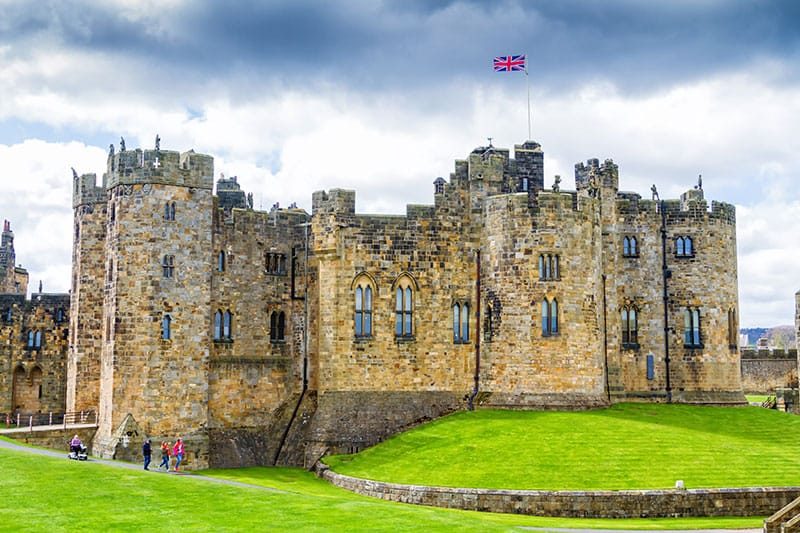
Built to guard a crossing over the River Aln, Alnwick Castle has been the seat of the Duke of Northumberland’s family for more than 700 years. Many will recognise it as the principal filming location for Hogwarts School of Witchcraft and Wizardry in the Harry Potter films, and as the stand-in for Brancaster Castle in Downton Abbey.

In the early 12th century, the castle played a key role in the conflicts between England and Scotland, and was twice besieged by William the Lion, King of Scotland. Following his capture, King John of England ordered the demolition of Alnwick Castle after its owner, Eustace de Vesci, was accused of plotting against him, though the order was never carried out.
When Henry Percy, 1st Earl of Northumberland, took residence, he undertook major improvements, adding towers, watch posts, two large octagonal towers, and a concealed postern gate for emergency escape. He also installed stone figures along the walls to give the impression of a more heavily defended stronghold.
During the 16th and 17th centuries, the castle fell into decline, with parts collapsing entirely. Its fortunes changed in 1776 when the Percy family were elevated from earls to dukes, and they transformed Alnwick from a military fortress into a grand Gothic-style residence, working with renowned architects such as Robert Adam and James Paine, while Capability Brown was commissioned to redesign the surrounding landscape.
Today, visitors can admire the results in the castle’s lavish state rooms. Highlights include the Drawing Room, with its Italian-inspired gilded ceiling, painted frieze, silk wall hangings, marble fireplace, and imposing ornamental mirror. The elegant Salon features period furnishings, historic artworks, and tall windows framing views of the grounds. In the Upper Guard Chamber, a striking marble terrazzo floor is complemented by statues of Justice and Britannia.
Outside, the grounds offer a peaceful contrast, with sweeping pastures leading down to the river, which reflects the castle’s silhouette. Spanning the water is the iconic Lion Bridge, with its three semi-circular arches and a lion emblem representing the Percy family, a favourite viewpoint for photographers.
The castle hosts a year-round programme of events, including live cannon firings, Elizabethan falconry displays, longbow demonstrations, and outdoor cinema screenings. Visitors can even take part in broomstick training on the very spot where Harry Potter had his first flying lesson, learning essential skills such as turning, manoeuvring, accelerating, and braking under expert guidance.
Stay nearby – farm cottages near Alnwick.
Lying between the villages of Craster and Embleton, Dunstanburgh Castle is an iconic 14th-century ruin that was once among the largest and most impressive fortifications in northern England. It was commissioned by Thomas, 2nd Earl of Lancaster, then the second wealthiest man in the country after the king, who took advantage of existing Iron Age earthworks and the area’s natural coastal defences.

Construction began in 1313, with materials including iron, coal from Newcastle upon Tyne, and timber imported from Scandinavia. Local labourers, likely from Embleton, are thought to have worked on the castle as part of their feudal obligations. A constable was appointed in 1319 to oversee its defence, and by 1322 the castle was complete.
The fortress was vast, with a formidable stone curtain wall, an imposing gatehouse, and six outer towers. It was naturally protected by cliffs on one side, while a harbour on the south side provided access from the sea.
Despite the scale of the project, Thomas scarcely used the castle and is believed to have visited only once. In 1321, the Despenser War broke out, a rebellion against Edward II of England. While attempting to reach Dunstanburgh, Thomas was intercepted en route, leading to the Battle of Boroughbridge. He was captured and later beheaded near Pontefract Castle in 1322.
Following his death, the castle passed into royal control, as Edward II saw it as a key stronghold against Scottish threats. It was initially managed by Robert de Emeldon, a Newcastle merchant, and defended by a garrison of 40 men-at-arms and 40 light horsemen.
Over the next 150 years, Dunstanburgh changed hands several times and suffered damage during conflicts including the Wars of the Roses, when it was held by Sir Ralph Percy for the Lancastrians against Yorkist forces. However, little money was invested in its upkeep, and by the early 16th century, the garrison had turned to piracy to supplement their income, while the castle itself was stripped of valuable materials, with its lead roofing removed for use at Wark-upon-Tweed and timber repurposed for buildings in Embleton.
A survey in 1584 estimated that repairs would cost £1,000 (equivalent to almost four million pounds today), but its distance from the Scottish border made restoration unjustifiable. Between 1594 and 1597, Alice Craster, a wealthy widow, lived in the gatehouse, carrying out some restoration work while farming the surrounding land.
After the unification of England and Scotland in 1603, Dunstanburgh lost its strategic importance and gradually fell into further decline. It later came into the hands of the Grey family, who used the land for agriculture while the castle itself was looted for stone.
Although there were occasional restoration efforts in later centuries, the decision was ultimately made to preserve the ruin rather than rebuild it. It became a favourite subject for artists, notably J. M. W. Turner, who featured it frequently in his work.
Today, the castle is owned by the National Trust and managed by English Heritage. The surrounding coastline offers spectacular walks and is rich in wildlife, with seabirds nesting along the cliffs and grasslands supporting species such as skylarks and meadow pipits.
In 1900, a golf course was laid out beside the castle, designed by James Braid, the Scottish Open Championship winner renowned for his classic links designs.
Stay nearby – farm cottages near Craster.
Also known as Holy Island, Lindisfarne is a tidal island just off the Northumberland coast, accessible on foot via a causeway at low tide. Its recorded history dates back to the 6th century, when it served as a place of retreat for monks and hermits.
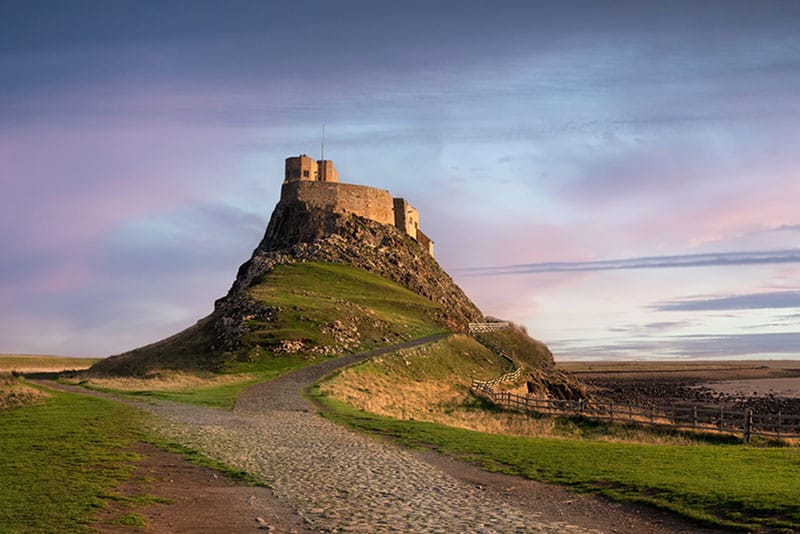
Like much of the region, Lindisfarne lay in a historically volatile border area between England and Scotland, and following the Dissolution of the Monasteries, Henry VIII ordered Thomas Manners, 1st Earl of Rutland to fortify the site. A small fort was constructed on top of a volcanic outcrop known as Beblowe Crag, equipped with an assortment of guns.
After Henry’s death, Elizabeth I continued the project, using stone from nearby Lindisfarne Priory to build a more substantial fortified castle. However, the garrison remained relatively small, and following the Union of the Crowns, the castle was abandoned as a military stronghold.
In the 18th century, it saw brief use by Jacobite rebels and later served as a coastguard lookout, but gradually fell into disrepair.
A new chapter began in 1901, when Edward Hudson, the owner of Country Life magazine, purchased the castle from the Crown as a holiday home. He commissioned architect Edwin ‘Ned’ Lutyens and garden designer Gertrude Jekyll to transform it into an elegant Edwardian residence. Working in the Arts and Crafts style, they incorporated pink sandstone and enhanced the surviving Tudor masonry with features such as mullioned windows, substantial lintels, and a new semi-octagonal tower.
Inside, Lutyens played creatively with scale and perspective, furnishing small rooms with oversized pieces, introducing winding passageways, and juxtaposing low doorways with high ceilings. Subtle changes in level between rooms added to the building’s character, while the use of stone, brick, slate, and wood created a deliberately simple, almost austere atmosphere.
The walled garden, once the garrison’s vegetable patch, was redesigned by Jekyll as a vibrant flower garden, intended to peak in summer when Hudson was in residence, while remaining a sheltered and leafy retreat year-round. Planting included hardy species suited to the coastal climate, such as clematis, sweet peas, delphiniums, poppies, daisies, hollyhocks, and sea buckthorn.
Hudson frequently entertained at the castle, hosting guests that included politicians, royalty, writers, and film stars. In 1922, he sold the property to Oswald Toynbee Falk, a stock broker and economist, who soon passed it on to Edward de Stein, a merchant banker. Since 1944, the castle has been in the care of the National Trust, along with nearby lime kilns and upturned herring boats once used as sheds.
Today, visitors can explore the castle’s distinctive interiors and experience its unique blend of history and design. Highlights include the entrance hall, whose columns evoke the nave of Durham Cathedral; the dining room, formerly the castle kitchen, which retains its Tudor fireplace complete with bread oven and salt recess; and the Upper Gallery, once used as a performance space by cellist Guilhermina Suggia. Other notable features include a wind indicator showing real-time wind direction and a model ship suspended from the drawing room ceiling.
Outside, Jekyll’s garden has been carefully recreated by National Trust gardeners, and there are plenty of places to stop for a picnic while enjoying views across the sea towards the Farne Islands and Bamburgh Castle.
Stay nearby – farm cottages near Lindisfarne.