The origins of British pub names can be traced back to the Romans. Across the Empire, single-room shops known as tabarnae sold a wide range of goods, including leather, books, jewellery, textiles, and other crafted items. These permanent retail spaces transformed the economy by allowing traders to establish thriving centres of commerce, rather than relying solely on travelling sales or periodic markets.
Tabarnae also became popular places to buy food such as olives, bread, cheese, and hot dishes accompanied by wine, and those that sold wine would hang vine leaves or a bunch of grapes outside as a sign. When the Romans expanded into Britain, grape vines were scarce, so small bushes were used instead to mark out these establishments. It is thought that this practice explains why many pubs bear names such as The Bush, The Holly Bush, The Mulberry Bush, and The Old Bull and Bush. Even today, the brackets from which pub sigs are hung often incorporate grapes, ivy, and vine leaves into their designs.
Following the fall of the Roman Empire and its departure from Britain in the fifth century, the Anglo-Saxons developed their own versions of tabarnae along the Roman road network, establishments that sold ale, a native drink brewed using a warm fermentation process. Early alehouses were often private homes where the ‘ale-wife’, often a widow, brewed and served beer for consumption either on or off the premises. To advertise their trade, they would hang the long stirring poles used in brewing outside their doors, signalling to passers-by what was available inside. These alehouses primarily served the lower classes of society.
Taverns also emerged, deriving their name from the tabarnae. Unlike alehouses, taverns specialised in wine and typically catered to the upper echelons of society. The third type of establishment was the inn, which provided overnight accommodation, meals, and stabling for horses. Back then these terms had strict definitions. Today, however, they are often used interchangeably, and have largely disappeared, replaced by the catch-all term public house, or pub, to distinguish them from private residencies.
Pubs grew increasingly popular. A tqx census conducted in 1577 recorded 14,202 alehouses, 1,631 inns and 329 taverns across England and Wales, roughly one pub for every 187 people.
To set themselves apart from neighbouring buildings, publicans hung objects outside their premises, which ranged from everyday household items, such as lanterns, bells, copper kettles, and boots, to agricultural implements including ploughs, scythes, and wheatsheaves. By the twelfth century, it had become common practice to give pubs specific names, but as much of the population was illiterate, illustrated signs were used to represent those names visually.
In 1393, Richard II of England passed an Act requiring all inns and taverns to display a sign outside their door. This enabled ale-conners, officials responsible for ensuring the quality of bread and ale, and for regulating measures and prices, to identify licensed premises easily. Many establishments adopted The White Hart, the King’s personal livery badge, others simply took their name from the object hanging outside, and sporting and hunting references were also common.
Some of the earliest inns were run by religious orders, providing shelter for pilgrims and for knights travelling to the Crusades. Pub names that derive from this period include The Turk’s Head, The Saracen’s Head, The Cross Keys, The Lamb and Flag (the lamb symbolising Christ and the flag representing the crusaders), and Ye Olde Trip to Jerusalem.
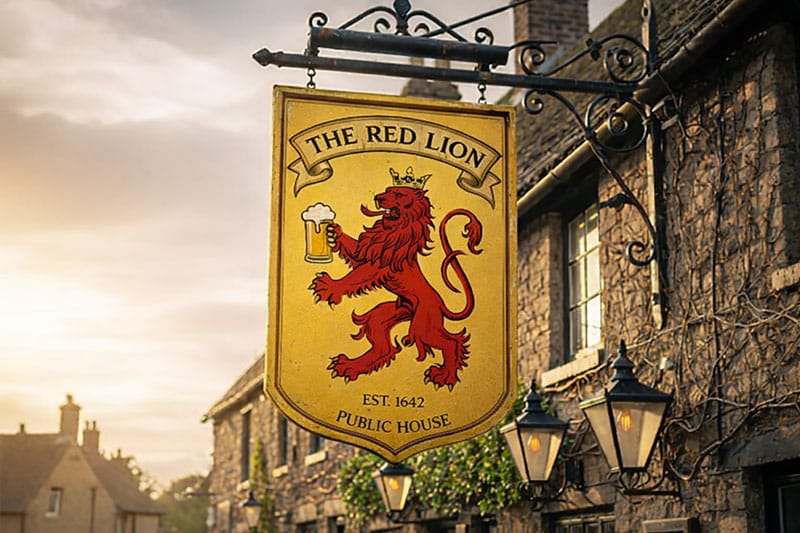
The Red Lion is the most common pub name in Britain, with an estimated 500 or more bearing the title. Despite its popularity, historians remain divided over its true origin.
One theory links the name to James I of England (James VI of Scotland), who, upon his accession to the English throne, is said to have ordered the Red Lion of Scotland to be displayed on prominent public buildings. Another suggestion is that the name derives from the heraldic coat of arms of John of Gaunt, Duke of Lancaster.
However, there is little firm evidence to support either explanation. John of Gaunt was widely unpopular during his lifetime, making it unlikely that publicans would have named inns in his honour. Similarly, although James’s arrival from Scotland may have increased the visibility of the red lion symbol, this alone does not fully explain its widespread adoption.
A more convincing explanation lies in English heraldry. The red lion was a common emblem among aristocratic families, many of whom featured it prominently in their coats of arms. In heraldic terms, both the lion and the colour red, known as gules, symbolise courage, nobility, valour, and strength. As influential landowners and lords of the manor, these families played significant roles in their local communities. iven that pub signs often reflected local history and prominent families, it is hardly surprising that the red lion, one of the most enduring symbols in heraldry, became such a popular choice.
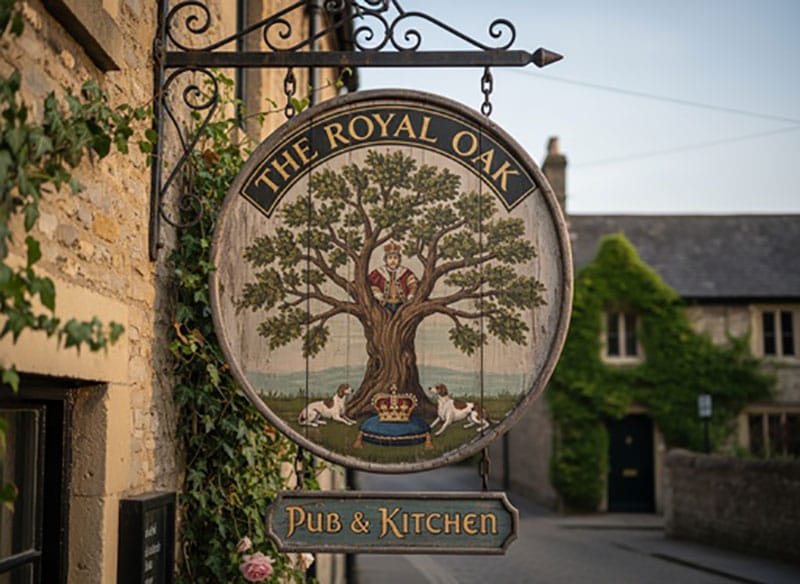
Said to be the third most popular pub name in Britain, The Royal Oak commemorates the young Prince Charles, who later became King Charles II.
After his defeat at the Battle of Worcester in 1651 during the English Civil War, the prince fled from Cromwell’s Parliamentarian forces. He found refuge at Boscobel House, a timber-framed farmhouse and hunting lodge in Bishops Wood, Staffordshire, owned by the Giffard family. The Giffards were recusants – Catholics who refused to conform to the established Church of England – and their house served as a secret sanctuary for Catholic priests, complete with concealed priest holes.
To avoid capture, Charles was guided to a nearby English oak tree in the surrounding woodland and climbed into its branches with William Careless, one of the last Royalists to escape the battlefield. From their hiding place they could watch Parliamentarian patrols searching for the fugitive king. Later, Charles returned to the house and spent the night concealed in one of its cramped priest holes before moving on to Moseley Old Hall near Wolverhampton. Disguised as a servant, he eventually made his way to the south coast and escaped to France.
When Charles was restored to the throne in 1660, returning to London on his thirtieth birthday on the 29th of May, the oak tree that had sheltered him became a powerful symbol of loyalty to the Crown. Many inns were subsequently renamed The Royal Oak in his honour. The date itself was declared a public holiday, Restoration Day, more commonly known as Oak Apple Day or Royal Oak Day.
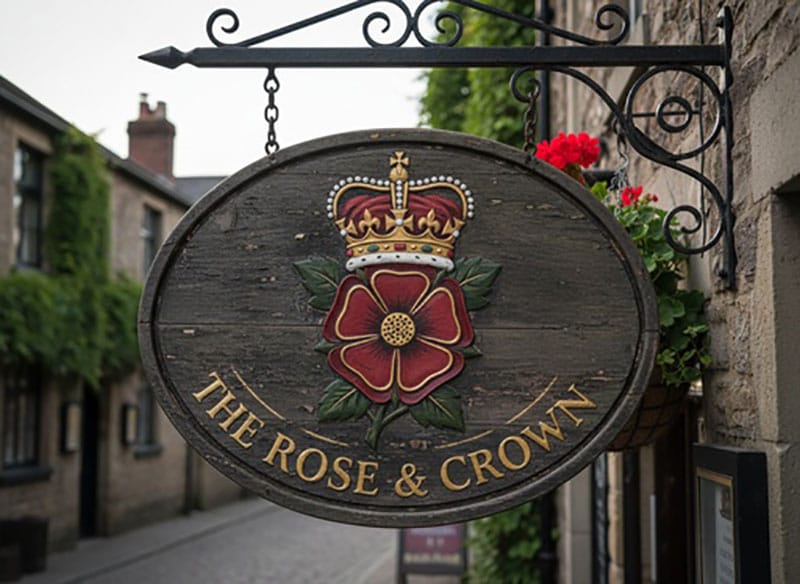
The Rose and Crown also commemorates a civil war: the Wars of the Roses, a series of battles and campaigns fought between 1455 and 1487 for control of the English throne. The conflict arose from deep-rooted social and economic problems following the Hundred Years’ War with France, as well as tensions created by the powerful duchies established under King Edward III.
The declining mental health of King Henry VI of the House of Lancaster revived the ambitions of his cousin, Richard, Duke of York, who pressed his own claim to the throne. The rival houses adopted different emblems: the red rose for Lancaster and the white rose for York.
The struggle reached a turning point at the Battle of Tewkesbury in May 1471. The Lancastrian male line was ended when the seventeen-year-old Edward, Prince of Wales, Henry VI’s only son and heir, was killed. Following the defeat of his army, Henry VI was imprisoned in the Tower of London, where he soon died, widely suspected to have been murdered.
Fourteen years later, in 1485, the conflict finally came to an end at the Battle of Bosworth. Henry Tudor, whose father was the half brother of Henry VI sharing the same mother, defeated and killed the Yorkist king Richard III and was crowned Henry VII.
With a relatively weak claim to the throne, he secured his position by marrying Elizabeth of York, Richard III’s niece. Their union brought together the red and white roses, and they went on to found the great Tudor dynasty. Many pubs were subsequently named The Rose and Crown in honour of the couple.
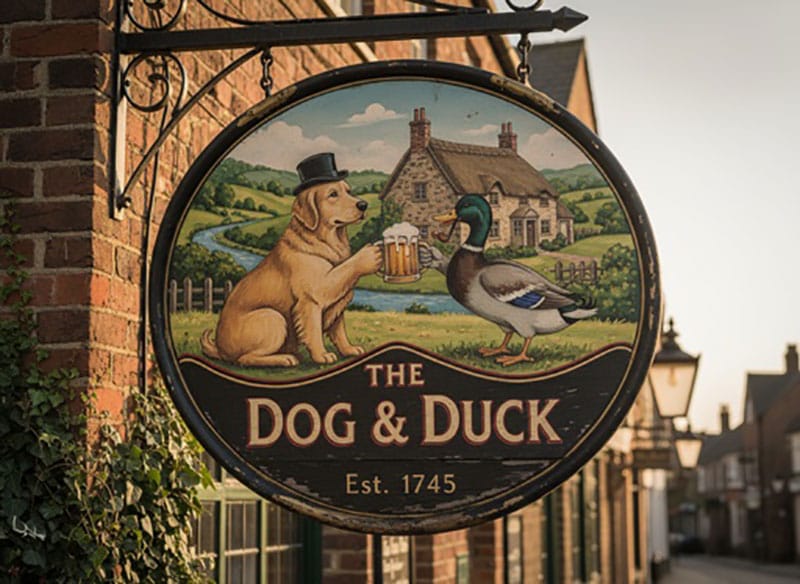
At first glance, The Dog and Duck may seem like an innocuous phrase referring to animals commonly found in the British countryside. In reality, however, the name has far darker origins, stemming from the blood sport known as duck-baiting.
The sport involved pinioning a duck – restraining its wings to prevent flight – and releasing it onto a pond, where it would be chased by a dog. Breeds commonly used included the now-extinct English Water Spaniel and Tweed Water Spaniel, both valued for their ability to dive underwater as effectively as the duck itself.
Unable to escape by flying, the duck became the focus of a dramatic underwater chase. The dog would repeatedly dive in pursuit, but was often unable to match the duck’s speed beneath the water, and frustrated, would surface before diving again. Eventually, either the dog would abandon the chase or the exhausted duck would surface and be caught. Spectators gambled on the outcome, backing either the dog or the duck. Those betting on the dog sometimes threw stones at the duck to disable it, frequently sparking fights among the crowd. Prizes were awarded to dogs that captured the duck in the shortest time.
Publicans who owned ponds or were situated near wetlands often hosted duck-baiting events, advertising them with signs depicting a dog and a duck. They understood that spectators would later crowd into the pub to either celebrate their winnings or drown their sorrows.
Other pub names similarly reflect the entertainments they once offered, such as The Bull for bull-baiting, The Bear for bear-baiting, and The Cock Inn for cockfighting, while inns located near hunting grounds adopted names such as The Fox & Hounds, The Hare & Hounds, The Greyhound, and The Bird in Hand, the latter referencing falconry.