Scotland’s landscapes, from highland forests to coastal waters, are home to an array of unique wildlife. Here are 12 of the most iconic species you’ll want to look out for on your farm holiday in Scotland.
Known as the ‘Monarch of the Glen’ the red deer is Scotland’s largest land mammal and an iconic symbol of the Highalnds. It has dark reddish-brown fur with a paler buffy patch on its rump, and a pale tail.
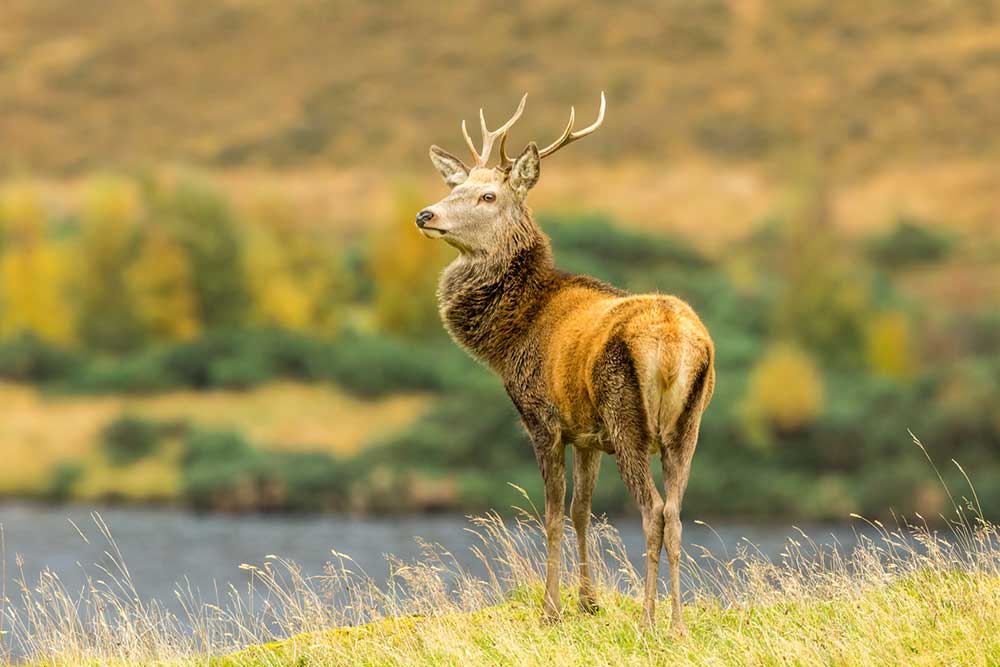
Males have large, branching antlers that increase in size as they get older, measuring up to a metre in breadth and weighing over 30 lbs. During the autumn rut when they fight over females, they can sometimes injure each other with their sharp antlers. They shed them between March and May with new ones starting to grow immediately covered in a soft skin called velvet which helps protect them. In autumn, the velvet is shed, and the antlers stop growing and begin to calcify as the stags’ testosterone levels increase ready for rutting season.
Red deer can be found in the Cairngorms National Park, Glencoe, the Isles of Syke, Mull, Arran, and Jura, and Galloway Forest Park. The best times to spot them are during dawn and dusk when they are most active.
With a wingspan of over 6 feet, the majestic golden eagle is a huge bird of prey, second only in size to the white-tailed eagle in the British Isles. It has dark brown plumage with a golden head and neck, and pale tips to its wings. The large, hooked bill is slate grey with a black tip, and it has yellow feet with legs covered in thick feathers. Young birds have white patches and a white base on their tails.
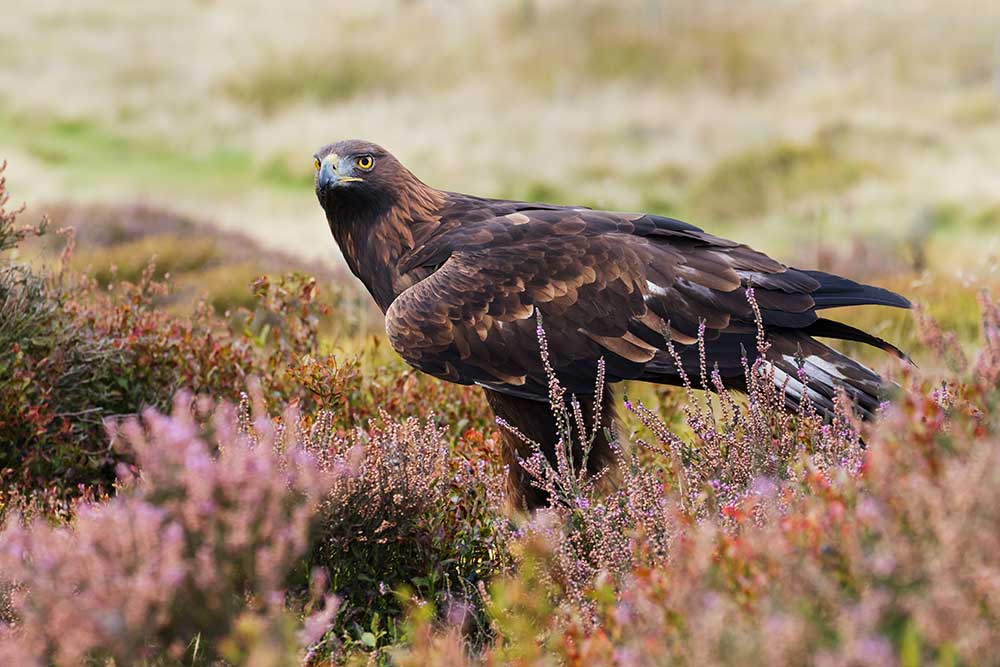
The golden eagle is the top predator in Scotland feeding on small mammals such as mice, foxes, rabbits, and mountain hares, as well as game birds like grouse and ptarmigan.
They can be seen soaring over the uplands, open moorlands, and mountains of the Highland Glens, Cairngorms, Outer Hebrides, and Loch Lomond and the Trossachs. They are often confused with buzzards which are much small and much more common.
Colloquially known as the ‘clown of the sea’ the Atlantic puffin is a comical looking bird with black and white plumage and bright reddish-orange webbed feet. It has a large, bulky bill that during breeding season is striped orange, blue, and yellow giving rise to its other nickname, the ‘sea parrot’.
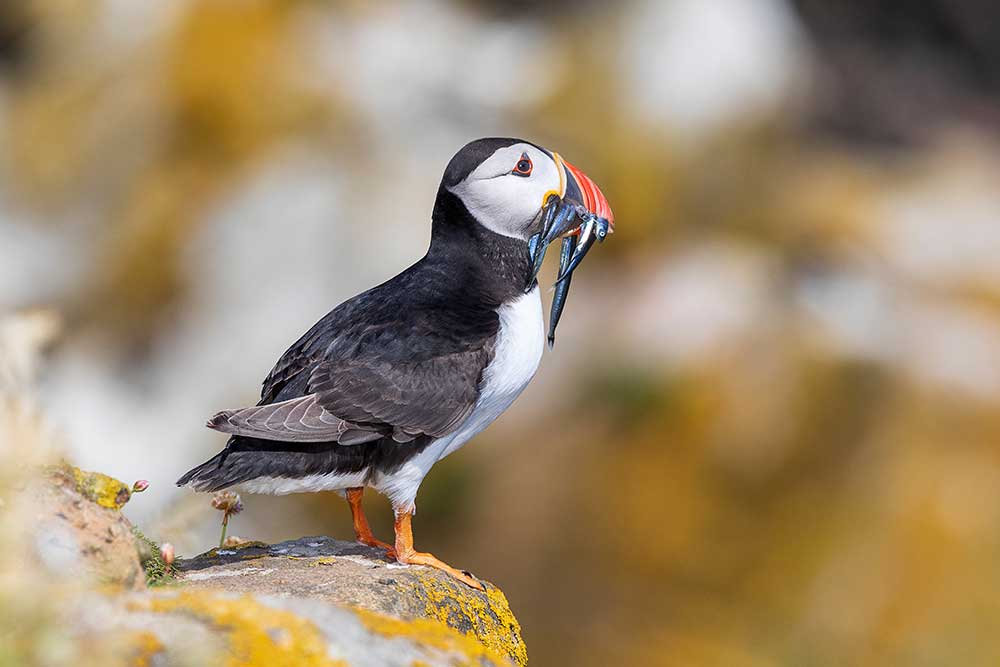
Spending winter out at sea, from April they come to shore to breed in huge colonies on coastal cliffs and rocky islands, where they lay a single white egg in a burrow. Fed on sand eels and other small fish, chicks, known as pufflings, grow rapidly and leave the nesting site in a few weeks, returning to the sea with their parents in August.
The Isle of May in the Firth of Forth is home to over 40,000 puffins during breeding season. Other good places to see them include St Kilda, Orkney, Shetland, and Fair Isle. Booking a boat trip gives visitors the opportunity to observe the colonies up close.
Known for its shaggy red coat and long horns, the Hairy Coo is one of the oldest breeds of cattle with its origins tracing back to the Scottish Highlands and Western Isles over 1,000 years ago. They were bred to withstand the harsh climate, poor grazing, and biting winds of their environment. They are also excellent climbers able to navigate steep, rocky terrain with ease.
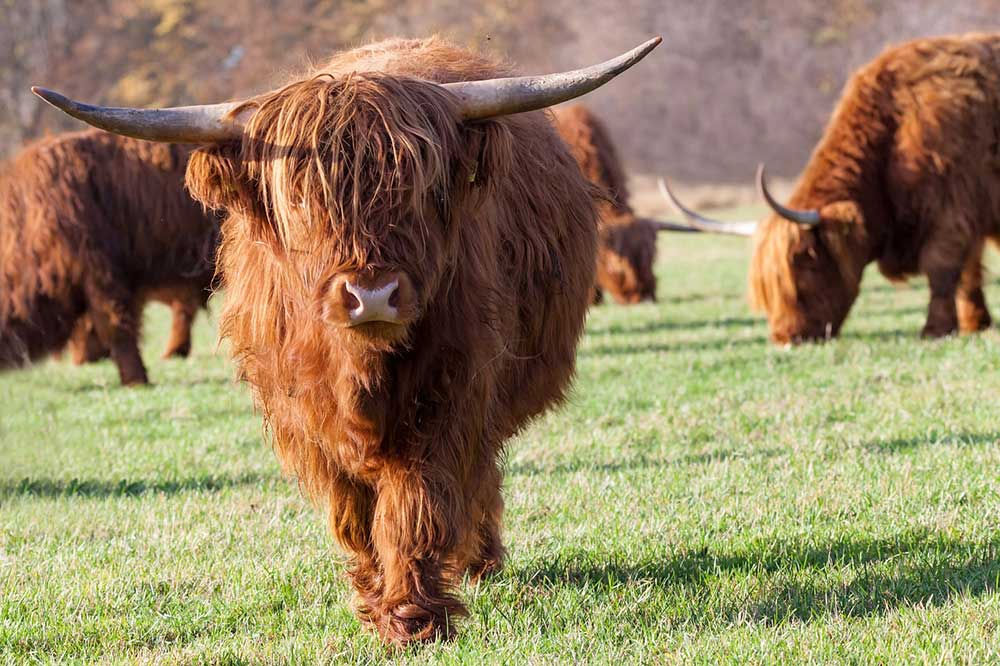
Highland cows are important conservation grazers, eating a wide range of vegetation unpalatable to many other breeds of cattle, and playing an important role in shaping the natural habitats of grasslands, wetlands, and woodlands.
Free roaming Highland cows can be seen all over Scotland. For a guaranteed sighting head to Bealach Na Bà, which translates to ‘Pass of the Cattle’, a winding drover’s road running through the mountains of the Applecross peninsula. Remember, although they may appear cuddly, like any wild animal, Highland cows should be approached with caution.
Often called the “Highland tiger”, the elusive Scottish wildcat is one of the UK’s rarest and most threatened mammals. It is similar to a domestic tabby cat, with which it is known to interbreed, but is stockier, with longer legs, and a fluffier tail. Rings on the tail, and stripes on its hind legs and cheeks enable it to be distinguished from hybrids, although genetic testing is often required for confirmation.
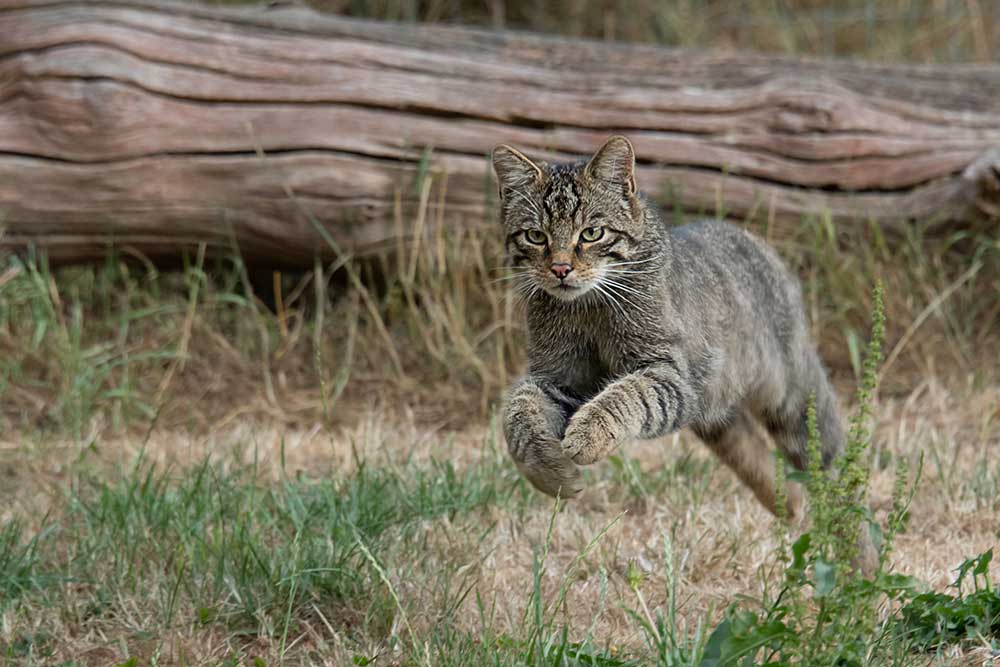
They inhabit the edges of woodlands, moorlands, and mountains, spending most of the day sleeping. At dawn and dusk they emerge into more open landscape where they hunt for rabbits, hares, and ground-nesting birds, patiently stalking their prey before pouncing.
With just a small population found in remote areas of the Highland, they are rarely seen. It is slightly more likely to come across their paw prints or scat although these are hard to tell apart from those of a domestic cat.
Scotland is home to about 80% of the British Isles’ red squirrel population which has gone through a drastic decline largely due to the introduction of non-native American grey squirrels in the late 19th century which outcompete them for food.
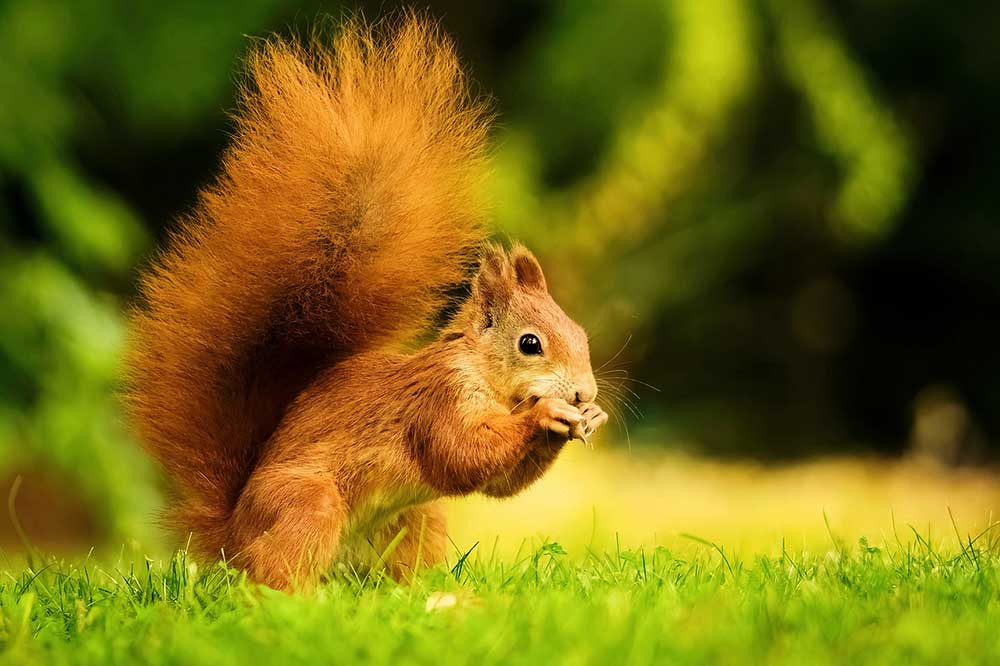
Although known for its orange-red fur, it is actually quite variable in colour ranging from dark brown and chestnut to ginger or even greyish. It has a paler belly and a long bushy tail and in winter large tufts develop on its ears.
Red squirrels have a varied diet eating mainly seeds and nuts although they will sometimes take insects, young birds, and eggs when food is scarce. Pine is a particular favourite which they eat by neatly stripping the cones to get at the seeds inside. Although they don’t hibernate, they become less active over winter, and store caches of food in holes in trees to see them over the colder months.
They can be spotted in mixed broadleaf and coniferous woodland across Scotland. Many forests have dedicated red squirrel trails which visitors can follow for the best chance of spotting them.
Bottlenose dolphins are the most familiar of all British dolphins and the ones most likely to be spotted out to sea. They are the biggest bottlenose dolphins in the world reaching lengths of 13 feet and weighing an average of 650 lb which helps them survive in our cold waters. They are plain grey with a darker back, a short, stubby beak, and a sickle-shaped dorsal fin marked with a pattern of notches and scratches which is unique to each individual.
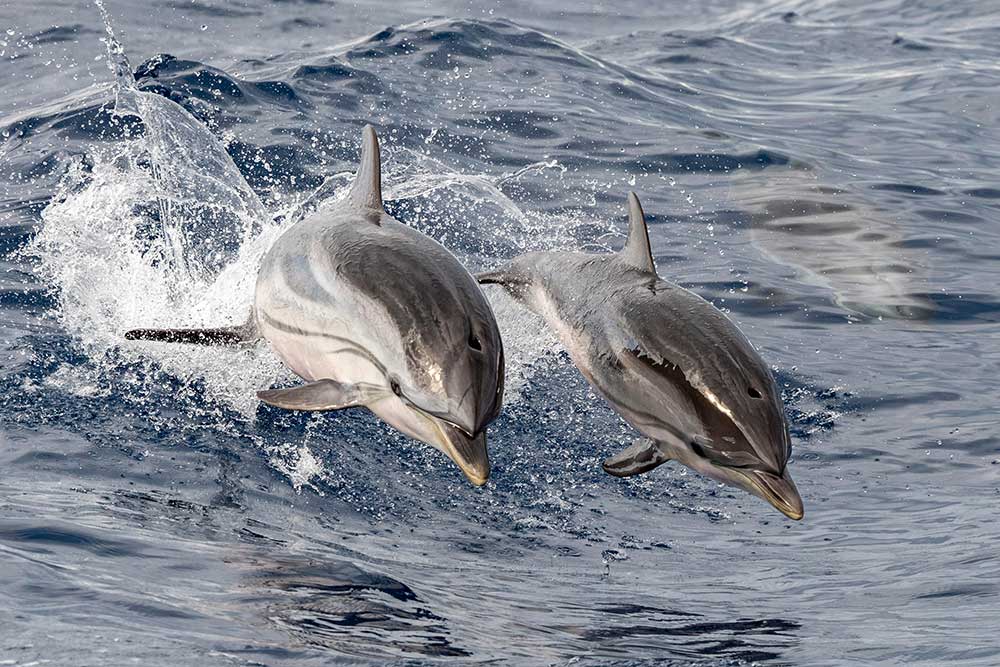
Bottlenose dolphins are usually seen in groups of three to ten animals, although larger group sizes are not uncommon, and are very acrobatic, often jumping out of the water or sometimes doing somersaults.
In Scotland, they are best seen in the Moray Firth, particularly at Chanonry Point on the Black Isle where they come to hunt for fish such as salmon, herring, mackerel, and cod. Known for their sociable behaviour, they will happily swim alongside boats. They can be seen all year, though summer months bring ideal conditions for viewing them up close.
The white-tailed eagle is Britain’s largest bird of prey weighing up to 15 lb and with a typical wingspan measuring between 6 ft to 8 ft. It was persecuted to extinction in the early 20th century but after a successful programme introducing birds from Norway in the 1970s there are now more than 100 pairs breeding in Scotland.
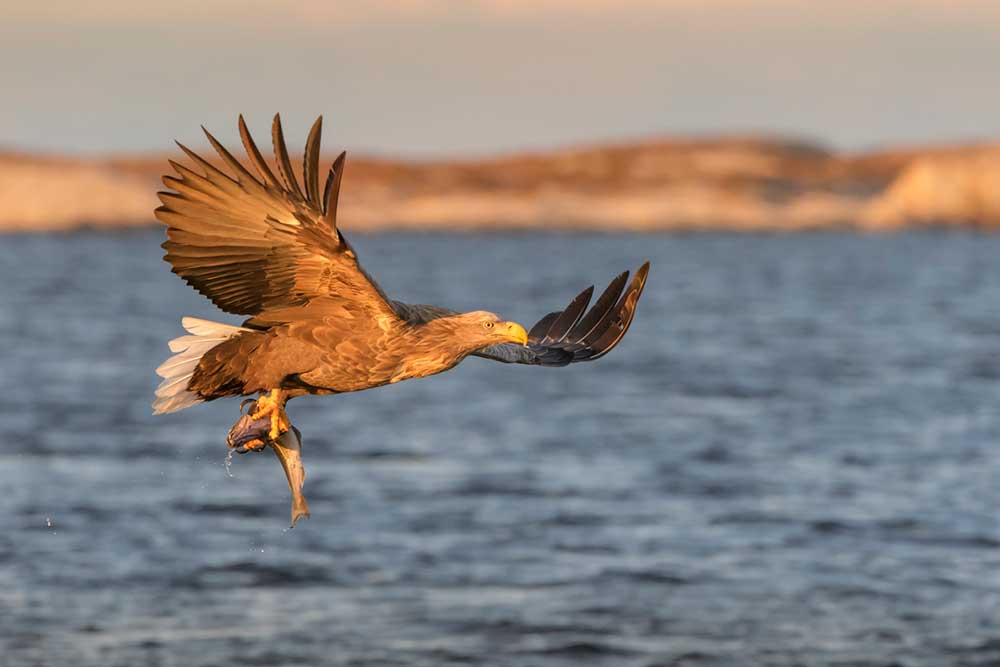
It has brown plumage with a white, wedge-shaped tail and yellow hooked bill. Also known as the sea eagle, it eats mainly fish, but will also prey on small mammals such as rabbits and hares, as well as the chicks and eggs from colonies of seabirds.
Best looked for on the west coast of Scotland, the Isle of Skye is home to several pairs of white-tailed eagles where they can be seen flying over cliffs, rocky outcrops, and lochs. They have also recently returned to Loch Lomond and the Cairngorms National Park.
Lost from most of England and Wales in the middle of the 20th century due to pollution of waterways, the otter population thrived in Scotland’s clean bodies of water and today there it is estimated there are about 8,000 individuals living in the country.
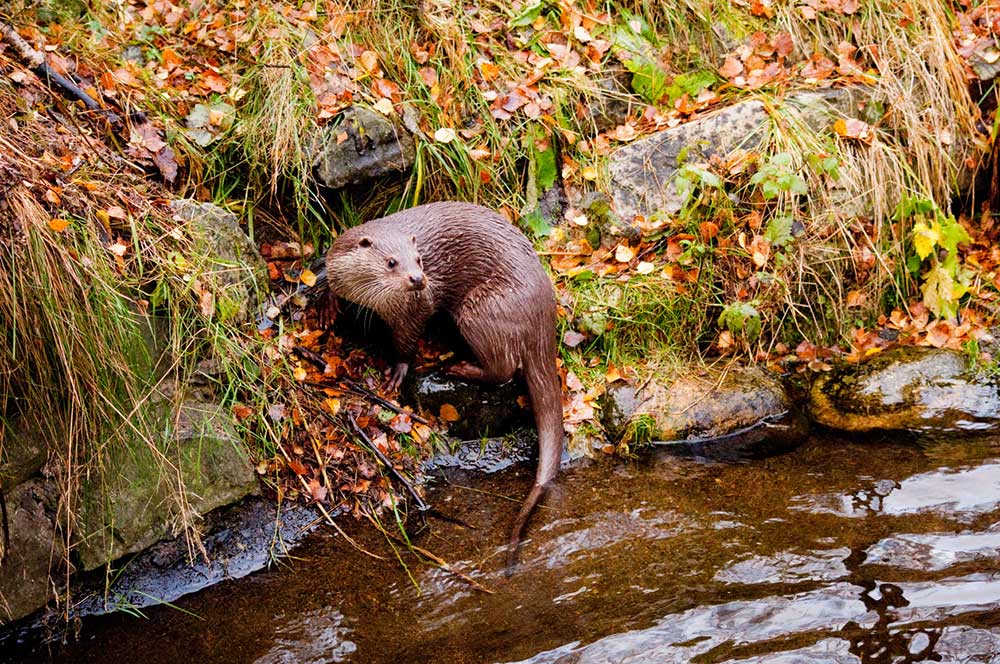
It is large, streamlined, semi-aquatic mammal about the size of a small dog with thick, brown, waterproof fur, broad snout, and webbed feet. The male is usually larger than the female, and it can be distinguished from the mink by its size and wider face. They are excellent swimmers using their strong tail as a rudder, and can close their ears and nose underwater as they hunt for fish, such as eels and salmon, as well as toads, frogs, voles, crustaceans, and waterfowl.
They spend much of their time in water, but sleep and breed in burrows, holes, and caves known as holts. Look out for them in rivers and lochs particularly along the west coast and Scottish islands. Signs that an otter is nearby are five-toed footprints, and droppings known as spraints, which often contain the remain of fish bones and have a surprisingly pleasant scent similar to freshly mown hay.
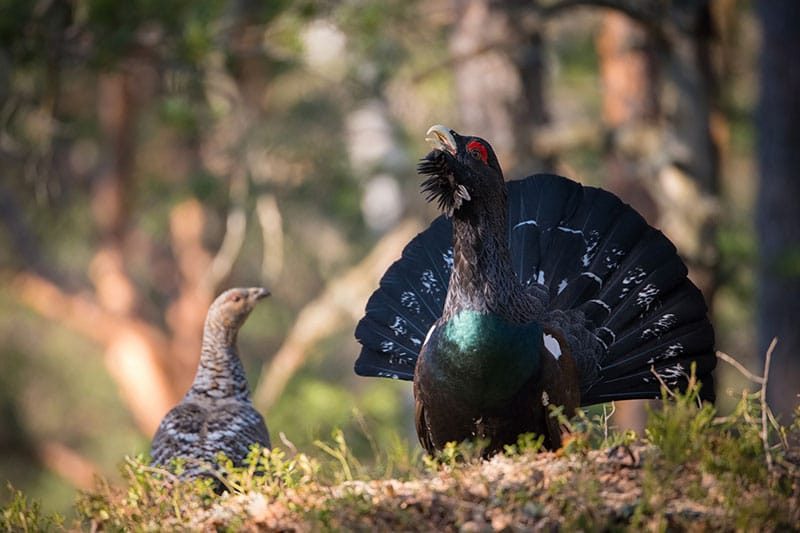
The capercaillie is a large gamebird about the size of a turkey that became extinct in the British Isles in the 1700s but Wass reintroduced from Sweden a century later. Its name comes from the Scottish Gaelic capall coille meaning ‘horse of the woodland”.
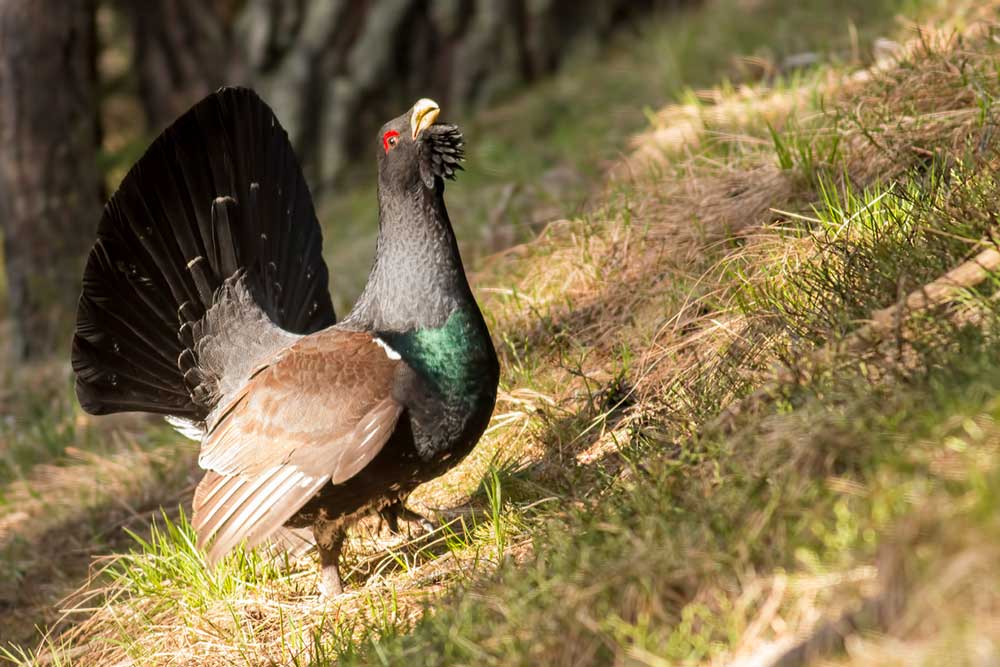
Males have dark grey plumage with glossy blue-green breasts, and dark brown wings with a white patch at the joint. Above the eye is a bright red comb while the bill is pale yellow. Females are much smaller with mottled grey and brown plumage with a rust patch under the chin.
It is known for its dramatic spring courtship displays when males gather in a ‘lek’ drumming, clicking, and displaying to attract females. They can also become aggressive chasing away people who enter their territories.
They are found in ancient Caledonian pine forests and commercial conifer tree plantations. Look out for them foraging on the ground for pine needles, berries, and grasses, and occasionally in trees eating shoots and buds.
The Eurasian beaver is Britian’s largest rodent, related to mice, rats, and voles, and the second heaviest in the world after the South American capybara, measuring up to 39 in in length and with a tail reaching 20 in. It has dense, brown fur, a flat, scaley tail, and orange front teeth.
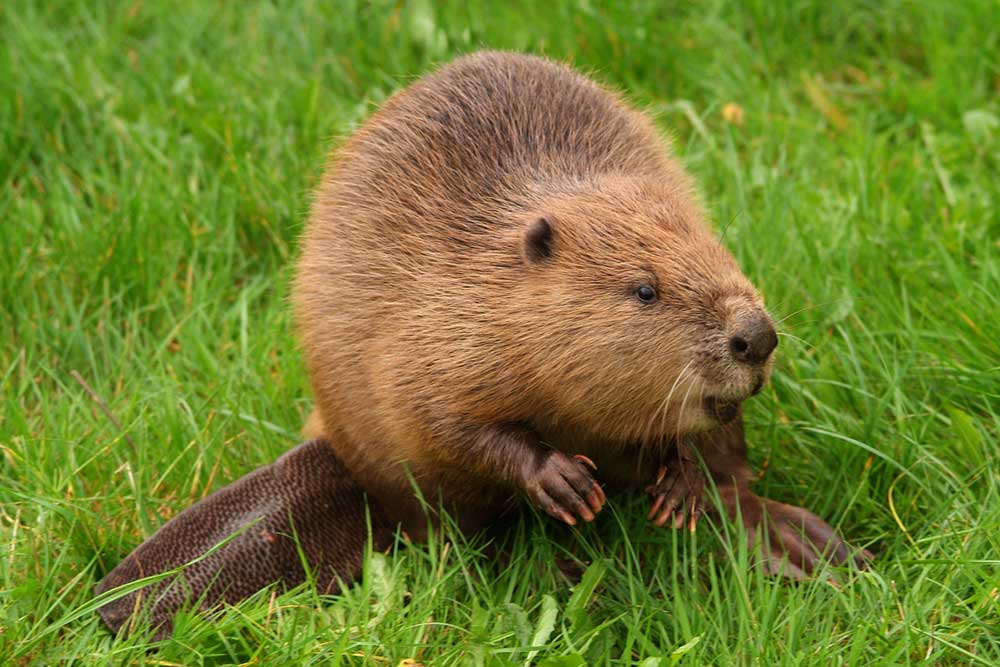
They became extinct in Britain about 400 years ago after being hunted for their soft fur, meat, and castoreum, a secretion from their scent glands that was used in perfumes and medicine.
Beavers play an important role in maintaining an ecosystem in which other wildlife can thrive. To protect themselves from predators they build dams across rivers which creates a deep pool of water in which they construct a small island called a ‘lodge’ from branches, vegetation, and mud, to deter land animals. Today, beavers in Britain have few natural predators such as bears and wolves, yet they still instinctively build lodges which can be as large as 30 ft in diameter requiring a dam of over 300 ft in width. The ponds and canals formed from constructing the dam provide important wetland habitats for birds, frogs, fish, and aquatic insects, and can also prevent flooding further down the river.
Officially reintroduced to Scotland in 2009, they are now considered a native species and have been given formal protection. They can be seen in the Knapdale Forest in Argyll, the River Tay catchment in Perthshire, and the Bamff Estate.
Also known as the arctic hare, the mountain hare is slightly smaller than the brown hare but larger than the rabbit. In summer, it has a grey-brown coat with a bluish tinge and turns white in winter to blend into the snowy landscape with only the tips of the ears remaining black. The tail is white all year round which distinguishes it from the brown hare.
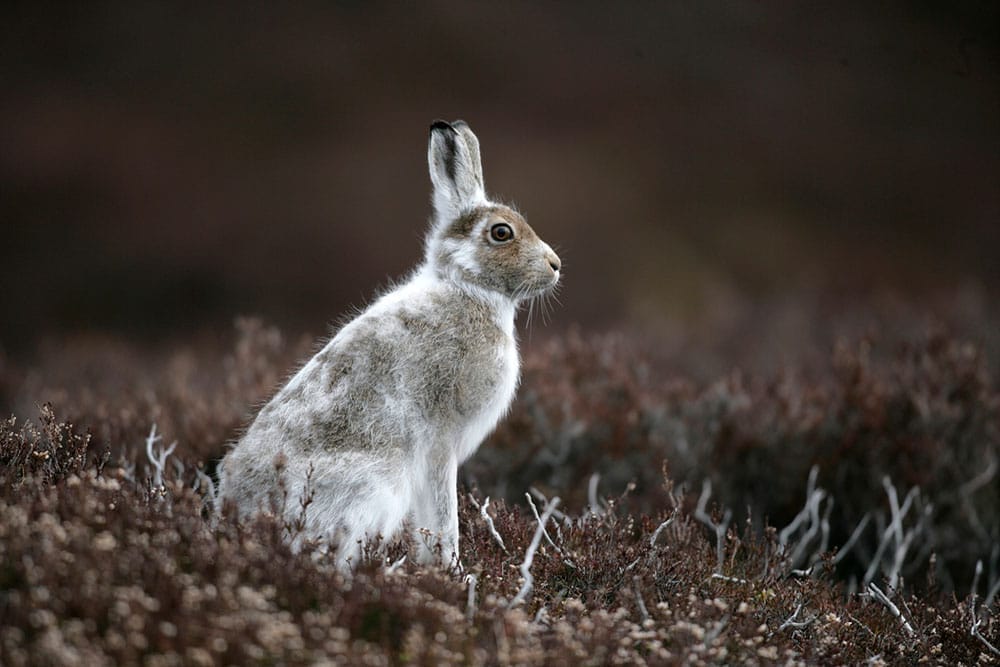
It is native to the Scottish Highlands but has been introduced to other parts of the British Isles including the Peak District and some Scottish Islands. A subspecies (Lepus timidus hibernicus) is found in Ireland which remains brown all year round.
Mountain hares are most visible in spring when the snow has melted but they have not yet shed their white winter coat. They can be found on heather moorland at altitudes above 980 ft in the Cairngorms National Park, the Monadhliath mountains, and the islands of Mull, Skye, Hoy, Jura, Harris, and Lewis.
Best Times to Visit: Spring and summer are excellent for viewing seabirds and dolphins, while autumn is best for red deer rutting. In winter, look for mountain hares in their snow-white coats and otters along the coast.
Bring Binoculars and Cameras: Many species, especially birds of prey, are best viewed from a distance, so binoculars or a zoom lens are invaluable.
Stay Quiet and Respectful: Wildlife watching in Scotland requires a respectful approach to avoid disturbing the animals. Following a “look but don’t touch” rule helps preserve the beautiful environment.
Visit Nature Reserves: Areas like RSPB reserves and Scottish Wildlife Trust sites provide the chance to see many of these animals, often with viewing platforms, hides, and knowledgeable staff to enhance your experience.