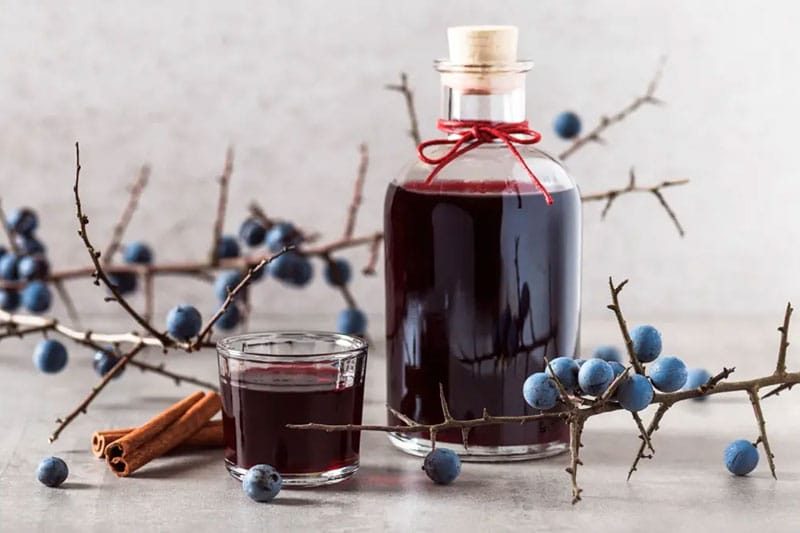
Sloe gin is a liqueur created by infusing gin with the fruit of the blackthorn. It’s a much-loved drink throughout the British Isles, especially in autumn and over the Christmas season.
The blackthorn (Prunus spinosa) is a large deciduous shrub belonging to the rose family. It has dark bark and dense, spiny branches, with oval, dark green leaves that have finely serrated edges. In spring, the blackthorn is covered in clusters of creamy white flowers, which are pollinated by insects. Although it usually grows as a bush, it can mature into a small tree, reaching heights of up to 20 feet. Blackthorn makes an excellent firewood that burns slowly with a good heat, producing very little smoke. Traditionally its wood was used to make walking sticks, and, in Ireland shillelaghs, thick cudgels historically used as weapons.
The fruit of the blackthorn, known as sloes, ripen in autumn, and are black with a deep blueish-purple, waxy bloom. The word sloe comes from the Middle English slo, derived from the Old English slah, which in turn traces back to the Proto-Germanic slaikhwon and the Proto-Indo-European sleiə-, meaning “blue”, “bluish”, or “blue-black”. People with dark eyes are sometimes described as sloe-eyed, a term that originates from the same root.
In parts of Scotland, sloes are still known as slaes, preserving the original pronunciation from before The Great Vowel Shift. This older form can be seen in the title of Alexander Montgomerie’s poem The Cherrie and the Slae, in which the poet faces a dilemma: whether to strive for the noble cherry tree on the crag or be content with the sloe bush at his feet.
Sloes are drupes, or stone fruits, similar to damsons or small plums, containing a single seed or kernel encased in a hard shell surrounded by a layer of flesh.
They have a high tannin content, which gives them an intensely sour, bitter taste when eaten raw and makes them highly astringent, drying the mouth. Despite their tartness, sloes have an underlying plum-like flavour, and like many other stone fruits, they also contain trace amounts of hydrogen cyanide.
We often think of sloe gin as a refined, comforting drink, something to be sipped in medicinal measures after an evening of carol singing, or enjoyed with something sparkling at a cocktail party. Yet its history tells quite a different story.
As we’ve seen, sloes themselves are far from sweet, and their sharp, bitter flavour means they were never subject to large-scale cultivation, unlike their much sweeter relatives, plums, damsons, cherries, peaches, and apricots.
Then, in the 17th century, Parliament began passing a series of Inclosure Acts that established property rights over what had previously been common land and open fields. As land was transferred into private ownership, farmers and landowners needed clear boundaries to enclose their holdings.

Hedgerows became the solution, and blackthorn, along with hawthorn and elm, was a popular choice thanks to its dense growth and sharp thorns, which served as an effective deterrent to trespassers. Before long, the countryside was criss-crossed with thousands of blackthorn hedges, and consequently, there was an abundance of these otherwise inedible fruits.
At the same time, the British government introduced legislation to restrict imports of brandy and promote domestic gin production, spurred by ongoing political and religious tensions with France. This policy eventually culminated in the infamous Gin Craze of the early 18th century, when magistrates condemned gin as “the principal cause of all the vice and debauchery committed among the inferior sort of people”.
Mixing gin with sloes at that time would likely have produced a concoction as unappealing as the ingredients themselves. However, another historical twist soon changed that. Britain’s expanding involvement in the sugar trade during the mid-17th century, when it took control of Caribbean islands such as Jamaica and Barbados, led to the establishment of vast sugar plantations. Tons of sugar began flowing into Britain through ports like Bristol and Liverpool, with more than a hundred refineries in operation by 1750.
With sloes in abundant supply, gin plentiful and cheap, and sugar becoming increasingly available, the conditions were ideal for industrious farmers to create a palatable liqueur from what had once been a harsh, inedible fruit. By infusing gin with sloes and sweetening it with sugar, the resulting drink transformed the sharp, astringent berries into something rich, warming, and pleasantly tart.
For many years, sloe gin was likened to a poor man’s port and in a poem published in 1717 by the satirical writer Ned Ward, homemade sloe gin was singled out for criticism.
Young Lasses spoil’d by Rakes and Bullies,
And old ones starv’d for want of Cullies;
Base Rings, and Spelter Trinkets sold
To Fools, for Silver and for Gold;
And to the great reproach of France,
Damn’d English Spirits vouch’d for Nantz:
Besides rare Wines of e’ery sort,
White, Claret, Sherry, Mountain, Port,
Tho’ none of’t e’er had cross’d the Seas,
Or from the Grape deriv’d its Lees,
But made at Home, ‘twixt Chip and Dash,
Of Sugar, Sloes, and Grocer’s Trash,
Or Cyder dy’d with Cochineal,
If Fame their Secrets can reveal.
From: British wonders: or, a poetical description of the several prodigies and most remarkable accidents that have happen’d in Britain since the death of Queen Anne.
It wasn’t until the late 19th century, when established distilleries began producing high-quality sloe gin, that the drink’s reputation started to improve, although for many years it was still primarily served neat as a Christmas digestive.
In the early 1900s, American bartenders discovered sloe gin and created the Sloe Gin Fizz, a riff on the popular Gin Fizz, combining sloe gin with lemon or grapefruit juice and sugar, which is shaken with ice, poured into a tumbler, and topped with carbonated water, a refreshing drink that can be enjoyed all year round.
The number of sloes produced each year varies according to the weather in the preceding spring and summer. If the conditions are too dry, the fruits remain small and shrivelled; if too cold and wet, they may fail to develop at all. A good crop requires just the right balance of warmth and moisture.
Traditionally, sloes were gathered after the first frost. It was believed that freezing made the fruit’s cell walls more permeable, converted some of the starches into sugars, and reduced the tannin content, resulting in a milder flavour. However, the first frost, typically in late October or early November, coincided with the fruit’s natural ripening, meaning these changes would have occurred anyway.
Nowadays, sloes tend to ripen well before the first frost, and if left too long, they are quickly eaten by birds. The best time to pick them is when they are fully ripe, which can be tested by gently squeezing the fruit between your thumb and finger. They should yield slightly to pressure, like other stone fruits, and come away easily from the branch.
Harvesting sloes can be tricky because of the blackthorn’s sharp, spiny branches. It’s wise to wear heavy-duty gardening gloves, long sleeves, thick trousers, and wellington boots to protect your arms and legs.
One useful technique is to hold an umbrella upside down beneath the bush and use a walking stick to gently pull the branches towards you. The sloes can then be plucked and allowed to drop into the umbrella before being transferred to a bucket or bag.
As with all foraging, take only what you need, leaving plenty for others and the wildlife that depends on them.
Another advantage of picking sloes after the first frost was that their skins became thinner, making it easier to prick each one – traditionally with a blackthorn thorn or silver needle – to help release the juices into the gin. However, this was always a time-consuming task, and thanks to modern technology, the freezer now does the job for us.

Freezing sloes replicates the effect of the first frost. As the fruit freezes, the skins split naturally, eliminating the need for pricking. Simply place the sloes in a freezer bag or plastic container and freeze them overnight. An added benefit of this method is that the fruit can be stored and used whenever you’re ready to make your sloe gin.
Despite having just three ingredients, there’s a surprising amount to consider when making the perfect sloe gin.
The first step is to find your sloes, which means making an autumn foraging trip. They are most commonly found in hedgerows along the edges of fields and woodlands. If you live in a town or city, don’t despair: blackthorn can also grow on scrubland, in parks, and along public footpaths. Sloes are fairly easy to identify, though they can be confused with wild damsons. The key differences are that damson bushes have no thorns and their fruit hangs from long branches, whereas sloes grow on short-stemmed, spiny bushes. Alternatively, you may find sloes for sale at farmers’ markets or online.
Choose your gin carefully. Poor-quality gin will not be rescued by the sloes. The aim is to complement and enhance the gin’s flavour while adding complexity. A juniper-forward London dry gin works beautifully, but you could also experiment with a gin that has warmer, spicier notes for a different depth of flavour.
For sloe gin, granulated or caster sugar is usually best, as it is neutral in flavour and easily available. For a richer, darker liqueur, demerara or muscovado sugar can be used, though they will alter both the colour and flavour. Resist the temptation to over-sweeten to mask the sharpness of the sloes, as this can prevent the natural fruit sugars and flavours from infusing properly, resulting in a syrupy, overly sweet drink. Another option is to leave out the sugar altogether during infusion and sweeten later with simple syrup once the gin has fully steeped.
Purists may recoil at the idea, but once you’ve mastered the classic sloe gin, there’s plenty of room to get creative. Warming spices such as cinnamon, star anise, cloves, or nutmeg add a festive note, while a vanilla pod or a few drops of vanilla extract can impart a smooth, sophisticated, and subtly sweet finish.
Citrus zest, from lemons or oranges, brings a bright lift that complements the deep, rich flavours, perfect if you plan to use your sloe gin in summer cocktails.
Other fruits, such as damsons, elderberries, or cherries, can be added alongside sloes to enhance the overall fruitiness. Almonds are another popular addition as the stones of the sloes naturally contain benzaldehyde, which gives an almond or marzipan-like flavour. A few crushed almonds or a drop of almond extract can help bring out this distinctive note.
500 g ripe sloes
250 g sugar (or less – see note above)
1 litre gin
Freeze the sloes overnight, then defrost them. Check each fruit, and if any skins haven’t split, prick them gently with a cocktail stick.
Place the sloes in a Kilner jar and pour over the sugar and gin.
Seal the jar and give it a good shake.
Store the jar in a cool, dry place. For the first week, shake the jar once a day to help the sugar dissolve completely.
After about three months, strain the sloe gin. The easiest method is to line a plastic sieve with muslin and place it over a bowl.
Decant the strained gin into bottles. Your sloe gin is ready to drink immediately, but it will continue to mature and improve over time. For the best flavour, try to make it a year in advance and enjoy it the following Christmas.