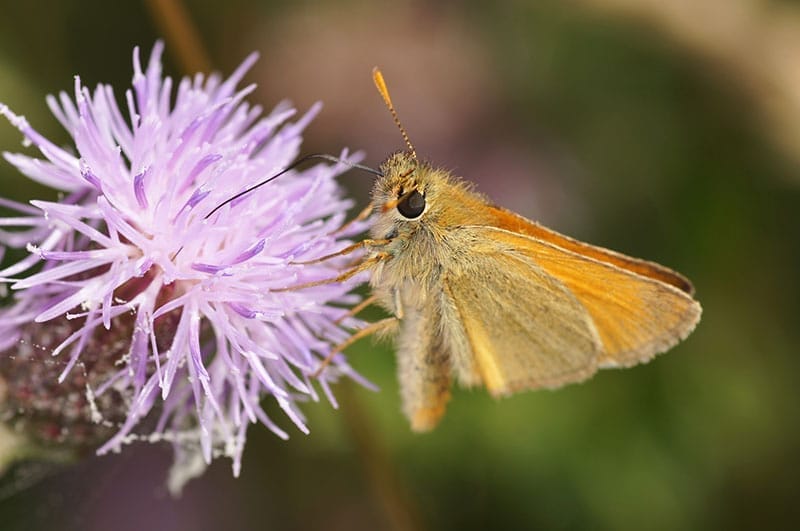
The small skipper is a compact butterfly with bright rusty-orange upper wings edged in a darker border with pale fringes. The underside of the wings is a silvery-white, while its body is brown with orange-tipped antennae. Males are easy to identify by the thin black line on each forewing, a streak of scent scales used to attract females.
Eggs are laid in July and August, with caterpillars hatching later in summer. The tiny larvae begin life by eating their own eggshells, then enter hibernation. They reawaken in spring and start feeding, favouring Yorkshire fog (Holcus lanatus), a flowering perennial grass, along with other grass species. After completing metamorphosis, adults take flight from late June to August, peaking during high summer.
Widespread across England and Wales, small skippers thrive in open countryside with long grasses, such as field margins, meadows, and woodland glades. They are excellent fliers but are often seen basking in the sun with wings held half open amongst tall vegetation. They are particularly fond of purple wildflowers, especially thistles and knapweed.
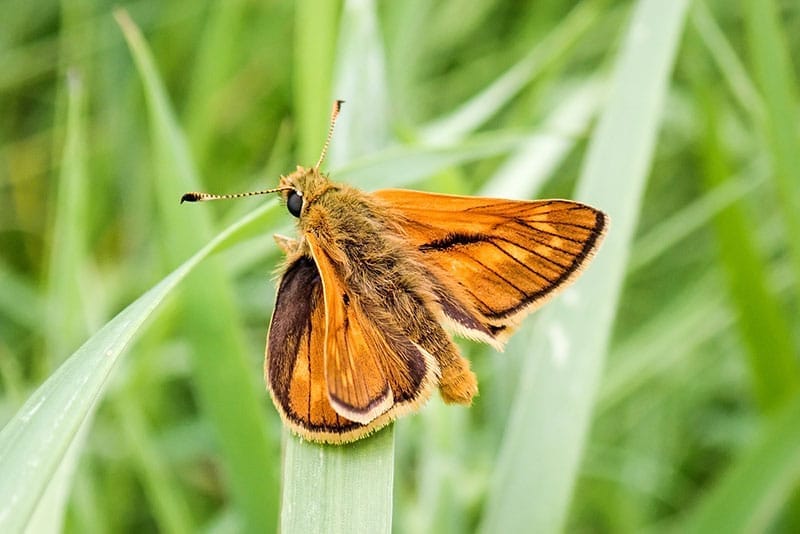
Only slightly bigger than the small skipper, the large skipper has russet-brown wings edged with dark patches and scattered with orange chequered marks. The underside is a muted greenish-yellow, with sparse pale spots. The male has a dark line across its forewing. A pair of hooked antennae and its distinctive markings help distinguish the large skipper from the other orange skippers.
Eggs are laid in July and August, hatching about two weeks later. The caterpillar creates a cocoon by rolling a leaf and sealing it with silk, where it hibernates through the winter as a half-grown larva. In spring, it re-emerges to feed, mainly on cock’s-foot (Dactylis glomerata), along with purple moor-grass (Molinia caerulea) and false brome (Brachypodium sylvaticum). Adults are on the wing from June to August.
Large skippers favour places with tall, uncut grasses, such as meadows, pastures, the edges of fields, and woodland clearings. They are also often seen in churchyards. Look out for them darting through vegetation and feeding on bramble flowers in hedgerows.
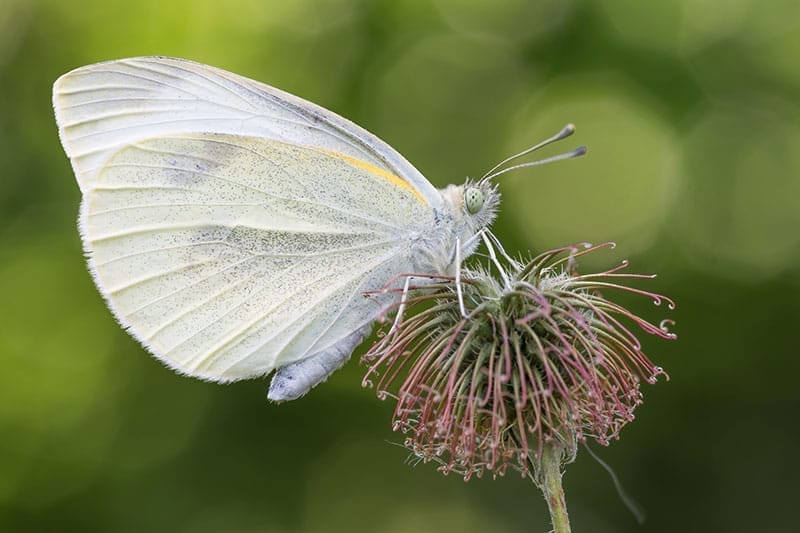
Also known as the Cabbage White, the large white is one of Britain’s most recognisable butterflies. Its brilliant white wings have black tips on the forewings, which extend down the edge, while the undersides are a soft creamy greenish-white, marked with two pale spots. Females also have two dark spots and a dash on each forewing,
Eggs are laid from late April to early September, usually in two broods per year, though a third is possible in warm seasons. They hatch in about a week, and the yellow-and-black caterpillars feed on wild and cultivated members of the Brassicaceae family, favouring cabbages, Brussels sprouts, cauliflowers, oilseed rape, and nasturtiums. Their colouring warns predators they’re toxic, having absorbed mustard oils from their host plants.
Adults are on the wing from April to October, and are widespread across the British Isles, though less common in northern Scotland. You’ll often spot them flying slowly through gardens, allotments, and farmland, especially where brassicas are growing.
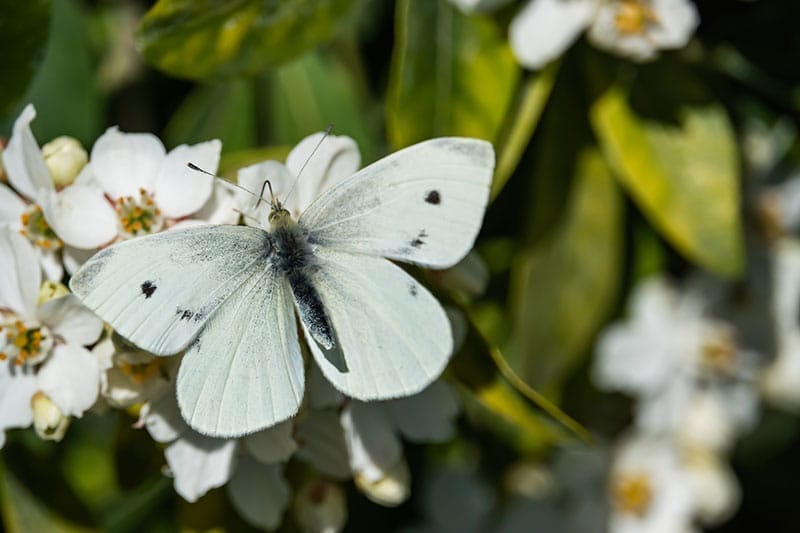
The small white butterfly resembles the large white, but has less black on the tips of its forewings. The upper sides of its wings are white, while the undersides are pale yellow with a scattering of black speckles. Like the large white, female small whites have two black spots in the centre of each forewing.
Adults can be seen flying from April to October with eggs laid by September. Caterpillar foodplants are similar to those of the large white, including cultivated brassicas and a variety of wild crucifers, such as wild cabbage (Brassica oleracea), charlock (Sinapis arvensis), hedge mustard (Sisymbrium officinale), garlic mustard (Alliaria petiolata), and hoary cress (Lepidium draba).
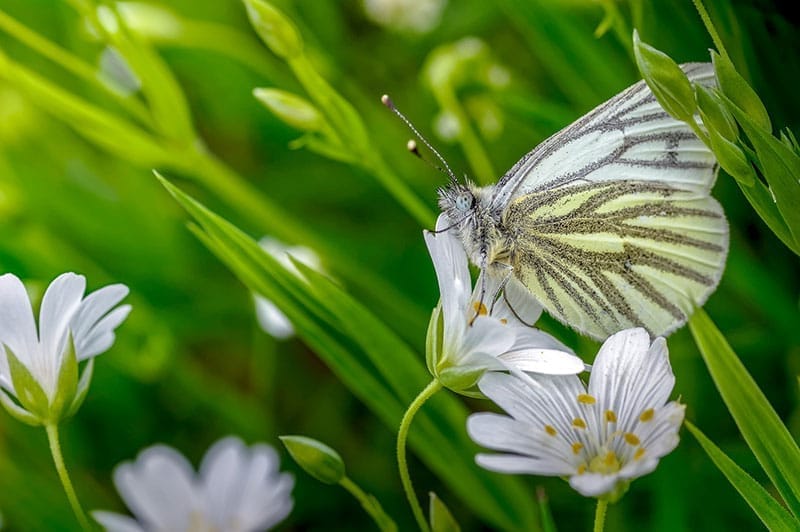
The green-veined white butterfly has white upper wings with black tips. Females have two black spots on each forewing, while males have just one. The undersides are pale yellow with prominent greyish-green veins, which distinguish it from the similar small white.
The first brood of eggs is laid in May, with larvae hatching two weeks later. After feeding for up to a month, the caterpillars pupate and emerge as adults after about two weeks. A second generation follows in late summer, with the pupae overwintering and emerging as adults the following spring.
Unlike other white butterflies, the caterpillars of the green-veined white rarely feed on cultivated plants, preferring wild crucifers such as watercress (Rorippa nasturtium-aquaticum) and wild radish (Raphanus raphanistrum). Adults can be seen flying from April to October. They are widespread across the British Isles and are commonly found in damp, lush habitats such as woodlands, ditches, riverbanks, lake and pond edges, and wet meadows.
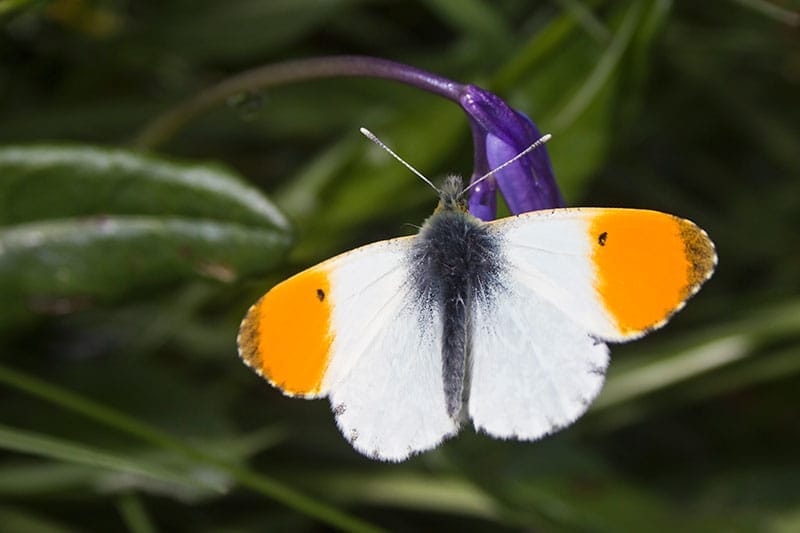
The orange-tip is a medium-sized butterfly. Males are easily recognised by the bright orange patches on their forewings, each tipped with pale grey. Females lack the orange, appearing white with black wingtips, but both sexes share mottled green underwings, that helps distinguish the female from the similar-looking small white.
It typically produces a single brood from May, though in years with an early spring in southern England a second brood may occur. Eggs are initially white, then turn orange, and finally brown within a few days, and are coated with a pheromone that discourages other females from laying on the same plant. Like other white butterflies, orange-tips prefer crucifers, especially cuckooflower (Cardamine pratensis) and garlic mustard (Alliaria petiolata), though they will also use honesty (Lunaria annua) and dame’s-violet (Hesperis matronalis), where survival rates are thought to be lower. Caterpillars pupate in July and overwinter as chrysalides, emerging as adults the following spring.
Adults are on the wing from April to July. Males and females tend to frequent different habitats: males are a familiar sight along woodland edges and hedgerows, while the more elusive females are found in open meadows.
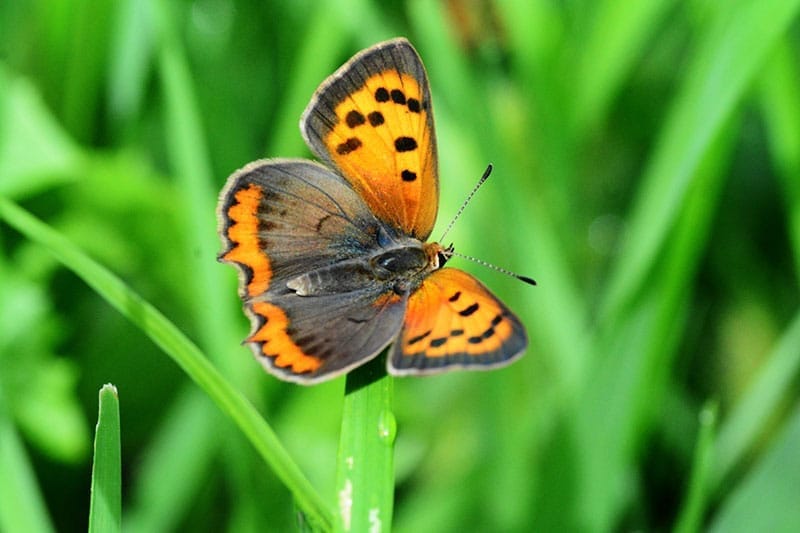
The small copper butterfly has bright orange forewings edged with a broad dark brown stripe and marked with eight or nine dark spots. The hindwings are dark brown with an orange border, and some females (L. p. eleus ab. caeruleopunctata), may also have a row of blue spots. The underwings mirror the pattern of the upper side but are paler, with black spots outlined with yellow and the darker areas grey-brown.
It produces two or three broods each year. Its main food plants are common sorrel (Rumex acetosa) and sheep’s sorrel (R. acetosella), though broad-leaved dock (R. obtusifolius) is sometimes used. Caterpillars are green, and some have a purple stripe along the back. The species overwinters as a caterpillar, with pupation occurring in the leaf litter.
Adults are on the wing from April to October, and occasionally into November. They occupy a wide range of habitats, including chalk downs, grassland, heathland, moorland, and woodland clearings. Males are territorial, often seen basking on rocks and chasing away other insects that stray into their domain.