
The saying “Red sky at night, shepherd’s delight. Red sky in the morning, shepherd’s warning” can be traced back as far as the Bible, appearing in Matthew 16:2–3. Variations of the proverb also exist, including “Red sky at night, sailors’ delight. Red sky in the morning, sailors’ warning.”
In many cases, a red sunset does suggest fine weather the following day, but this is mainly true in regions where weather systems generally move from west to east, including most mid-latitude areas such as the British Isles. A red sky occurs when dust and small particles trapped in the Earth’s atmosphere by high pressure scatter shorter blue wavelengths of light, allowing the longer red wavelengths to dominate the sky’s colour.
A red sky in the evening indicates that high pressure, which is typically associated with settled, clear conditions, is approaching from the west, the direction of the setting sun. As a result, fair weather is likely the next day.
Conversely, a red sky in the morning suggests that the high-pressure system has already passed overhead and is moving away, to be replaced by lower-pressure air arriving from the west, bringing cloud, rain, and potentially stormy weather.
The old saying “Oak before ash, in for a splash; ash before oak, in for a soak” suggests that if oak trees come into leaf before ash trees, summer will bring only light rain, whereas if ash leafs first, summer will be a washout.
Both species come into leaf between late March and May, although the exact timing varies. Oak trees respond mainly to temperature, while ash trees are more strongly influenced by increasing daylight hours. As a result, an early, warm spring, with higher temperatures in February and March, often leads to oak leafing first. If colder weather persists into April and early May, ash is more likely to leaf before oak.
Historical records indicate that oak leafed before ash around 70% of the time. However, recent studies suggest this proportion has increased significantly, with ash now rarely leafing first due to rising spring temperatures.
Despite modern advances in meteorology, long-range weather forecasting remains notoriously difficult, and there is no proven link between spring conditions and the weather that follows in summer. A similar saying exists in Germany: “Blüht die Esche vor der Eiche, gibt es eine große Bleiche. Blüht die Eiche vor der Esche, gibt es eine große Wäsche,” meaning, “If the ash blossoms before the oak, there will be a very dry summer; if the oak blossoms before the ash, there will be a very rainy summer.” However, this prediction is the exact opposite of the British saying, highlighting that there is little scientific basis in the proverb.
The saying “Rain before seven, fine by eleven” is an optimistic promise that if you wake to heavy rain, you may only have to endure it for a few hours before brighter weather arrives. While far from foolproof, there is some truth behind the proverb, largely due to the fast-moving weather systems that frequently affect the British Isles.
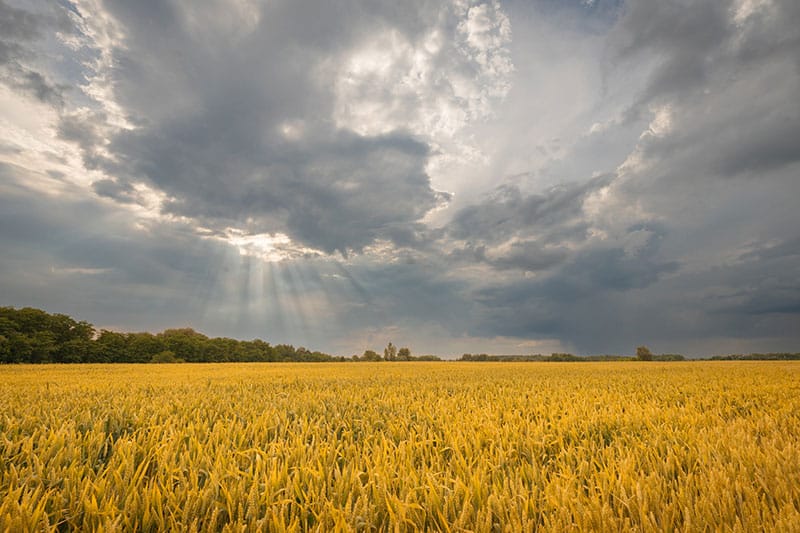
Bands of rain often take three to four hours to pass through, meaning early morning rain has usually cleared by mid-morning. However, the saying is most reliable when the rain is light or drizzly and accompanied by a steady breeze. During periods of heavier rainfall, or when winds are light and weather systems move more slowly, wet conditions can linger for much longer.
St Swithin was an Anglo-Saxon Bishop of Winchester who later became the patron saint of Winchester Cathedral. He was consecrated in October 852 and, although little is recorded about him during his lifetime, his death in July 863 was noted in the Canterbury manuscript of the Anglo-Saxon Chronicle. Today, his name is most closely associated with a well-known piece of weather folklore claiming that if it rains on St Swithin’s Day, the 15th of July, it will continue to rain for the following forty days.
St Swithin’s day, if thou dost rain,
For forty days it will remain.
St Swithin’s day, if thou be fair,
For forty days ’twill rain no more.
A Buckinghamshire variation runs:
If on St Swithun’s Day it really pours,
You’re better off to stay indoors.
The origins of the proverb are uncertain, although a popular 17th century theory suggests that when St Swithin’s remains were moved from an outdoor grave to a new indoor shrine, a torrential downpour followed, said to be the saint expressing his displeasure at being disturbed.
There is, however, a degree of scientific reasoning behind the saying. Around mid-July, the jet stream often settles into a relatively stable pattern that can persist until late August. When the jet stream lies to the north of the British Isles, continental high pressure, which typically brings clear skies and settled weather, can dominate. When it shifts across or south of the islands, Arctic air, and Atlantic low-pressure systems are more likely to prevail, bringing cloud, rain, and stronger winds.
Despite this, meteorological records dating back to 1861 show that there has never been a recorded instance of forty consecutive days of either rain or sunshine following the 15th of July.
Around 60% of the British public believe that a field of cows lying down is a sign that rain is on the way. Several theories have been suggested to explain this supposed connection. A 2013 study in the United States found that cows tend to stand during hot weather, as exposing more of their skin helps them cool down more efficiently. This led to the idea that when temperatures drop ahead of rainfall, cows may lie down to conserve heat. Another theory proposes that cows can sense approaching rain through rising humidity or falling air pressure and lie down to keep a patch of grass dry for grazing later.
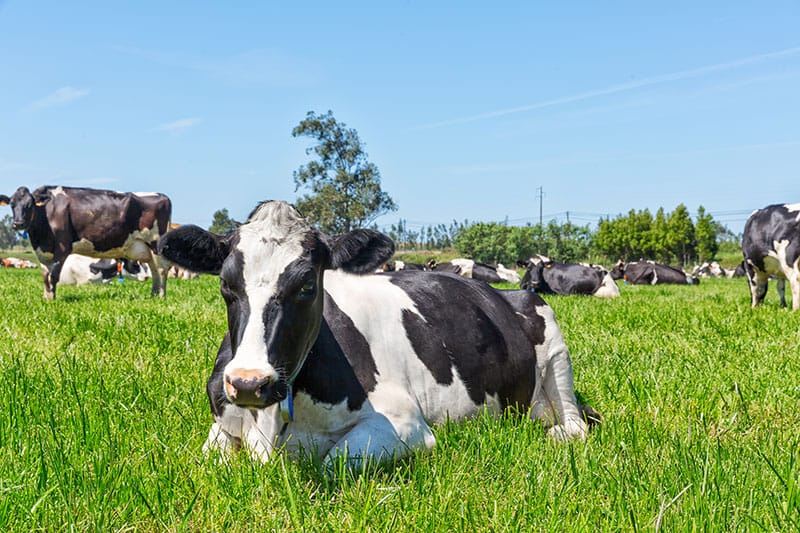
However, there is no solid scientific evidence to support this piece of weather folklore, and the association is most likely coincidental. Cows spend roughly half their lives lying down, either resting or chewing the cud, meaning there is about a fifty–fifty chance they will be lying down at any given time. In a country where rain occurs somewhere between 30% and 50% of the year, depending on the region, it is hardly surprising that cows lying down often coincides with wet weather on the way.
One of the earliest recorded appearances of the proverb “March comes in like a lion and goes out like a lamb” can be found in Gnomologia: Adagies and Proverbs; Wise Sentences and Witty Sayings, Ancient and Modern, Foreign and British, a compendium published in 1732 by the English physician, writer, and preacher Thomas Fuller. The saying has since become widely known across the British Isles and has also spread to North America, where it frequently appears in farmers’ almanacs.
The proverb neatly captures March’s famously changeable weather as the month marks the transition from winter to spring. Traditionally, the first half of March is associated with fierce, wintry conditions, like a lion, while the latter half is expected to be gentler and more settled, like a lamb. A reverse version of the saying also exists, describing a mild start followed by colder or stormier weather, sometimes referred to as a “false spring”, which can occur when the polar jet stream shifts southwards during March.
For farmers and gardeners, a false spring can be particularly damaging. Warm conditions may encourage plants to emerge from dormancy too early, only for a sudden cold snap to kill fragile new growth. Even when plants survive, the energy spent repairing frost damage can reduce their ability to produce flowers and fruit later in the season.
Some believe the expression may also have astronomical origins, linking it to the constellations Leo, the lion, rising in the east at the beginning of March, and Aries, the ram, setting in the west towards the month’s end.