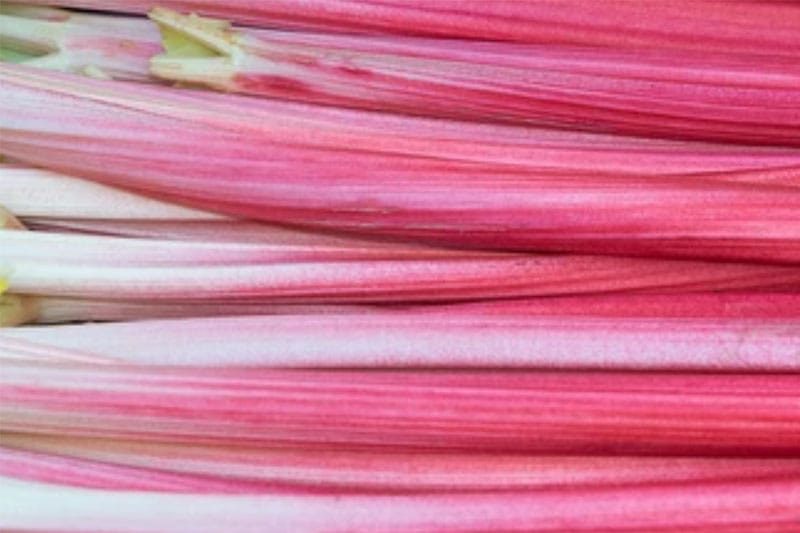
Forced rhubarb is one of Britain’s most distinctive agricultural products. Grown in complete darkness and harvested by hand during the winter months, it is prized for its rose-pink colour, tender texture, and delicate flavour. Unlike field-grown rhubarb, forced rhubarb appears early in the year, forced out of its natural winter hibernation, using similar techniques that are used for producing the white asparagus and endive so beloved by the French. Over time, it has become closely associated with Yorkshire, where unique growing conditions and long-established traditions helped shape its development.
Although botanists and horticulturists do not agree on the exact taxonomy of rhubarb, it is widely regarded as a perennial vegetable. Today it is grown primarily for culinary use, but for much of its history it was valued for its medicinal properties.
Varieties of rhubarb have played an important role in Chinese medicine for thousands of years, with the dried roots used chiefly to aid digestion, but also to clear heat and treat pain caused by blood stagnation, including that resulting from injury.
The earliest references to rhubarb in Western literature date to the mid-first century AD and indicate that it was not cultivated within the Roman Empire, but imported from the East, where its medicinal use was already well established. In De Materia Medica, a pharmacopoeia of medicinal plants written by a Greek physician serving in the Roman army, a plant known as “ribes” is praised as a mild laxative. There is, however, some debate as to whether this refers specifically to Rheum ribes or to another related species.
Over time, rhubarb became an important commodity along early trade routes, including the Silk Road, and by the tenth century, rhubarb appears in the Canon of Medicine by the Muslim physician Avicenna, who described its ability to cure indigestion, regulate bowel movements, and relieve menstrual cramps. Due to the expense of transporting it from Asia, rhubarb commanded prices several times higher than those of other prized herbs and spices, including saffron and cinnamon, and was valued on a par with silk, musk, rubies, diamonds, and pearls.
Rhubarb is thought to have arrived in Britain by at least the sixteenth century and is mentioned by William Shakespeare in Macbeth, in which the doctor is asked whether he knows of a laxative powerful enough to purge Scotland of the English:
“What rhubarb, senna, or purgative drug,
Would scour these English hence?”
Its high price and growing demand among apothecaries encouraged attempts to cultivate rhubarb in Europe. It was first introduced to Scotland in 1763 by John Hope, King’s Botanist to George III, who received seeds of Rheum palmatum from Dr James Mounsey, having brought them from the physic garden in St Petersburg.
Rhubarb thrived in Britain, being well suited to the cool, wet climate and cold winters that mirror its Siberian origins. Before long, a patch of rhubarb could be found in almost every garden. This abundance, combined with the increasing availability of cheap sugar, led to rhubarb’s use as a food. Several early nineteenth-century recipes include rhubarb, including one found in Maria Eliza Rundell’s A New System of Domestic Cookery, published in 1806.
Rhubarb Tart
Cut the stalks in lengths of four or five inches, and take off the thin skin. If you have a hot hearth, lay them in a dish, and put over a thin syrup of sugar and water, cover with another dish, and let it simmer very slowly an hour—or do them in a block tin sauce-pan.
When cold, make into a tart, as codlin [a variety of cooking apple]. When tender, the baking the crust will be sufficient.
However, it was one man who pioneered its widespread adoption in the kitchen.
Joseph Myatt was born in 1771 in Maer, a rural village south-west of Stoke-on-Trent. Little is known about his childhood, but the fact that he could read and write and later conduct business suggests that he received some formal education.
There are no records of his employment before the age of thirty, but by that time he was working in the gardens of Prestwold Hall, a large country estate in Leicestershire. In 1809 he moved his family to Rosehill Park in East Sussex, now known as Brightling Park, where he became head gardener. At the time, Rosehill Park was the home of the well-connected MP John Fuller, a wealthy and eccentric bachelor who was a generous patron of the arts and sciences. Among Fuller’s notable friends was J. M. W. Turner, and he was related by marriage to Capability Brown, the most celebrated English landscape designer of the period. During Myatt’s tenure at Rosehill Park, gardening tastes were shifting from formal European designs towards a more natural, pastoral style.

This period also saw a significant expansion of the middle classes in England, driven by industrial development and a growing capitalist economy, which allowed increasing numbers of people to advance through education, skill, hard work, and ambition. Myatt’s character was well suited to this environment, as evidenced by his rise from a small rural village to positions of responsibility at grand country estates. Eventually, he resolved to stop working for others and seek his own fortune. In 1814, he left Rosehill Park to grow fruit and vegetables for the London produce markets.
The Myatt family moved to Camberwell in Surrey, where Joseph established his own market-garden business. He cultivated a wide range of fruits and vegetables, selling them at Borough Market in London. Alongside established varieties, he applied his considerable expertise in plant propagation to develop several new cultivars, including Myatt’s Early Offenham cabbage and Myatt’s Ashleaf potato.
It was during his time in Camberwell that Myatt began experimenting with rhubarb, having received a few dozen roots imported from Russia from his friend Mr Oldacre, gardener to Sir Joseph Banks, the renowned naturalist, botanist, and patron of the natural sciences. Myatt set about producing hybrids of large cultivars with differing colour, flavour, and texture, specifically intended for cooking. Even so, early cooking rhubarb remained tough and sharply sour, requiring large amounts of sugar to make it palatable, and contemporary accounts report that Myatt was ridiculed by fellow greengrocers and market gardeners as “the man who sold laxative pie”.
Although the practice of forcing plants was already known in horticulture allowing growers to produce crops earlier than normal by manipulating temperature and light conditions, its application to rhubarb was discovered by accident. According to the story, a gardener at the Chelsea Physic Garden inadvertently left an upturned bucket over a rhubarb plant and later found that it had produced sweeter, more tender stalks.
With this new technique, the popularity of cooking rhubarb increased rapidly, and through Myatt’s persistence it became a staple of Victorian tables, appearing in pies, tarts, jams, puddings, and wines. Before long, London was encircled by fields of rhubarb, fertilised with ‘night soil’- human waste collected from the city’s cesspools and privies – and watered by the abundant supply from nearby canals.
In 1838, The Gardener’s Magazine reported:
“From Mr Myatt of Deptford, stalks of a new kind of rhubarb, called the Victoria. It appeared to be a variety of Rheum hybridum, of enormous size; the leafstalks were each 2 ft. 8 in. long, and 6 in. in circumference, and twelve of the stalks weighed 46 lb.
Few vegetables have made a more rapid progress in their cultivation, within the past twenty years, than this article, and we yet expect to see it cultivated by the hundred acres and brought to our market in wagon loads.“The edible kinds were first introduced in the London market by Mr. Myatt, about 20 years ago, and it is now in high demand. Among the varieties may be named Tobolsk, Washington, Giant, Mammoth, Myatt’s Victoria, Large Early Red, Myatt’s Linnaeus, and many more recently introduced seedlings.
“Myatt’s Linnaeus is the largest and best Rhubarb known. It maintains its colour after being cooked, and requires less sugar than other sorts. Many of the Rhubarbs form a mass or magma by cooking, but the Myatt’s Linnaeus scarcely changes its figure, and is still more tender and less stringy than any of the other sorts.”
By the end of the nineteenth century, rhubarb had become so popular in Britain, Europe, and America that demand outstripped supply.
As London expanded and the railway network developed, the city no longer depended on the market gardens that once surrounded it, as fresh produce could now be transported quickly from the real countryside. Rhubarb production consequently shifted north, and a nine-square-mile area between Wakefield, Morley, and Rothwell in Yorkshire proved to be particularly well suited to its cultivation. Known as the Yorkshire Triangle, the region offered ideal conditions: fertile soil, a reliable water supply from the Pennines, and plentiful shoddy – a nitrogen-rich by-product of the wool industry – used to mulch the fields.
Rather than using buckets or bell-shaped terracotta pots to force rhubarb, Yorkshire growers scaled up production by constructing long, windowless forcing sheds capable of housing thousands of plants. Beneath many of these sheds lay coal mines, which provided an inexpensive source of fuel to heat them.
Forced rhubarb is produced by lifting mature crowns after they have been exposed to winter frost, which induces dormancy. The crowns are then transferred to warm, dark sheds, where the sudden change in conditions triggers rapid growth. Under optimal conditions, rhubarb can grow more than an inch a day, fast enough to be heard popping and creaking as the stalks stretch upwards in search of light that never comes. The absence of light prevents the formation of chlorophyll, resulting in long, smooth, pale pink or red stalks with yellow leaves, and instead of being used to produce large green leaves, sugars remain concentrated in the stalks, giving forced rhubarb a sweeter, more delicate flavour than its outdoor-grown counterpart.
Within just two months, forced rhubarb can reach over three feet in height, and growers must monitor it carefully to ensure it is harvested at precisely the right moment. Inspections are traditionally carried out by candlelight, as stronger illumination could disrupt the process. The technique demands careful timing, experience, and intensive manual labour, which is why forced rhubarb production remains the preserve of specialist growers.
In 2010, the exceptional reputation of forced rhubarb grown within the Yorkshire Triangle was formally recognised with the award of Protected Designation of Origin (PDO) status, helping to safeguard traditional production methods and the region’s distinct identity.