Around 40 per cent of the world’s grey seal population live in British waters and a significant number of common or harbour seals also call the islands home. They’re found along much of our coastline but also venture into estuaries and rivers too. Other species of seals, such as the harp seal, hooded seal, and ringed seal are very occasional visitors to the British Isles, but any sightings of these species are extremely rare.
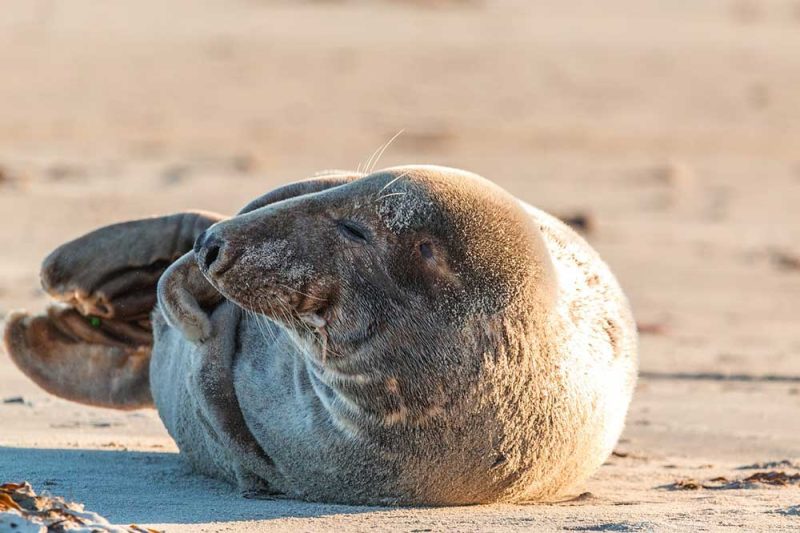
The grey seal has a robust, elongated body with a thick neck and a broad, rounded head. Its coat is typically grey or brownish-grey, but it can vary widely, with darker spots or patches on a lighter background or vice versa. Males tend to be darker and much larger than females, with a more prominent, arched nose, giving them a “Roman” profile, whereas females have a more delicate face with a flatter nose. Their scientific name Halichoerus grypus literally translates as ‘hook-nosed sea pig’ due to their distinctive facial features.
It has large, dark eyes, and short whiskers that help it detect prey. Its flippers are long and webbed, helping it swim efficiently, while on land, it often appears clumsy.
At birth, grey seal pups have a thick, fluffy white coat known as “lanugo,” which is shed after a few weeks as they grow and develop their waterproof, darker fur.
The common seal is smaller and rounder than the grey seal, with a more dog-like face and a distinctive “V” shape to their nostrils. They are variable in colour with coats ranging from blonde to black but are usually grey or brown with fine speckled patterns.
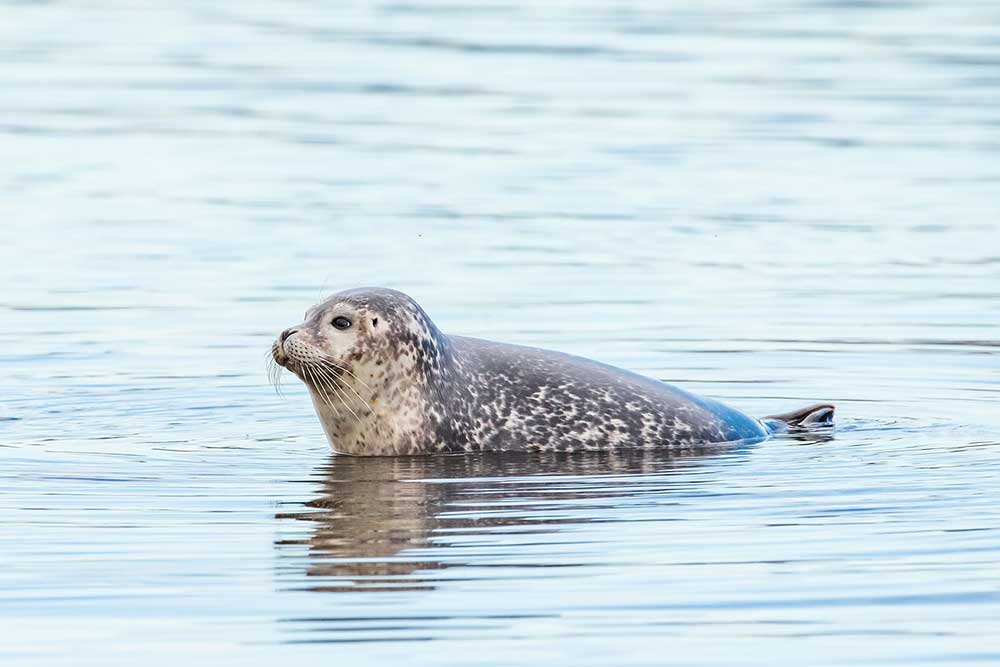
Unlike grey seals, common seal pups shed their fluffy coat while they are inside the womb, so when they are born, they are ready to swim within hours.
The best time to spot seals on land is during their pupping seasons, when they haul out onto beaches to give birth and care for their pups. Grey seals pup in the autumn and winter, and harbour seals give birth in the summer. In England, grey seal pubs are born between September and October in the south west and during December on the west coast, while in Scotland they typically give birth from October to December. In Wales grey seals can start pupping as early as August and in Northern Ireland, September is the best time to see them.
Both species of pup stay with their mothers for just a few weeks. During the nursing period, common seals spend time with their mother in the water learning to swim and dive from an early age.
Grey seal pups stay on the beach, feeding on their mother’s milk until she departs to mate again and returns to the sea. Once weaned, the pup sheds its white coat, and increasing hunger eventually compels it to venture into the water in search of food.
You can also see seals all year round on land particularly during low tide when the haul out onto rocks, sandbanks, and beaches to rest, warm up, or escape predators. Keep an eye on the water too, as they can often be seen ‘bottling’, bobbing around vertically or horizontally with just their head or back above the surface, allowing them to sleep at sea while keeping their airways exposed. You may also see them playfully swimming or hunting for fish around harbours and the bottom of cliffs.
The Farne Islands are home to a large colony of grey seals, with about 3,000 pups born each autumn. They can be seen all year round basking on the rocky outcrops or swimming in the surrounding waters. Boat trips operate from Seahouses harbour to view the seals, as well as vast numbers of seabirds such as puffins, terns, guillemots, and shags that gather on the cliffs to breed. Small numbers of common seals live on nearby Holy Island and around the Teesside estuary.
Stay nearby – coastal farm stays in Northumberland
Home to England’s largest grey seal colony, around 9,000 pups are born at Blakeney Point between the end of January and the middle of January. The best way to view them is by joining a boat tour from Morston Quay. Common seals pup at the Point during the summer, when the nature reserve also plays host to little, common, Arctic, and Sandwich terns performing their elaborate aerial mating displays
Stay nearby – coastal farm stays in Norfolk
Uninhabited by humans, the Monach Isles are home to one of the world’s largest breeding colonies of grey seals with about 10,000 individuals hauling onto the beach each autumn. Several companies run day trips to the Monach Isles from Uist, from where you may also get the chance to spot dolphins and minke whales in the water.
Stay nearby – coastal farm stays in the Scottish Islands
Covering a stretch of coastline between Grainthorpe Haven and Saltfleet, Donna Nook is a nature reserve comprising sand dunes, mudflats, and salt marshes. From late October to December grey seals come to pup at the foot of the sand dunes with a special viewing area erected so visitors can observe them safely. During winter, large flocks of fieldfares, redwings, and starlings also arrive to feed on sea buckthorn berries.
Stay nearby – coastal farm stays in Lincolnshire
The Moray Firth is home to both species of seals, where they can be seen all year round hauled out on sandbanks, rocky beaches, and harbours. Visit in June and July to see common seals pup and October and November to see grey seals. Other marine life to look out for include bottlenose dolphins, harbour porpoises, and basking sharks.
Stay nearby – coastal farm stays in Highland
Between 500 and 700 pups are born on Ramsey Island between August and November making it the largest grey seal pupping site in southern Britain. On the opposite side of St Bride’s Bay, is Skomer island where recent conservation efforts have seen a significant increase in the grey seal population with over 250 pups born annually. Both islands are important bird sanctuaries home to breeding seabirds, choughs, and peregrine falcons.
Stay nearby – coastal farm stays in Pembrokeshire
Seals are large, powerful mammals with bulls weighing as much as 50 stone, and can be intimidating close up. They can move surprisingly quickly and, having sharp teeth similar to a dog, can inflict nasty bites. Seals can be playful around humans but could seriously injure you if they are spooked, stressed, or think you are trying to attack them.
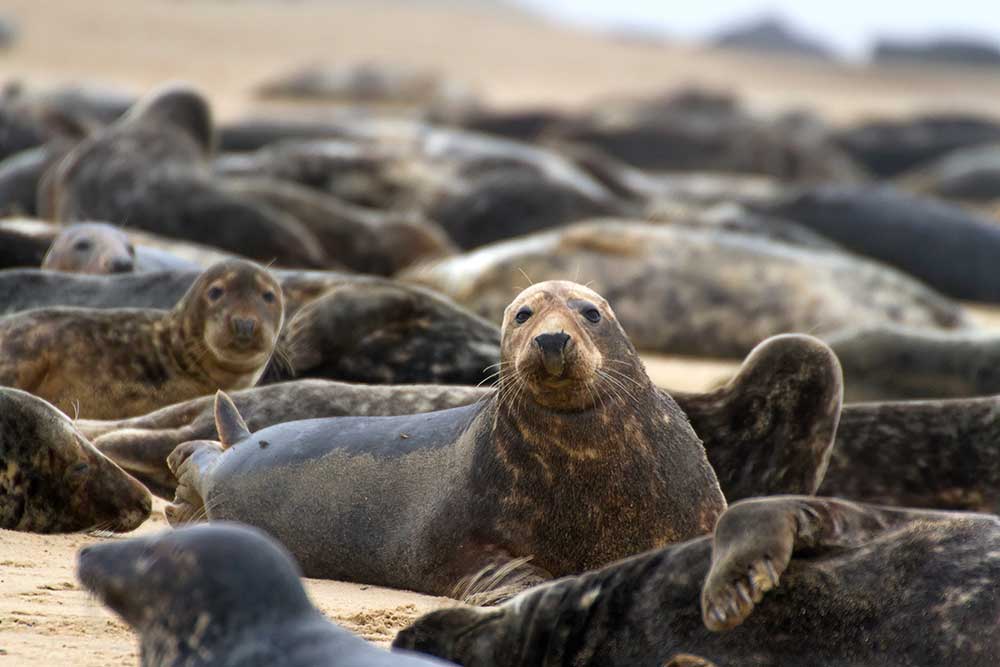
Avoid entering the sea to swim near hauled seals and if you encounter one in the water keep your distance, move around slowly, and don’t make loud noises. They may come and investigate, exploring you with their flippers, whiskers, and mouths, but never reach out to touch them which may startle it. If they show signs of becoming agitated, back away gently and avoid eye contact.
Don’t feed wild seals either. They are perfectly capable of finding their own food and as fast learners, just one feed could change their behaviour for life, reducing their natural fear of humans.
Avoid getting too close to seals Mothers with pubs can be very protective and may abandon her pub if it smells of humans. During pupping season, many beaches and rookeries will have signs or fenced-off areas to protect the seals. Make sure to respect these zones and use a pair of binoculars or a telescope if you want to get a closer view.
Dogs can alarm seals so are best left at home. If you must bring your dog keep it on a short lead and if it starts barking or trying to approach the seals move away.
The best time to see seals on a beach is at low tide so check tide times before you go
Dress in warm, waterproof layers as coastal weather can be unpredictable, and even in summer, it can be chilly near the water.
One of the best ways to see seals up close without disturbing them is to join a guided boat tour. These tours are led by knowledgeable guides who can help you spot the seals and provide insights into their behaviour and habitat.