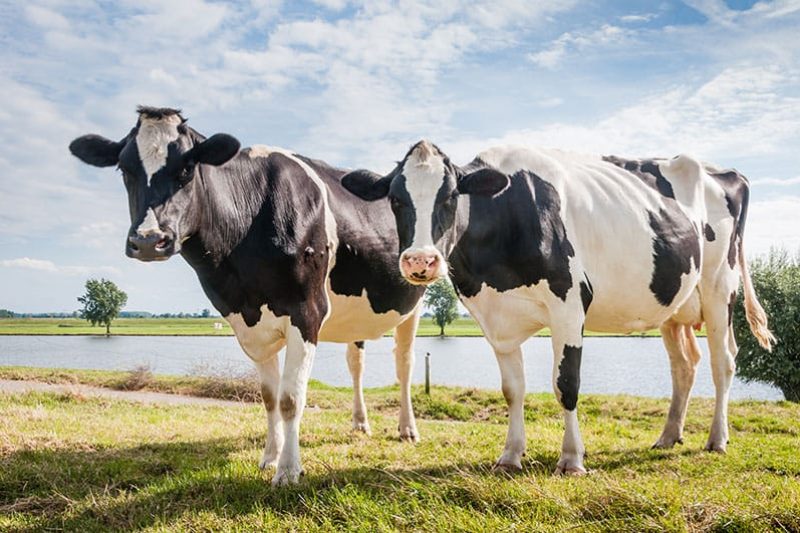
There are about 1.8 million dairy cows in the UK looked after by over 10,00 farmers producing the milk for your tea and coffee, butter for your toast, cream for your scones, yogurt for a healthy snack, ice cream for a treat, and award-winning cheese to enjoy with your wine.
If you’re planning on a holiday to a dairy farm, you may have the chance to see up close how all this milk is produced, which according to DEFRA is an average milk yield per cow of 8,215 litres a year or 11,456 pints, the equivalent of about 31 pints a day.
Before you go, take a look at our guide to find out how dairy farmers get the most from their cows. For example, the most common dairy breed in Britain, the Holstein-Friesian cow produces over 40 pints a day, a significant increase since the 1970s when the average daily yield was just 21 pints.
The main reason for the increase in milk production is selective breeding. Dairy farmers have always bred cows that produce the most milk, but modern techniques such as artificial insemination or genomics where DNA markers can be used to predict certain traits in both bulls and cows have accelerated this process over the last 50 years. Unfortunately, this has led to an increase in health problems such as lameness, issues with udders, and reduced fertility so current goals focus more on efficiency, balancing productivity with increased sustainability and resistance to disease.
Other traits that farmers select for in dairy cows include high butterfat, which is responsible for the flavour, texture, and creaminess in products like butter, full fat yogurt, and ice cream, better feed conversion, longevity, and reduced methane emissions.
The other important factor that influences milk production is diet. Dairy farmers need to ensure that food can deliver an adequate supply of nutrients to meet a cow’s needs and can be fed effectively with the equipment and facilities available while achieving a balance of ingredients that will optimise milk production.
High protein diets are essential for a cow to produce large amounts of milk, but if a cow only eats grass and other plant matter, where does its protein come from?
The answer lies in rumination, the natural process of regurgitating, re-chewing, and re-swallowing partially digested food known as the cud.
After water is removed grass typically contains about 20% crude protein, which is measured by multiplying the nitrogen content by 6.25. Crude protein consists of both true protein and nonprotein nitrogen compounds.
Although it’s a misconception that humans don’t get any protein from plant-based foods, the percentage is very small. As well as water and protein, plants contain cellulose, a tough carbohydrate forming the cell walls. Humans are unable to digest cellulose so most of it passes through the gut as fibre.
When cows eat grass, the cellulose is stored in the rumen, the first and largest compartment of its stomach. Millions of microorganisms including bacteria, protozoa, and fungi, live in the rumen, which produce an enzyme called cellulase, which breaks down the tough cellulose into simple sugars, fatty acids, and use the nonprotein nitrogen compounds to build their own body protein. Eventually these microbes pass to the abomasum, the fourth ‘true stomach’, where they are digested by the cow supplying up to 70% of its protein needs. The fatty acids are used for energy and to synthesise fat. Dietary unsaturated fats are also saturated by rumen bacteria before being used for milk fat.
Crude protein levels are highest in young, growing grass and decline as the plant matures, and different types of grass have different amounts of protein. For example, perennial ryegrass, the most commonly grown productive grass used in Britain has a protein level of up to 25% while Timothy grass which is often used to feed dairy cows in the weeks preceding calving contains just 10%. Lucerne, a type of legume also known as alfalfa, and used as an alternative to grass, contains up to 20%.
Clover, another type of legume, is often mixed with grass as a cheap alternative to nitrogen fertiliser. It also has several benefits for dairy cows. It is highly digestible compared with grass, allowing cows to eat more and increase overall forage intake, it has a high protein content particularly during the spring and summer, and cows prefer it to grass leading to high consumption rates.
However, young clover can cause bloat, a potentially fatal condition caused by rapid fermentation, so farmers employ grazing methods to limit access to pastures and prevent cows gorging on clover.
Although a small percentage of farmers keep their dairy herds indoors all year round, particular on large-scale farms, most farmers bring their cows indoors only for the winter when grass is scarce.
Indoor dairy cows are fed a nutrient-dense, scientifically formulated diet known as a Total Mixed Ration (TMR). A typical TMR consists of forages like grass or maize silage and lucerne and grass hay, blended with corn, wheat, and rolled barley for energy, and soya and rapeseed for protein. To utilise agricultural byproducts, rations sometimes include sugar beet pulp or molasses.
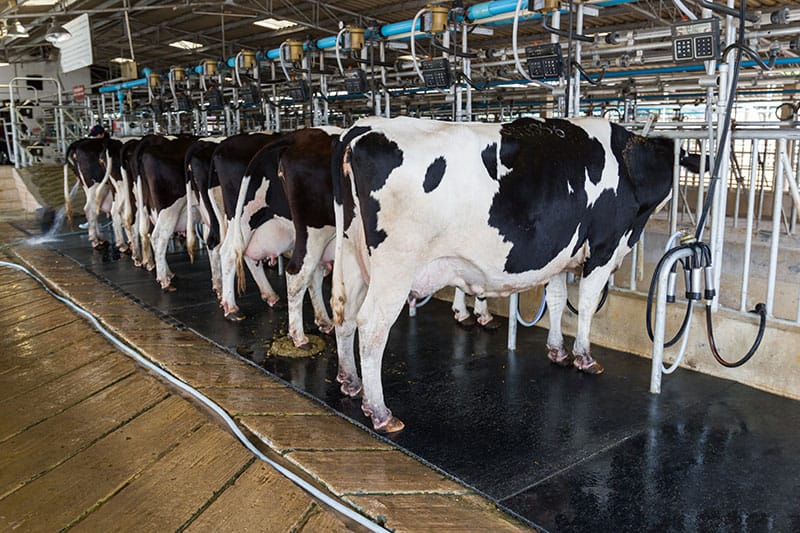
It is important that cows eat their rations evenly to maintain a balanced diet, so preventing sorting, where cows select smaller, high-energy feeds and reject longer fibres, is essential. Proper mixing, adding water, reducing particle size, and avoiding excess feed can all help prevent this.
To produce milk, cows must first calve, and the period between one calving and the next is known as the lactation cycle or lactation curve.
Dairy cows typically have their first calf at 24 months of age. After that, the cycle is split into four phases with a 10 month milking period flowed by a dry rest period.
Management focuses on preventing excessive weight loss in early lactation and avoiding obesity in the dry period
After calving, milk production rises rapidly to a peak at about 6-9 weeks, while the cow’s appetite remains low requiring only about half the usual food required. This is because during the dry period, the growing calf takes up space, reducing the volume of the rumen. After calving, it can take up to 12 weeks for the rumen to stretch back to its usual size.
During this time, cows will lose weight and use their own fat reserves to meet the high nutrient demands for milk production. Following peak lactation, the appetite will start to increase until they can consume all the nutrients required for milk production while maintaining their body weight.
Mid lactation is an important period for stabilising the cow’s weight and maintaining persistent high-quality milk production. High-quality nutrition is essential, as it is also during this phase that cows are bred.
Milk yield begins to decline, but energy is still important to ensure a healthy pregnancy, and the need to build up an energy reserve for the next lactation.
Milk production stops completely to allow the recovery of the mammary glands and regeneration for the next cycle. Maintaining the cow’s condition is essential to ensure it has adequate fat reserves for the next lactation. Cows with high reserves can reach peak lactation within two or three months of calving, whereas milk production will suffer in early lactation in cows in poor condition, as they do not have enough body fat to contribute energy.
The shape of the lactation curve depends on both generic and environmental factors, with lactation persistency the ability of a cow to maintain high milk production after reaching its peak, resulting in a flatter curve and a slower decline in yield. It is an economically important trait, as it can reduce feed requirements, improve fertility, and lower metabolic stress.
Since the 1980s, the size of British dairy cows has steadily increased, meaning farmers are now feeding and managing the equivalent weight of around ten additional cows within a herd. However, larger body size does not necessarily correlate with higher milk production, and because bigger cows are more prone to injuries and complications during pregnancy and calving due to larger calves, they are likely to be less efficient overall.
With modern husbandry techniques and better scientific knowledge around feeding and genetics, many farmers find that smaller cows can produce just as much as larger individuals.