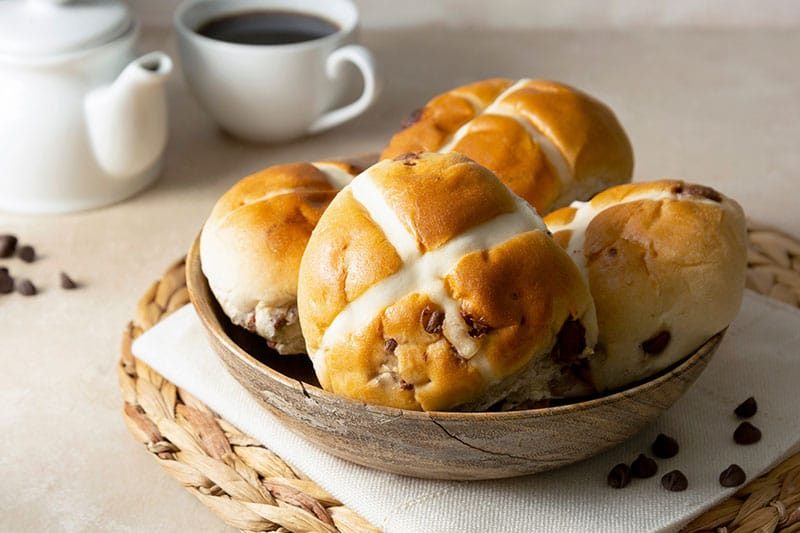
Hot cross buns were traditionally eaten on Good Friday to mark the end of the fasting period over Lent. Today, however, they are available for a much longer period with supermarkets stocking them all year round and in a wide variety of flavours such as chocolate and cherry, carrot cake, salted caramel, apple and cinnamon, rhubarb and ginger, orange marmalade, and even red velvet, with many bearing little resemblance to the original rich yeast buns flavoured with warming spices and dried fruit.
Although the cross is now added to commemorate the crucifixion of Jesus, crossed buns predate Christianity by several centuries.
According to historians, the Ancient Egyptians baked small round breads to celebrate their gods, and marked the tops with crosses to divide the bread into four equal parts, to represent either the four seasons or the four phases of the moon. Evidence also shows that the Anglo-Saxons baked similar shaped rolls as offerings to Ēostre, the goddess of the dawn and spring, and purported source of the word ‘Easter’.
In the Middle Ages, bakers scored their loaves with crosses as they believed it would ward off evil spirits that would prevent the dough from rising.
The precursor of the hot cross bun is said to date to 1361, when Brother Thomas Rocliffe, a 14th century monk at St Albans Abbey, developed a recipe not unlike the buns we know today.
A copy of The St Albans Times and Herts Advertiser from 1862 discovered at the end of the 20th century records that:
It is said that in a copy of ‘Ye Booke of Saint Albans’ it was reported that;
“In the year of Our Lord 1361 Thomas Rocliffe, a monk attached to the refectory at St Albans Monastery, caused a quantity of small sweet spiced cakes, marked with a cross, to be made; then he directed them to be given away to persons who applied at the door of the refectory on Good Friday in addition to the customary basin of sack (wine). These cakes so pleased the palates of the people who were the recipients that they became talked about, and various were the attempts to imitate the cakes of Father Rocliffe all over the country, but the recipe of which was kept within the walls of the Abbey.”
The time honoured custom has therefore been observed over the centuries, and will undoubtedly continue into posterity, bearing with it the religious remembrance it is intended to convey.
The Alban Bun proved so popular that other monasteries and churches began baking their own versions to distribute to the poor along with the more conventional soup on Good Friday. Over time, Alban Buns began to be baked outside the Lenten period across the whole of Britain.
Two hundred years later events took place which put the crossed bread in jeopardy, and one could argue it is nothing short of a miracle that these buns have survived to be enjoyed today.
In 1517, the German theologian, Martin Luther, published The Ninety-five Theses, which gave birth to Lutherism and the beginning of the Protestant Reformation which challenged the papacy and authority of the Catholic Church.
Over in England, King Henry VIII who had been brought up as a strict Catholic, attending daily Mass and conducting pilgrimages to holy sites, was angered by the rise of Protestantism in Europe and wrote a passionate defence of Catholicism. The pope was so grateful that he awarded Henry with the title Defender of the Faith.
However, in the 1520s the King tried to end his first marriage to Catherine of Aragon by seeking an annulment. In June 1529, Pope Clement VII agreed to allow Henry to have his marriage put on trial in an English court, but after months of debate the annulment was denied.
At the same time, Henry had become romantically involved with Anne Boleyn, who had embraced many reformist ideas and was a significant influence on the King. Protestant sympathisers in England had also started to openly criticise the wealth of the Catholic church and suggested diverting it from Rome could help Henry with his financial issues brought about by war and his lavish lifestyle.
In 1934, Henry used an Act of Parliament to annul his marriage and make him the head of the English church. The Treasons Act quickly followed which declared that anyone who questioned Henry’s position as head of the Church of England was to be punished by death.
Just two years later Anne was beheaded, accused of adultery, incest, and high treason, although the charges were widely believed to have been fabricated to allow Henry to remove a queen who had failed to produce a male heir and was becoming politically inconvenient.
Despite this, Protestants such as Thomas Cromwell who had risen to the powerful position of the King’s Chief Minister, continued to push for change, with monasteries a particular target for reformation. At the time monasteries, abbeys, and religious houses were some of the wealthiest institutions in England, owning a quarter of all cultivated land.
Royal commissioners were sent up and down the country to report back with details of their wealth and lifestyles of their inhabitants. They found that many lived in luxury and not the humble lifestyle expected of Christian monks.
Henry and Cromwell set about destroying the monastic system. A new government department, the Court of Augmentations, was set up with the job of selling off the monasteries and their land to noble families who sympathised with Henry’s break from Rome, with profits taken by the Crown.
St Albans Abbey was dissolved in 1539 with the monks pensioned off and the buildings looted of their treasures. The land including Redbournbury Mill, which had stood on the site since the 11th century, was seized by the King becoming part of the Crown Estate, and on his death was bequeathed to his daughter Princess Elizabeth.
The Dissolution of the Monastries had a devastating impact on the poor with the loss of welfare. Many monasteries has acted as hospitals, hospices, and providers of alms for the destitute.
When Elizabeth I succeeded to the throne in 1558, she was initially more tolerant towards Catholics than her father, primarily to avoid rebellion. But after being excommunicated by Pope Pius V in 1570, she viewed Catholicism as a security threat and enacted a series of strict laws against those still practising.

The Religion Act of 1592 was passed to enforce obedience to the Crown and maintain religious unity, imprisoning anyone over the age of sixteen who didn’t attend Church or attended unlawful religious meetings. Crosses and crucifixes were removed from churches as reformers aimed to distance themselves from Catholic traditions, seeing the veneration of the cross, the crucifix, and other relics as “superstitious” and a false representation of faith.
And there was also an attempt to rein in the little Lenten buns which were seen as a symbol of the Catholic past. They were initially completely banned from commercial sale until bakers successfully argued that a cross cut into a loaf or bun induced a more pronounced rise in the oven. The Queen agreed to a comprise and the London Clerk of the Market, a royal official responsible for regulating food markets, ensuring fair trade, and enforcing standardised weights and measures, issued a decree that allowed cross buns to be sold only for funerals, Christmas, and Good Friday. Further attempts to suppress their sale took place during the reign of James I.
Despite these restrictions bakers and domestic cooks carried on the tradition started all those years ago by Thomas Rocliffe.
The original recipe remains a closely guarded secret, but ingredients include flour, eggs, fresh yeast, currants, cardamom, and grains of paradise, a spice in the ginger family. Lacking fruit, less sweet, and with a firmer texture than hot cross buns, the other difference is that instead of piping the cross on top it is slashed with a knife.
Still, many bakers claimed to have discovered the original recipe. During Holy Week in 1851, a St Albans shop advertised ‘cross buns’ that were:
“Hot from the Oven every hour from four o’clock on Thursday until seven on Friday evening. Remember Father Rocliff’s Buns, eight for sixpence.”
The first written record of the term ‘hot cross bun’ is found in a London street cry, published in 1733 in Poor Robin’s Almanack, a satirical almanac series.
Good Friday comes this month, the old woman runs,
With one a penny, two a penny, hot cross buns,
Whose virtue is, if you believe what’s said,
They’ll not grow mouldy like the common bread.
The last line refers to the belief that adding kneaded dough to the Good Friday host prevented it from spoiling.
Hot cross buns are also most famously referenced in the children’s nursery rhyme Hot Cross Buns with the earliest surviving version printed in a 1767 edition of The London Chronicle.
One a penny, two a penny, hot cross-buns;
If you’ve no daughters, give them to your sons;
And if you’ve no kind of pretty little elves,
Why then good faith, e’en eat them all yourselves.
Iona and Peter Opie, folklorists who applied modern techniques to understanding children’s literature and play, collected yet another version:
Tis Good Friday morning, the little boy runs,
Along with his sister, to buy hot cross buns;
Her apron is full, yet her brother, the elf,
Unsatisfied still, must buy one for himself.
Despite their popularity in Georgian and Victorian times, there are no written recipes for cross buns before then, implying that they were passed down by oral tradition.
An early recipe appears in Five Thousand Receipts in all the Useful and Domestic Arts published in 1823 by Colin Mackenzie, a Scottish-born writer who spent his adult life in London.
Cross Buns
Put 2½ Ibs. of fine flour into a wooden bowl, and set it before the fire to warm; then add ½ a lb. of lifted sugar, some coriander seed, cinnamon and mace powdered fine; melt ½ Ib. of butter in half a pint of milk; when it is as warm as it can bear the finger, mix with it three table spoonsful of very thick yeast, and a little salt; put it to the flour, mix it to a paste, and make the buns as directed in the last receipt. Put a cross on the top, not very deep.
Forty years later, Mrs Beeton includes fruit, but there is still no sign of the pastry cross. Instead, she suggests using a tin mould or the back of a knife.
Ingredients.—2 lbs. of flour, ½ a lb. of sugar, 1 oz. of yeast, 1 pint of warm milk, ½ a lb. of butter, 1 lb. of currants, ½ a teaspoonful of salt, 1 teaspoonful of mixed spice.
Method.—Mix the flour, sugar, spice and currants; make a hole in the middle of the flour, put in the yeast and ½ a pint of warmed milk; make a thin batter of the surrounding flour and milk, and set the pan covered before the fire until the leaven begins to ferment. Put to the mass ½ a lb. of melted butter, add the salt, and beat well together, make up into rather a soft paste with all the flour, using a little more warm milk if necessary. Cover this with a clean cloth, and let it once more rise up for ½ an hour. Shape the dough in buns, and lay them apart on buttered tin plates or baking-sheets in rows at least 3 inches apart, to rise for ½ an hour. Place a cross mould on them (this may be done roughly with the back of a knife), and bake in a quick oven from 15 to 20 minutes.