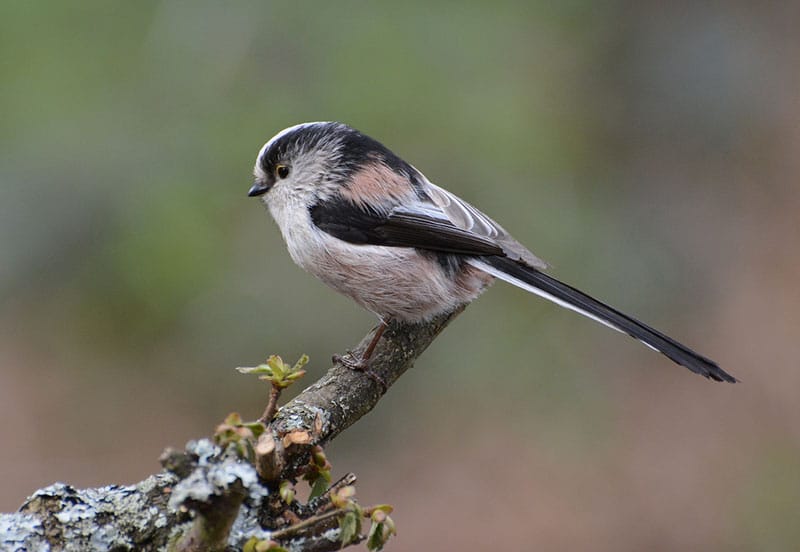
The long-tailed tit is a tiny bird with a black back, pink rump, and black-and-white wings. Its underparts are pale pink, marked with fine black streaks across the breast. The head is pink with a faint dusky wash, and a broad pink stripe runs down the centre of its black crown.
For much of the winter, long-tailed tits move about in lively flocks, calling excitedly and playing ‘follow-my-leader’ as they flit from branch to branch. In February, however, pairs break away from the group to begin collecting nesting material.
Nest-building can take up to a month, which is longer than in most songbirds, because the structure is extraordinarily complex. The nest is an intricate domed structure woven from moss and spider webs, camouflaged with lichen, and lined with more than a thousand downy feathers. Ingeniously designed to stretch as the chicks grow, it expands to accommodate the developing brood.
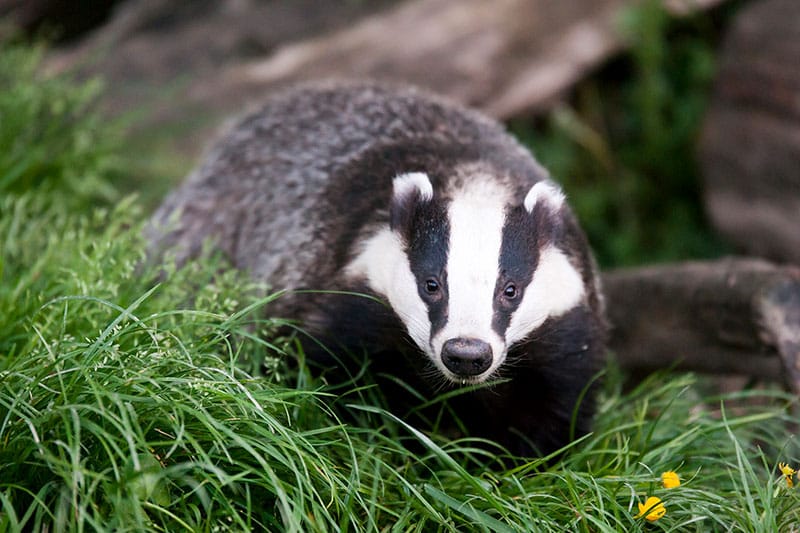
With its characteristic black-and-white striped face, grey fur, short fluffy tail and sturdy build, the badger is unlike any other British mammal. It is Britain’s largest land predator, feeding on small mammals, eggs, worms, vegetation, and fruit.
Female badgers, known as sows, give birth very early in the year, which may seem surprising. However, after they are born, the cubs spend around two months underground in a burrow called a sett. They first emerge in early spring, when food is becoming more plentiful giving them plenty of time to feed and build up the fat reserves they will need to see them through their first winter.
Badgers are nocturnal and are rarely seen during daylight hours. One of the best ways to catch a glimpse of them is to locate a sett and wait quietly for its inhabitants to emerge. If possible, position yourself downwind to prevent them catching your scent, and always keep a respectful distance to avoid causing disturbance.
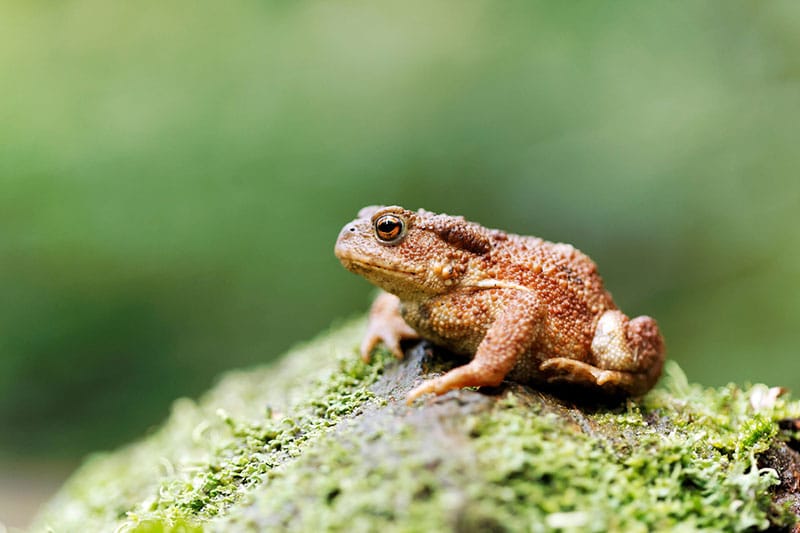
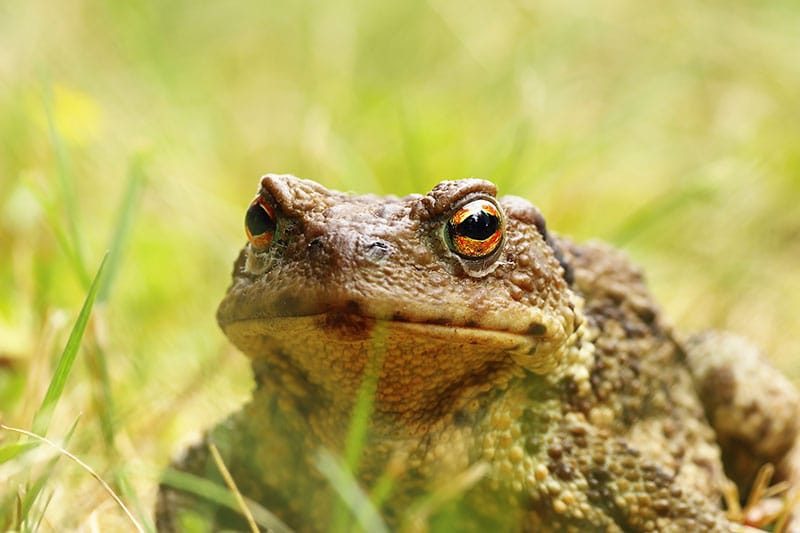
The common toad is Britain’s largest and heaviest amphibian. It has thick, dry, olive-brown warty skin striking copper-coloured eyes with horizontal pupils. Its back legs are relatively short, so unlike frogs it tends to walk rather than hop. Males and females look similar, although the female is typically almost twice the size of the male.
Each year from late February, as the evenings grow milder and damper, common toads emerge from hibernation beneath log piles, compost heaps and stones in woodland, grassland and gardens, to migrate, in large numbers, to their ancestral breeding ponds. Males arrive first and compete for females, grappling with rival males for the chance to mate.
Females lay long, double strings of spawn containing up to 1,500 eggs, with tadpoles hatching around ten days later. Common toad tadpoles contain toxins that make them unpalatable to predators, allowing them to survive in deep ponds where fish are present. They complete their development in around 16 weeks.
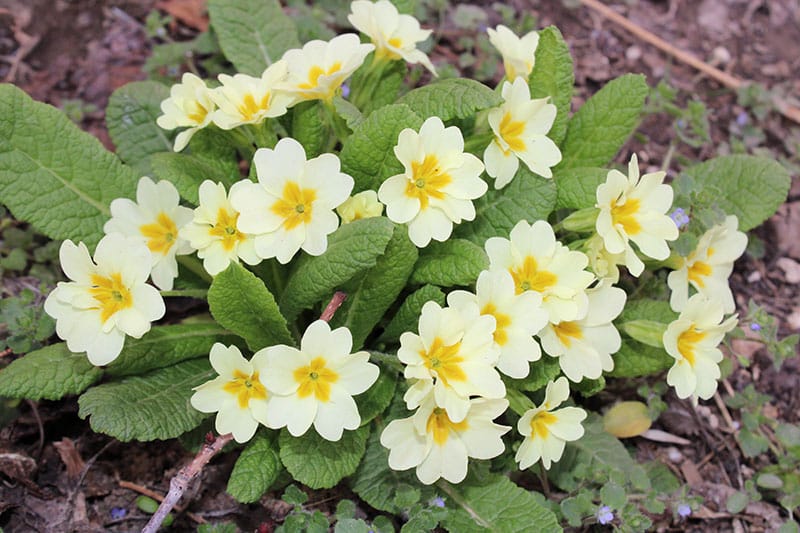
The primrose is a hardy little plant that can begin flowering as early as December in mild years. It forms a low, evergreen rosette of tongue-shaped, deeply veined bright green leaves, from which emerge scented, creamy-yellow flowers. Alongside other meadow flowers including bluebells, cowslips, and columbines, and the clustered seeds of the ash tree, primroses were once known as ‘culver keys’, as their blooms resemble a bunch of keys, with ‘culver’ being an old English word for dove or pigeon.
Primroses are the favoured food plant of the caterpillars of the rare Duke of Burgundy butterfly, as well as several species of moth. Their early flowers also provide an important source of nectar for early fliers, such as the dark-edged bee-fly, the hairy-footed flower bee, and newly emerged queen bumblebees in need of food after hibernation. Widespread across Britain, primroses thrive in woodland and grassland habitats.
Goat willow is a large, spreading deciduous shrub or small tree with grey-brown bark that develops diamond-shaped fissures as it matures. Its young twigs are hairy, later becoming smooth and often appearing reddish-yellow in sunlight. The oval green leaves grow on short stalks; they are slightly tapered at the tip, which bends to one side, and have a soft, felted layer of grey hairs underneath.
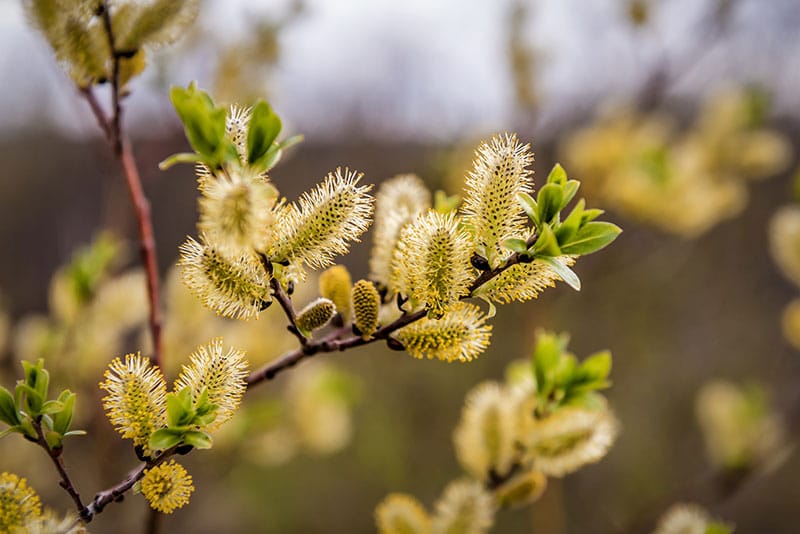
Goat willow is dioecious, meaning that male and female flowers grow on separate trees. In late winter, before the leaves emerge, it produces catkins. The male catkins are rounded and silver-grey at first, turning bright yellow as they release pollen, while the female catkins are longer and green. The soft, silvery male catkins, which resemble a cat’s paw, have given rise to the familiar name ‘pussy willow’. It is also known as great ‘sallow’, ‘Sally’, ‘black Sally’, and ‘palm willow’, the latter reflecting its traditional use as church decoration during Lent.
Goat willow is the food plant of the caterpillars of the purple emperor butterfly. As one of the earliest trees to flower, it is a valuable source of nectar and pollen for insects, and its branches often hum with hoverflies, bumblebees, and solitary bees in early spring.
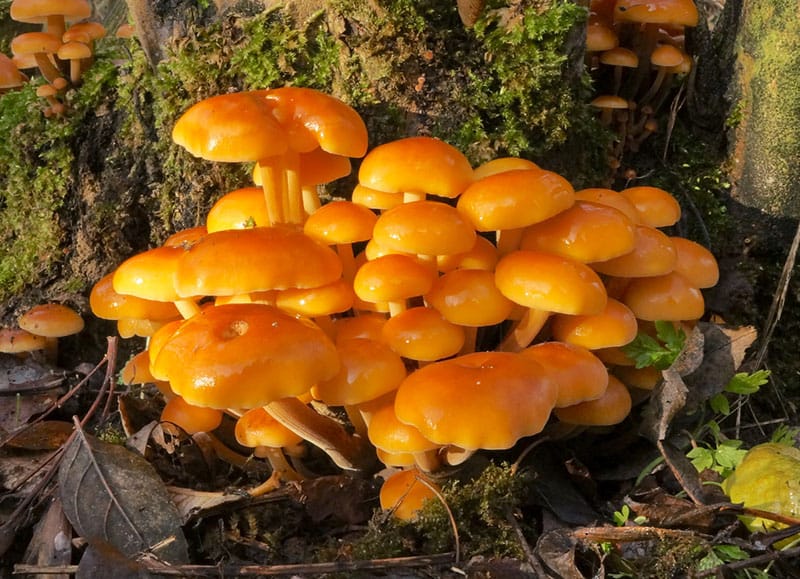
One of the few fungi to fruit through winter, velvet shank can be found in the coldest months into early spring and is capable of surviving after being frozen solid. It has a fibrous, velvety stem and a bright orange cap, which becomes very slimy in wet weather before drying to a smooth sheen. The caps are often misshapen as a result of growing in dense clusters. The gills are white when young, turning pale yellow with age.
Velvet shank is edible, although the skin of the cap should be removed before eating. It has a mild, nutty, slightly sweet flavour and is well suited to casseroles and stews. Care must be taken not to confuse it with the funeral bell, which has a darker cap and is toxic.
It is fairly common throughout the British Isles, where it grows in clusters on the dead or decaying wood of deciduous trees such as elm, beech, ash and oak. It provides an important food source for woodland invertebrates.