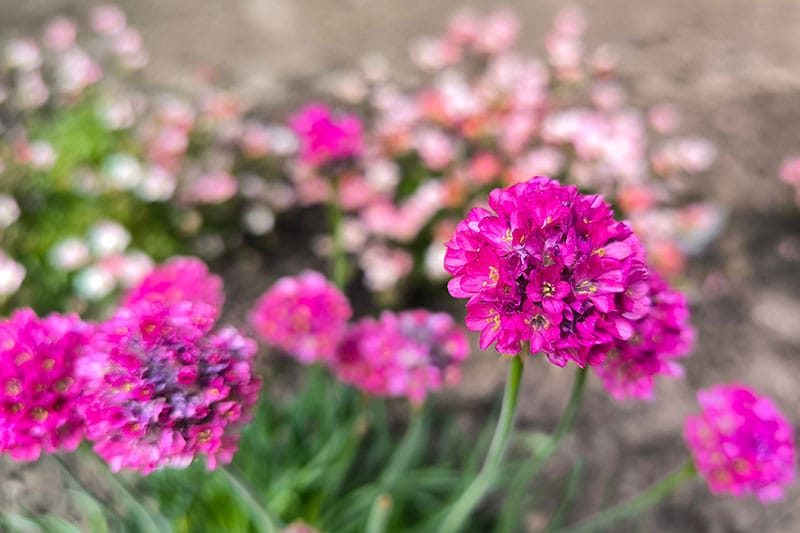
Coastal plants are a resilient group of species that thrive in the challenging conditions found along the shoreline. With constant exposure to salty sea spray, strong winds, shifting sands, and often nutrient-poor soils, these plants have developed remarkable adaptations to survive in such environments.
They are vital for wildlife, providing food, shelter, and breeding grounds for many species of birds, insects, and marine life that rely on coastal vegetation to sustain their populations in some of the harshest environments in Britain.
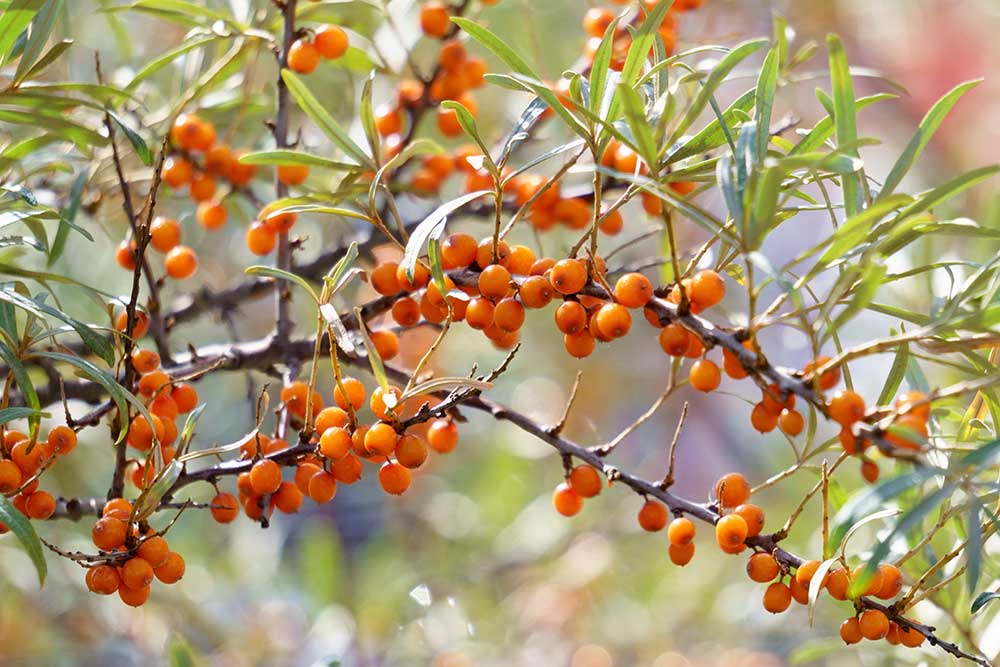
Sea buckthorn is a large shrub with rough brown or black bark and thorny shoots. It has narrow, pointed leaves with silvery-green upper faces. The male plant has small brown flowers that grow in clusters, while the females are greenish-yellow. In autumn, the female produces oval-shaped fruit which vary in colour from pale yellow to dark orange. Sea buckthorn is also known as ‘sallow thorn’, ‘swallow thorn’, and ‘willow thorn’.
It is native to the east coast of England but is considered invasive elsewhere where its dense thickets can out-compete smaller plants.
Look out for sea buckthorn near the coast in sand dunes and on sea cliffs. It is easily identifiable in autumn by its fruit.
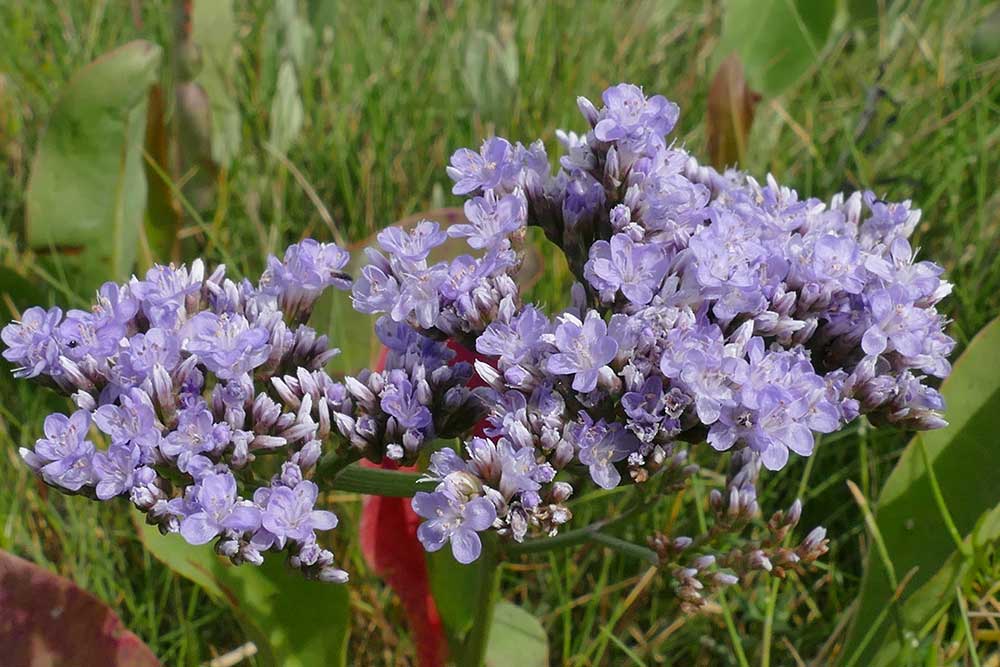
Common sea-lavender is a herbaceous plant with long, stiff, slender stems and small, narrow, grey-green leaves at the base. In summer, it produces small purple, lilac, or blue flowers in dense clusters at the top of the stems. The flowers have five petals that are fused at the base. Common sea-lavender is also known as ‘statice’,’ marsh-rosemary’, and ‘sea thrift’.
It is found around the coasts of England and Wales. Look out for it in salt marshes, salty pools, mudflats, and other saline habitats.
Despite its name, common sea-lavender isn’t a type of lavender and does not share its fragrance. It has a long blooming period from July to October, but looks at its best in August.
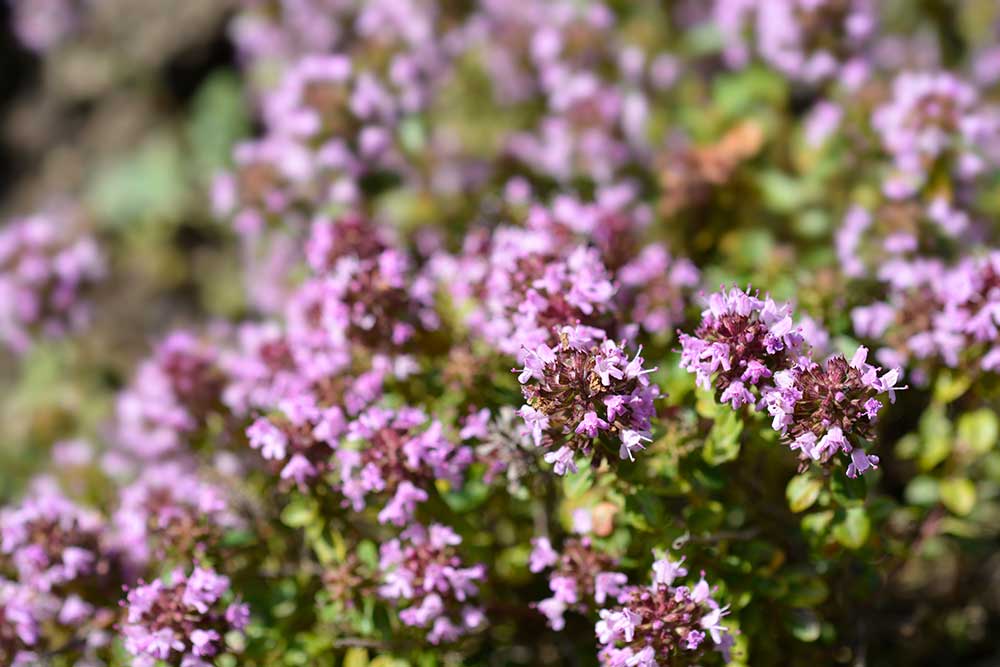
Broad-leaved thyme is a small, spreading shrub, with reddish, woody, square-shaped stems that have hairs on the lower part. The small, green, oval leaves, which grow in opposite pairs, are highly aromatic, similar to other species of thyme. In early summer, it produces spikes of tiny pink or purple tubular flowers. The upper petal is notched, while the lower petal is larger with three flattened lobes that form a lip. Broad-leaved thyme is also known as ‘large thyme’, ‘greater wild thyme’, ‘lemon thyme’, or ‘downy thyme’.
It is found in south east England and East Anglia. Look out for it in chalky grassland, heathland, and sand dunes.
Broad-leaved thyme is similar to wild thyme, but is larger, it’s leaves are wider, and all the stems form flowering shoots. The best time to look for it is when it’s in flower from June to September
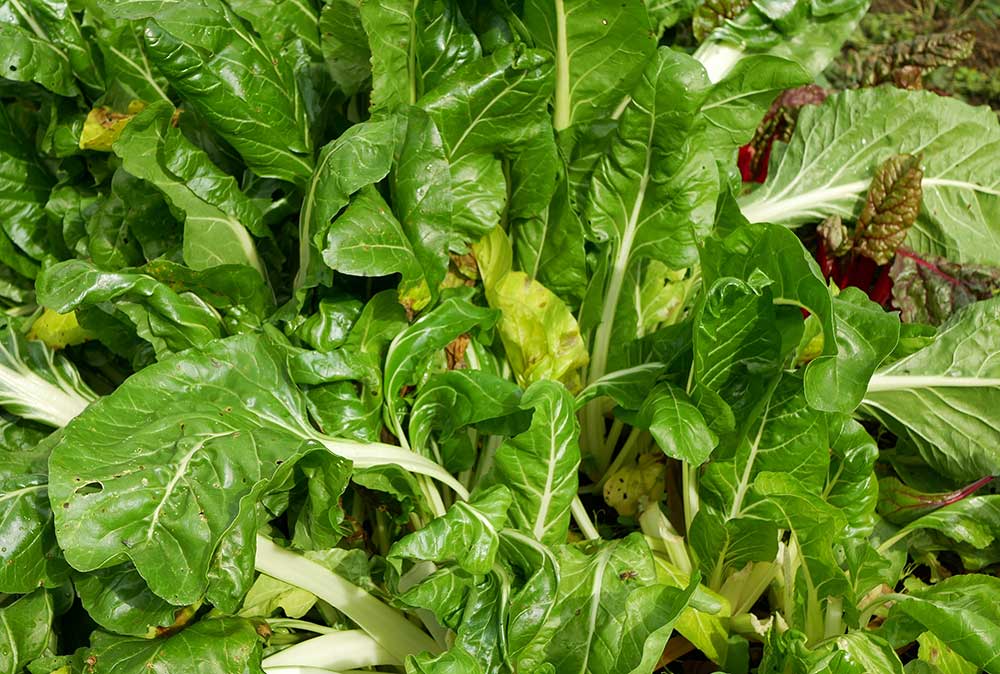
Sea beet has thick, glossy, dark green leaves and reddish stems. The leaves vary in shape, ranging from oval to triangular, with wrinkled edges. In summer it produces spikes of inconspicuous pale green flowers which grow in clusters close to the stem.
Sea beet is the wild ancestor of a variety of vegetables including beetroot, sugar beet, Swiss chard, rainbow chard, and perpetual garden spinach, as well as beets used for fodder such as mangelwurzel. It is also known as ‘wild spinach’.
Sea beet is found across the UK except for the very north of Scotland and is particularly common in the south east of England. It mainly grows near coasts in mudflats, salt marshes, sand dunes, shingle beaches, and between rocks, but can sometimes be found inland.
Sea beet is easily recognisable by its succulent leaves and is an excellent plant for foraging. The entire plant is edible, including the flower spike, and it can be harvested all year round. The leaves taste like a richer version of spinach, and the roots, when cooked, can be used like sweet potato. Remember, if you intend to uproot any plant you must first seek permission from the landowner.
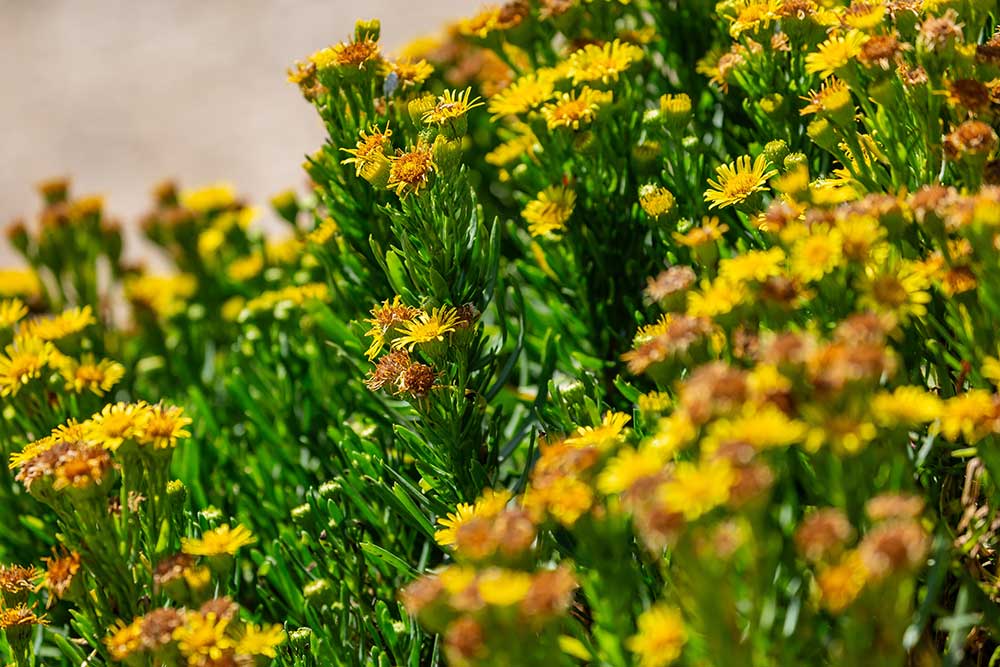
Golden samphire has tall, narrow, fleshy green or yellow green leaves which grow closely around the stem. The large, golden-yellow flower heads have six ray florets which are arranged in clusters at the top of the stem.
It is mainly found along the south coasts of England, Wales, and Ireland. Look out for it in salt marshes, shingle beaches, and on cliffs. It is occasionally found further inland in rocky habitats.
Despite its name, golden samphire is a member of the daisy family and its flowers look somewhat like dandelions and smell like shoe polish.
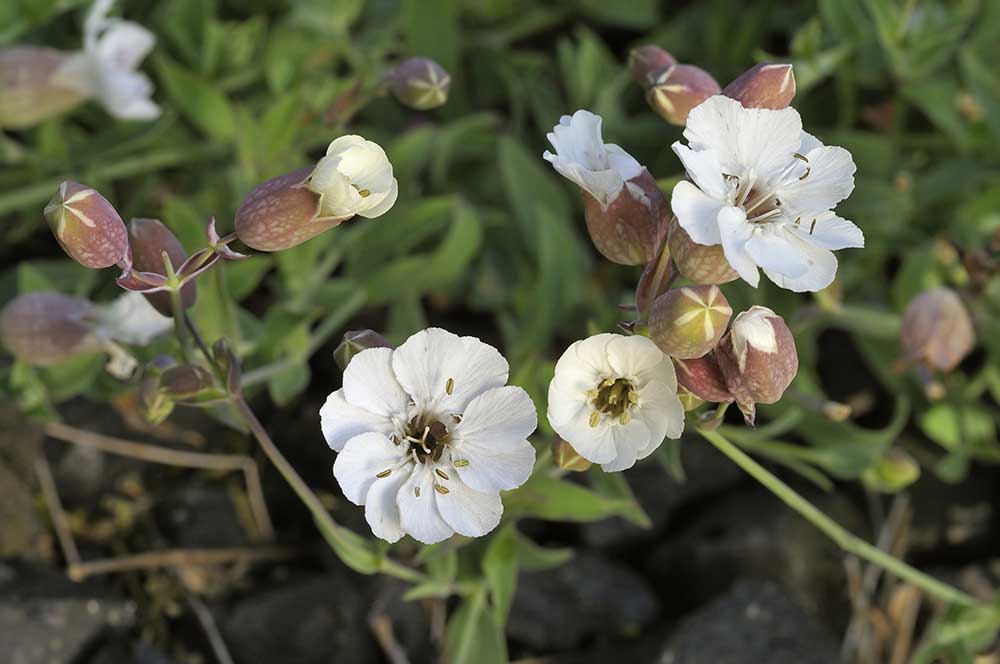
Sea campion is a perennial plant in the carnation family that forms a carpet on the ground. The lance-shaped, waxy leaves, which are arranged in pairs along the stem, are dark green and slightly fleshy. In summer, it produces white flowers with five overlapping, bi-lobed petals, sometimes tinged with pink. The deep notches in the petals create the illusion of ten instead of five. Sea campion is also known as ‘seaside catchfly’, ‘sea pink’, ‘dead man’s bells’, ‘witches thimbles’ and ‘Devil’s hatties’.
It can be found growing along coastlines and is widespread across the UK. Look out for it on sandy shores and along the tops of cliffs, usually found growing alone but can sometimes form small clusters. It blooms from May to September.
Sea campion may be confused with bladder companion, which is more branched and has large, ballon-shaped swellings beneath its flowers.
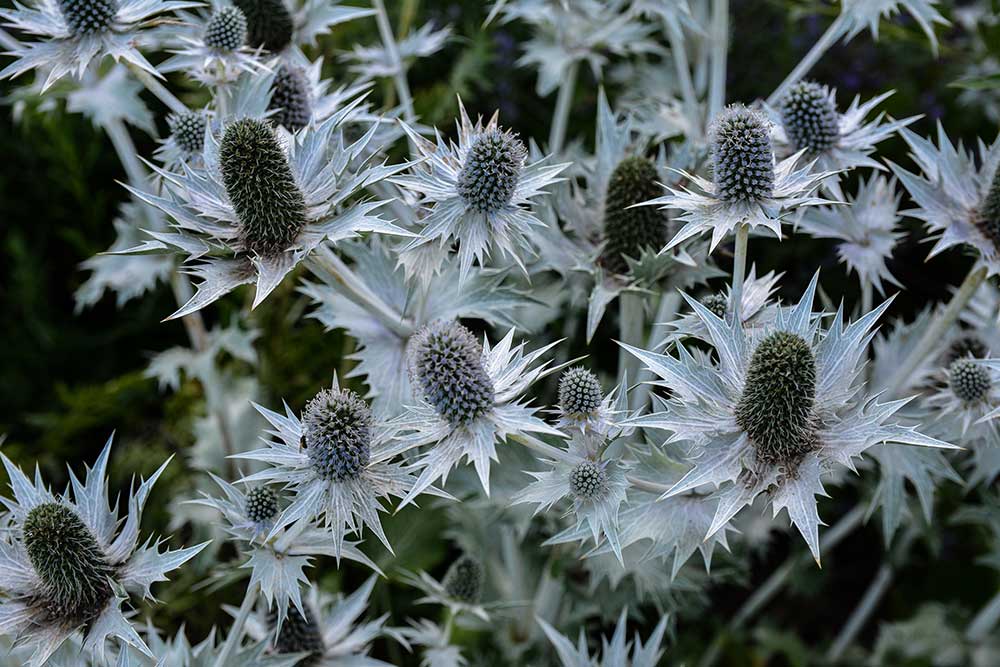
Sea-holly is a clump-forming perennial with stiff, spiky, grey-green leaves resembling those of holly, which gives the plant its name. The leaves are covered in a waxy cuticle to help it retain water in the dry conditions in which it thrives. It produces round, metallic-blue flowerheads surrounded by thorny bracts to protect it from grazing animals. Sea-holly is also known as ‘sea eryngium’, ‘sea eryngo’, and ‘sea holm’.
It is found around the coast of the British Isles but is scarce in Scotland and North East England. Look out for it in sand dunes, rocky areas, and pebble and shingle beaches.
Sea-holly’s distinctive appearance makes it fairly easy to identify. It can be seen all year round, but is best when in bloom between July and September.
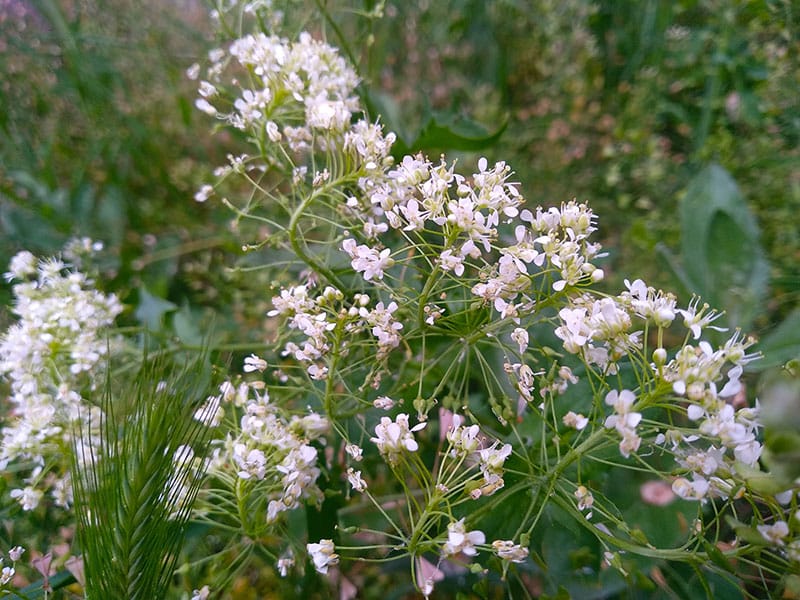
Dittander is a salt-tolerant herbaceous perennial in the cabbage family, with tall, upright, woody stems that can grow up to 1.5 metres in height, and grey-green, waxy leaves which are oval or lance shaped. In summer, it produces dense, rounded clusters of tiny, white four-petalled flowers at the top of the stems. Dittander is known by several other names including ‘perennial pepperweed’, ‘pepperwort’, ‘broad-leaved pepperweed’, ‘berwr gwyllt’, and ‘tall whitetop’.
It is a scarce plant, found mainly in South East England and East England, but has also been introduced to gardens as a culinary and medicinal herb. Look out for it on the edges of coastal marshes and wetlands. Cooked like spinach, it makes a nutritious vegetable with a peppery taste, and was used in the preparation of sauces before horseradish became more popular.
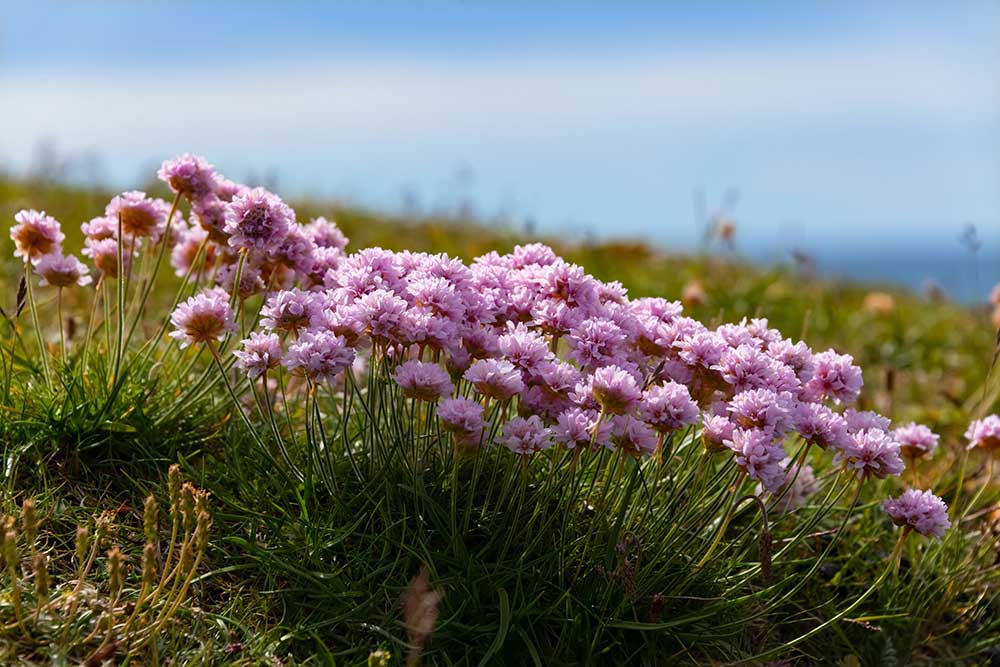
Thrift is a compact, evergreen plant with dense, needle-like, dark green leaves that form springy cushions. In spring, it produces globes of bright pink flowers on tall, erect stems. Purple, red, or white flowers may sometimes appear. Thrift is known by numerous other names including ‘sea pink’, ‘cliff clover’, ‘sea grass’, and ‘lady’s pin cushion’.
It is found all around the coasts of the British Isles, thriving in harsh, rocky conditions and adapting well to drought and drying winds. Look out for it on coastal cliffs, shingle beaches, salt marshes, and sand dunes.
Although thrift is evergreen, with its leaves visible all year round, the best time to spot it is during its flowering season. It typically blooms from April to July, but flowers can sometimes remain into early autumn.