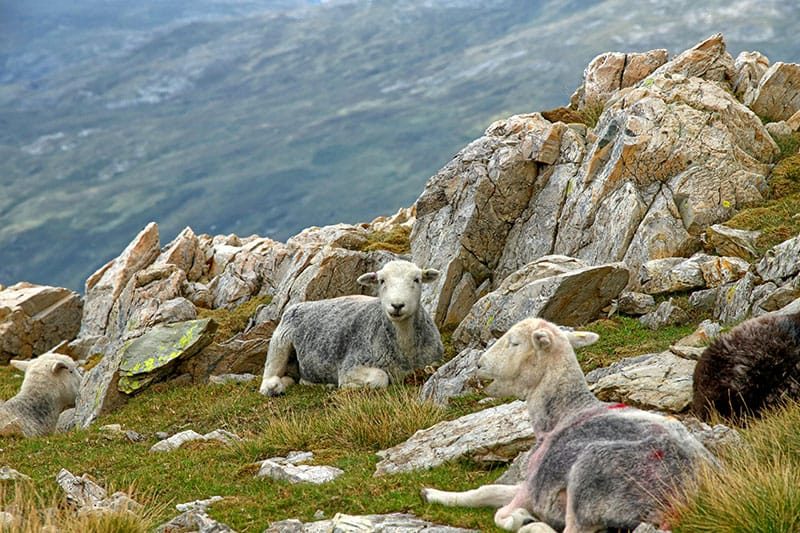
The Herdwick is a breed of sheep native to the Lake District, valued for its hardiness, strong homing instinct, and remarkable ability to survive almost entirely on natural forage.
Herdwicks have been grazed on the high fells of Cumbria for centuries, particularly around Coniston, Borrowdale, and the Langdales. Their lineage can be traced back to the earliest domestication of sheep, around 10,000 years ago, when animals from Southwest Asia spread into Europe. Genetic studies reveal that Herdwicks share ancestry with the Northern European short-tailed group of sheep, which also includes the Soay, Manx Loaghtan, and Boreray Blackface.
It is believed that Herdwick sheep were brought to Britain in the 10th or 11th century by Viking settlers. The name itself is of Norse origin, derived from herdvyck, meaning “sheep pasture”. Originally a general term used to describe sheep farms until the 17th century, by the 18th century it had come to refer exclusively to the breed.
Further genetic research has shown that Herdwicks, along with the Rough Fell and Dalesbred, share a rare link with sheep on Texel, an island in the Wadden Sea off the coast of the Netherlands, and once a Viking stronghold. The same study also discovered that these three breeds display a lower-than-average susceptibility to Maedi Visna, a slow-acting viral disease that affects millions of sheep worldwide.
Since then, the husbandry of Herdwick sheep has played a defining role in shaping both the Cumbrian landscape and its culture. Their grazing keeps the fells largely free of trees, while the iconic dry-stone walls that weave through the valleys were built to protect pasture and contain livestock.
Many Lakeland place names and dialect words can be traced back to sheep farming. Gimmer Crag, overlooking Langdale, comes from the Cumbrian dialect word for female sheep; Sheffield Pike derives from “sheepfold pike” (sceap, Old English for sheep, and fald, fold); while Wetheral means “the place where sheep were kept”, from Old English wether (sheep) and halh (corner).
The dialect is also rich in sheep-related vocabulary. A smoot is a hole in a stone wall just big enough for a sheep to pass through, a sheep so weighed down with wool that it cannot stand is described as kessen, and a hoggest refers to the shelter where young sheep spent their first winter.
Sheep farming also left its mark on local counting systems. The Cumbrian Score or the Yan Tan Tethera, is a traditional set of sheep-counting numerals still remembered in the region. The word yan (meaning “one”) remains in use across Cumbria, often heard in phrases such as “That yan there” or “Can I have yan of those?”, especially among children and speakers outside of received pronunciation.
Some sheep-related words have even entered the wider English language. For example, the word lug, an informal word for “ear”, is thought to derive from the Old Norse log, referring to the clipping of sheep’s ears to indicate ownership, a tradition shared with Scandinavian farmers. These identification marks were recorded in The Shepherd’s Guide, first published in Cumberland in 1817, and allowed stray sheep to be returned to their rightful owners. Today, ear tags have largely replaced this practice.
Another familiar term, bellwether, also comes from sheep husbandry. It originally referred to a castrated male sheep fitted with a bell around its neck so that shepherds could track the movement of the flock.
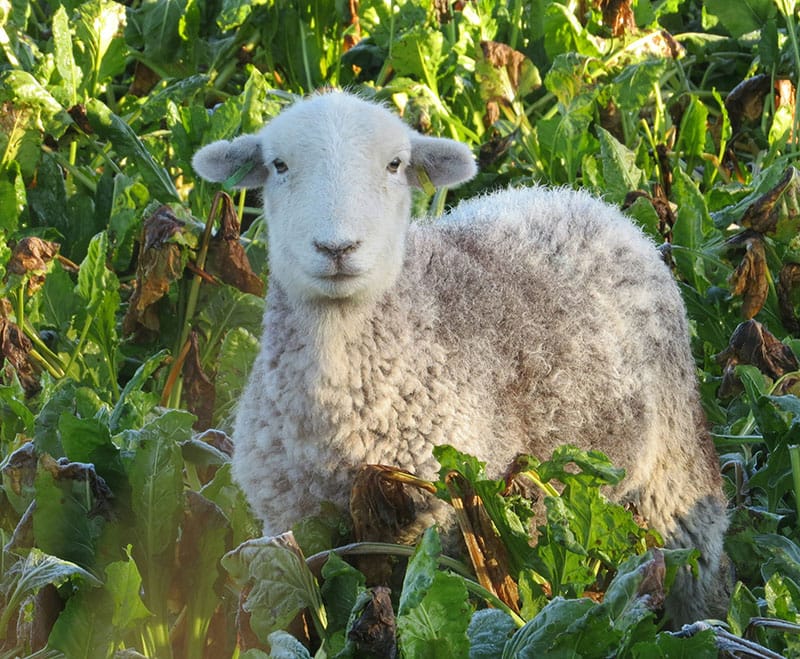
Herdwick sheep are a distinctive breed, easily recognised by their grey-streaked coats, white faces, and characteristic smiley expressions. However, if you visit the Lake District during lambing season, you might be surprised to see black lambs bounding about: for Herdwick lambs are born black.
The reason for this isn’t fully understood, but one theory suggests their dark colouring helps them absorb heat and stay warm on the cold fells. Another proposes that it offers camouflage, allowing them to blend into the nooks and crannies of the rocky landscape and hide from predators when they are most vulnerable.
As they grow, their fleece gradually lightens, turning a rich chocolate brown at around a year old. At the same time, the wool on their heads grows out, revealing the white face beneath. At this stage, they are known as hoggs or hoggets.
At around 15 months old, young Herdwicks are shorn for the first time, producing a chocolate-brown fleece known as the hog fleece. After this, their wool gradually lightens to a steel grey, becoming paler with each year. By the fifth shearing, it is a soft, pale grey.
Adult Herdwicks are sturdy, well-built sheep, with broad, long bodies and flat backs set squarely on legs that stand outside the body and large strong hooves that make them excellent hill climbers. Their hind legs are muscular and covered in bristles, while their tails are thick and strong. The face is broad and full between the eyes, with wide, open nostrils, and is covered, along with the jaws and crown, in coarse, bristly hair free from wool. Rams have smooth, whitish horns that sit low on the head.
The fleece is heavy and dense, composed of a mix of fibres including wool and kemp. With a staple length of up to 10 inches, it resists parting in the wind and naturally sheds water. Beneath this lies a finer wool undercoat that provides insulation, along with a distinctive ruff around the neck and shoulders.
These features are the result of centuries of selective breeding, shaping the Herdwick into a breed uniquely suited to the Lake District’s wet and windy weather, and able to endure extreme winters better than any other sheep.
Herdwick sheep possess another important characteristic, one without which it would be almost impossible to manage them on the mountains.
Heafing is the Cumbrian term for hefting, a traditional method of managing livestock on unfenced common grazing land. Wild and feral sheep possess a natural homing instinct to their maternal range, a trait that is particularly strong in Herdwick sheep and further reinforced through selective breeding.
This sense of belonging is passed down through generations, with lambs grazing alongside their mothers on the “heaf” associated with a particular farm. In doing so, they develop a lifelong understanding of where on the fell they should graze. As a result, Herdwicks are able to remain within specific areas of a fell without the need for fencing and with minimal shepherding, as they do not tend to wander far.

A successful heft depends on maintaining sufficient numbers of ewes in neighbouring hefts to act as natural boundaries, and sheep within a heft develop resilience to local parasites, mineral deficiencies, and certain plant toxins. Hefting is vital to sheep farming in the Lake District, where much of the central fell land is remote and difficult to access. If a sheep were to stray from Borrowdale to Eskdale, for example, it could involve a 100-mile round trip by road for the farmer to retrieve it.
Because of this unique and inherited homing instinct, many tenanted farms maintain a “landlord’s flock”. These sheep belong to the landowner rather than the tenant and are passed from one tenant to the next, ensuring that the knowledge of the heaf, and the tradition of hefting, is not lost.
The much-loved children’s author Beatrix Potter first fell in love with the Lake District during childhood holidays. In 1905, at the age of 39, she purchased Hill Top Farm, a small working farm near Near Sawrey. The farm became her sanctuary, where she could paint and write, and it was here that some of her best-known books, including The Tale of Tom Kitten and The Tale of Jemima Puddle-Duck, were written in the old farmhouse. Four years later, she bought Castle Farm, just across the road, driven by an ambition to own and preserve land in the Lake District. She was encouraged in this endeavour by local solicitor William Heelis, whom she married in 1913.
As she became increasingly involved in the rural community, Beatrix developed a deep passion for fell farming and for breeding and raising Herdwick sheep. In 1923, she purchased Troutbeck Park, a vast farm with disease-ridden flocks, which she painstakingly restored to health. Over the following years, she acquired a total of sixteen farms, including Yew Tree Farm, along with cottages, land, and flocks of Herdwick sheep and Galloway cattle. She used both her personal wealth and her husband’s position to secure properties discreetly, often purchasing them before sales were made public.
In 1930, the Heelises entered into a partnership with the National Trust to buy and manage the fell farms that formed part of the large Monk Coniston Estate. Beatrix acted as the de facto manager of the estate on behalf of the Trust for seven years, until it was able to repurchase much of the property from her. During this time, she became one of the most respected Herdwick breeders in the region, winning numerous prizes at local agricultural shows. In 1943, she was elected President of the Herdwick Sheep Breeders’ Association and would have become its first female president, but sadly she died from complications arising from pneumonia before she could take up the role the following year.
Beatrix Potter left almost all her property to the National Trust, including more than 4,000 acres of land, at the time the largest gift the Trust had ever received. This extraordinary legacy ensured both the preservation of the landscape and the continuation of traditional fell farming. William Heelis continued to steward their properties, as well as her literary and artistic legacy, for the remaining twenty months of his life. When he died in August 1945, he too left the remainder of his estate to the National Trust.